

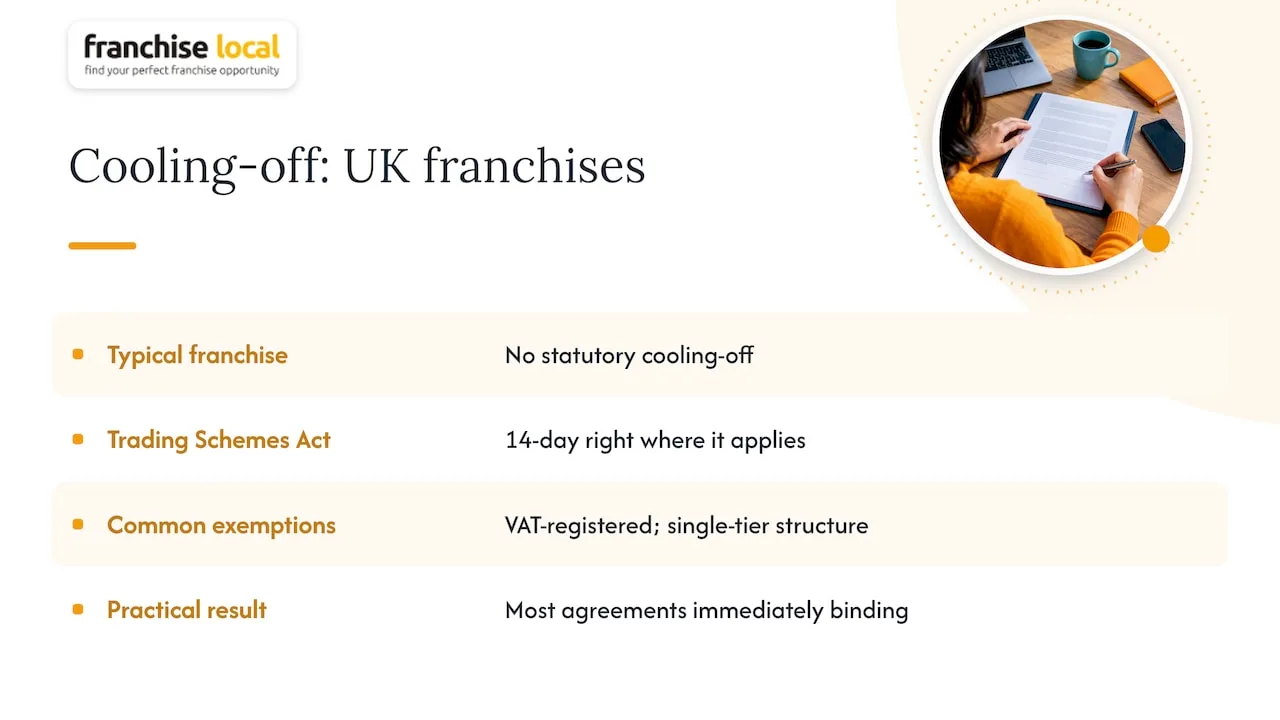
Most UK franchise agreements carry no automatic cooling-off period. A narrow exception exists under the Trading Schemes Regulations, but most franchisors structure their agreements to sit outside it. In practice, this means signing usually binds you to the contract immediately, so due diligence has to happen before you put pen to paper, not after.
Cooling off periods: consumer contracts versus business agreements
Cooling-off rights are a consumer protection. Under the Consumer Contracts (Information, Cancellation and Additional Charges) Regulations 2013, consumers buying certain goods or services, particularly online or at a distance, get a statutory window to change their mind and cancel without penalty. The regulations exist to protect individuals from pressured or uninformed purchases.
A franchise agreement is a different animal. It’s a business-to-business contract between you, acting as an entrepreneur, and a franchisor. The consumer protections built for retail purchases generally do not extend to this relationship, regardless of how the sales process feels.
- An online purchase from a retailer typically carries a 14-day cancellation right under consumer law.
- A franchise agreement for a van-based cleaning business typically carries no equivalent right once signed.
The contrast matters because franchise sales conversations often resemble consumer sales pitches, complete with brochures, success stories and time-limited offers. The legal footing underneath is entirely different.
Do franchise agreements have a statutory cooling-off period in the UK?
The direct answer: usually not. Franchise agreements typically do not come with a built-in cooling-off period in the UK, and once you sign, the contract is generally binding straight away.
There is one narrow statutory route. The Trading Schemes (Exclusion) Regulations 1997 set out a 14 day cooling-off right for participants caught by the Trading Schemes Act 1996, a piece of legislation originally aimed at pyramid-style trading arrangements rather than mainstream franchising.
Most legitimate franchise networks structure themselves to be exempt from the Trading Schemes Act, for example by requiring participants to be VAT-registered.
A 14 day cancellation right applies under the Trading Schemes Regulations where a scheme falls within the Act’s scope, but a VAT-registration requirement or a single-tier structure is enough to move a franchise outside it. Franchisors favour these exemption routes deliberately: falling under the Act brings disclosure duties and cancellation obligations that most networks would rather avoid, since they reduce the commercial finality of a signed deal.
The practical result is that the vast majority of UK franchise buyers sign an agreement with no statutory pause button attached.
What happens if you change your mind after signing
Signing a franchise agreement typically creates immediate, binding obligations. Initial fees are usually paid on or before signature, royalty commitments start on the dates set out in the contract and, if you’ve also signed a commercial lease, that exposure runs alongside the franchise terms regardless of how the franchise relationship develops.
Some agreements include conditionality clauses, such as finance approval or landlord consent, that can delay the point of no return. Termination clauses exist too, but they’re usually drafted to protect the franchisor’s brand and network, not to give you an easy exit.
- Fees paid before or at signing are rarely refundable once the agreement takes effect.
- Termination clauses tend to specify narrow grounds, such as breach or insolvency, rather than a general change of mind.
- Litigation over a disputed franchise exit is typically slow and expensive relative to the sums involved.
There is a limited statutory safety net. If a franchisor fails to provide required pre-contract information, the Consumer Contracts Regulations can, in specific circumstances, extend a cancellation period or support another remedy. These claims are fact-sensitive and time-limited, so they’re not something to rely on instead of proper checks beforehand.
Pro Tip: Treat the due diligence stage, not the contract itself, as your real cooling-off period: it’s the only window where walking away costs you nothing but time.
How to protect yourself before you sign
Because the legal exit routes are narrow, the protection has to come from what you do before signing, not after.
- Instruct a specialist franchise solicitor and ask for a written report along with a fixed fee and timescale upfront.
- Negotiate conditionality into the agreement, such as finance approval or landlord consent, or secure a signed side letter for specific concessions.
- Work through a due diligence checklist covering audited accounts, any past or pending litigation, supplier and lease obligations, training and support commitments, renewal rights and restrictive covenants.
- Set aside realistic time and budget for this stage rather than letting a franchisor’s timetable dictate yours.
A specialist solicitor’s written report is widely regarded by franchise practitioners as the most cost-effective protection available, because it identifies onerous clauses, quantifies likely lease exposure and often results in a short side letter capturing points the franchisor has agreed to change without rewriting its master template.
A written report from a specialist solicitor should flag anything unusual in the term length, renewal conditions or exit clauses, and it should arrive with a clear cost and turnaround time so you can plan around it rather than being rushed. Our franchise legal considerations checklist covers the clauses worth raising with your solicitor in more detail, and a structured background check on the franchisor is worth running in parallel.
Where to get help before or after signing
The British Franchise Association publishes guidance on what a franchise agreement should contain, and its Code of Ethics encourages good practice among member franchisors, though membership and its protections remain voluntary rather than a legal requirement.
- Use a specialist franchise solicitor for anything contractual, before signing wherever possible.
- Consider mediation or arbitration through BFA dispute resolution services where a relationship has broken down but litigation feels disproportionate.
- Ask prospective franchisors directly whether they are BFA members and what that membership covers.
- Use a directory to compare franchisors’ published terms, sectors and investment levels before you commit to detailed talks with any one brand.
A solicitor’s report tells you what a specific agreement means for you. Comparing multiple franchisors first tells you whether the terms on offer are typical or unusual for that sector.
Key takeaways
Franchise agreements in the UK usually carry no automatic cooling-off period, and the narrow Trading Schemes Regulations exception rarely applies once a franchisor has structured around it. Confirm your own position with a solicitor rather than assuming either way.
- Pause before signing: treat the due diligence stage as your real window to walk away.
- Instruct a specialist franchise solicitor for a written report before committing any fees.
- Secure conditionality or a side letter for any point you want changed, in writing, before signature.
How Franchise Local can help you research and compare UK franchise opportunities before you sign
Once you know there’s no built-in pause button after signing, the sensible move is to do your comparing early. Franchise Local’s search tools let you filter opportunities by industry, investment level and region, so you can see what typical terms look like across a sector before you’re sat opposite one franchisor’s sales team.
- Filter by investment level and location to shortlist franchisors worth a closer look.
- Browse trending UK franchise opportunities to see which sectors are attracting current interest.
- Check a franchisor’s published history and terms against others in the same industry before paying any fees.
Start building your shortlist on our franchise search page, then take your due diligence findings to a specialist solicitor before you sign anything.
Sources
- Cooling-Off Periods and UK Franchise Agreements: What You Need to Know Before Signing
- Consumer Contracts (Information, Cancellation and Additional Charges) Regulations 2013
FAQ
What is the legal cooling-off period in the UK?
Under the Consumer Contracts Regulations 2013, consumers buying goods or services, particularly at a distance, get a statutory window to cancel without penalty. This right is built for consumer purchases and does not generally extend to business-to-business contracts such as franchise agreements.
Can you back out of a franchise agreement?
Once signed, a franchise agreement typically does not come with a built-in cooling-off period, so backing out afterwards is usually difficult and can carry financial consequences. Your best point of leverage is before signature, through conditionality clauses or a negotiated side letter.
How to get out of a franchise agreement in the UK?
Exit routes depend entirely on the termination clauses in your specific contract, which typically cover breach, insolvency or other narrow grounds rather than a general change of mind. A specialist franchise solicitor can review your agreement and advise whether any limited statutory remedy applies, such as one linked to missing pre-contract information under the Consumer Contracts Regulations.
Can I get my franchise fee back?
Franchise fees paid before or at signing are rarely refundable once the agreement takes effect, since most contracts are structured to bind you immediately. Recovering a fee generally depends on proving a specific contractual or statutory breach, which is why reviewing the agreement with a solicitor before paying matters more than any recovery route afterwards.