

A franchise local SEO programme works when it combines centralised, authoritative location data with unique local pages, and treats review management as a mission-critical operation rather than an afterthought. Three actions come first: claim and verify every Google Business Profile through a business group, audit and publish your top 10 location pages with genuinely local content, and build a review collection and response process before you touch anything else. None of this happens overnight. Expect a few months to see the governance and content changes translate into map-pack visibility.
The core challenge: balancing brand consistency with local relevance
Most franchise SEO problems start with a template. A head office builds one location page design, swaps in the address and phone number for each branch, and publishes fifty near-identical pages. Google sees fifty thin, duplicate pages competing for the same rankings, and none of them wins.
The content problem is only half of it. Data consistency breaks down just as often. One branch lists its number with a mobile prefix, another uses a landline, a third has moved premises and nobody updated the old GBP listing. Google’s own guidance on representing your business is explicit that names, categories, and addresses need to stay consistent across every profile a franchise operates, because mismatches erode trust signals location by location.
Then there’s the local edit problem. A franchisee logs into their Google Business Profile, changes the category to something they think fits better, or adds a keyword-stuffed business name for a quick ranking boost. It backfires. Individual, uncoordinated edits create inconsistency across the network and can trigger review flags or suspensions that affect neighbouring locations too.
Three failure patterns show up repeatedly in franchise networks:
- Templated cloning: location pages differ only in the address block, with no unique local signal for Google to index separately.
- Data drift: phone numbers, categories, and hours diverge between the website, GBP, and third-party directories over time.
- Rogue local edits: franchisees editing GBP fields without oversight, often with good intentions but poor SEO judgement.
Fixing this requires governance before tactics. A franchise local search optimization strategy only works when someone owns the data centrally and enforces it consistently.
Website architecture and content strategy for multi‑location franchises
For most franchise networks, one site with a clean /locations/city-name/ structure beats running dozens of separate domains. A single domain consolidates backlinks and domain authority, which then lifts every location page riding on it. Multi-site setups only make sense when locations operate as genuinely distinct brands, perhaps after an acquisition, or when regional franchisees hold enough independence to justify their own web presence and marketing budget.
Each location page needs real substance to rank on its own merits, not just its own URL. That means:
- A physical address, phone number, and opening hours matching the GBP listing exactly.
- Named staff or franchisee details where relevant, especially for service businesses.
- At least one genuine local testimonial, not a generic brand-wide quote.
- Mentions of local offers, sponsorships, or community involvement.
- Local press coverage or event participation where it exists.
Templating rules keep this workable at scale without descending back into duplicate content. Every page needs a unique introductory paragraph, written for that specific town or postcode, not a find-and-replace of the brand copy. At least one photo should show the actual premises or team, not a stock image. And every page should carry one local element the head office cannot mass-produce: a community tie-in, a local review, or a franchisee’s own note about the area they serve.
Pro Tip: Give each franchisee a short brief (name of the local landmark nearest their branch, one community event they’ve sponsored, one staff member’s name) and feed it into your page template. That single input often does more for uniqueness than a full content brief.
For businesses weighing up their own site build, Franchiselocal’s website essentials checklist covers architectural decisions in more depth.
Google Business Profile and listings management at scale
Managing one GBP listing is straightforward. Managing forty is a different discipline entirely, and it starts with a business group rather than individual logins.
- Set up a business group. Google’s guidance on managing multiple locations recommends grouping locations under a single business account once you’re operating ten or more, which lets you bulk-verify and manage permissions centrally instead of chasing individual franchisee logins.
- Prepare a verification spreadsheet. Google’s bulk verification process needs accurate, consistent data for every location, ideally exported directly from your franchise management system rather than typed by hand.
- Watch for common verification blockers. Mismatched business names between the spreadsheet and the storefront signage, PO box addresses instead of physical ones, and duplicate listings from an old franchisee’s personal account all stall verification.
- Apply consistent naming and category rules. Google’s representation guidelines require the same brand name format everywhere, plus one primary category that accurately reflects the business, not a stack of tangentially related ones for extra visibility.
- Set the location type correctly. Storefronts need a precise physical address; Google ignores radius-based service areas for businesses that customers visit, so a franchise misusing the service-area setting can quietly damage its own local eligibility.
The access model matters as much as the setup. Central admin should own the fields that carry the most risk (business name, category, address, hours) while delegated local managers handle posts, photos, and Q&A responses within an approval workflow. Run a quarterly audit across every listing: check for category drift, stale hours, and duplicate profiles that franchisee staff may have created without realising one already existed.
Pro Tip: Build the audit as a recurring calendar task, not a one-off project. Data drift is gradual, and catching it quarterly is far cheaper than catching it after a location has silently dropped out of the map pack for six months.
Location pages and local content that ranks and converts
A location page has one job beyond ranking: getting a visitor to call, book, or walk in. That means every page needs the practical fields customers actually look for, alongside the local signals that give Google a reason to rank it independently.
At minimum, each page should include:
- Full NAP details (name, address, phone) matching the GBP listing exactly.
- Opening hours, including holiday exceptions where they differ from the standard schedule.
- A clear list of services or products available at that specific branch.
- Location-specific FAQs (parking, accessibility, appointment booking).
- Embedded reviews or a review widget pulling from that branch’s own profile.
- A single, obvious call to action: book, call, or get directions.
BrightLocal’s research on consumer search behaviour found that 85% of consumers rate accurate contact information and opening hours as an important factor when researching a local business, which makes those two fields far more consequential than most franchises treat them.
Beyond the functional fields, local content ideas give a page its own identity: a short neighbourhood guide, a bio for the branch manager or lead franchisee, a case study from a real local customer, or coverage of an event the branch sponsored. These are the elements that turn a directory entry into a page worth ranking.
Internal linking should connect each location page to relevant service or industry pages, and localised schema markup (covered in the technical section below) helps Google understand exactly which entity that page represents, which matters directly for map-pack eligibility.
Review and reputation management for franchise locations
Reviews are not a nice-to-have layer on top of local SEO. They are one of the clearest trust signals Google and customers both used to judge a branch. BrightLocal’s UK consumer research found that 61% of UK consumers have read online reviews for a local business, and 62% say they trust a business more after seeing positive reviews.
That single figure explains why a franchise with excellent branch-level service but poor review volume can still lose local customers to a mediocre competitor with fifty five-star reviews. Review presence, not just quality of service, drives the perception customers act on.
A repeatable collection workflow removes the guesswork. Ask for a review immediately after a positive interaction, whether that’s a completed job, a purchase, or a booked appointment, using whichever channel gets the highest response, usually SMS or email rather than a generic in-store sign. Templated response frameworks keep replies consistent without sounding robotic: thank the reviewer by name, reference something specific from their comment, and invite them back.
Negative reviews need an escalation path, not silence. A basic system looks like this:
- Any review below three stars triggers an alert to the location manager and a regional overseer.
- Response happens within 24 to 48 hours, acknowledging the issue without becoming defensive.
- Anything mentioning safety, discrimination, or legal risk escalates to head office immediately.
Diversify beyond Google. Sector-specific directories and social platforms carry weight too, and Franchiselocal’s guide to brand reputation covers how reputation compounds across a franchise network over time. For a structured approach to the collection and response mechanics, this step-by-step reputation management guide is a useful reference for building templates.
Technical checklist and structured data for local features
Structured data is what tells Google exactly what a location page represents, rather than leaving it to guess from unstructured text. Schema and its related properties are the foundation every franchise location page should carry.
| Schema type | What it marks up | Why it matters for franchises |
|---|---|---|
| LocalBusiness | Name, address, phone, business type | Confirms the page represents a real, distinct location |
| GeoCoordinates | Latitude and longitude | Supports map-pack accuracy and “near me” matching |
| AggregateRating | Review count and average score | Enables star ratings to appear in search results |
| openingHours | Standard and holiday hours | Reduces mismatches between search snippets and reality |
Beyond schema, technical hygiene decides whether any of this gets crawled and indexed properly. Canonical tags need to point each location page at itself, never at a head office hub page, or you’ll accidentally tell Google to ignore your own local content. A dedicated XML sitemap for location pages helps large networks get new or updated branches crawled faster. Mobile performance matters disproportionately here, since local searches skew heavily towards mobile devices in the moment someone is deciding where to go.
For franchises running a group or category page listing multiple locations, Google’s carousel rich results guidance requires correctly marked-up item lists on the summary page and complete entity markup on every linked detail page. Incomplete markup on even one location can affect eligibility for the whole carousel.
Measurement: KPIs and reporting cadence for multi‑location programmes
Franchise local SEO lives or dies on measurement, because with dozens of locations, the temptation is to report on the network average and miss the branches quietly failing.
Track these local KPIs at the individual location level, never blended:
- Map impressions and map clicks (from GBP insights)
- Direction requests and phone calls generated
- Bookings or enquiries attributable to the location page
- Review velocity (new reviews per month, per branch)
- Location-level conversion rate from page visit to enquiry
For attribution, build a simple funnel per location page and tag campaigns with consistent UTM parameters so head office can see which channels drive which branch’s traffic. Where store-level analytics exist (point-of-sale data, booking systems), tie them back to digital source where possible.
A three-tier cadence keeps this manageable: weekly automated alerts for anomalies (a sudden review drop, a listing suspension), monthly performance reviews at branch level, and quarterly strategic reviews comparing regions and setting priorities for the next quarter.
Governance and operational playbook to scale local SEO across franchisees
Local SEO for franchises fails without clear ownership. Split responsibilities before you split effort:
- Central team owns: brand name and category consistency, GBP verification, schema implementation, sitemap structure, and the location page template itself.
- Local franchisees own: photos, local offers, responding to reviews within agreed SLAs, and flagging data changes (new hours, staff, services).
- Shared responsibility: review response quality, with central providing templates and local providing the personal detail.
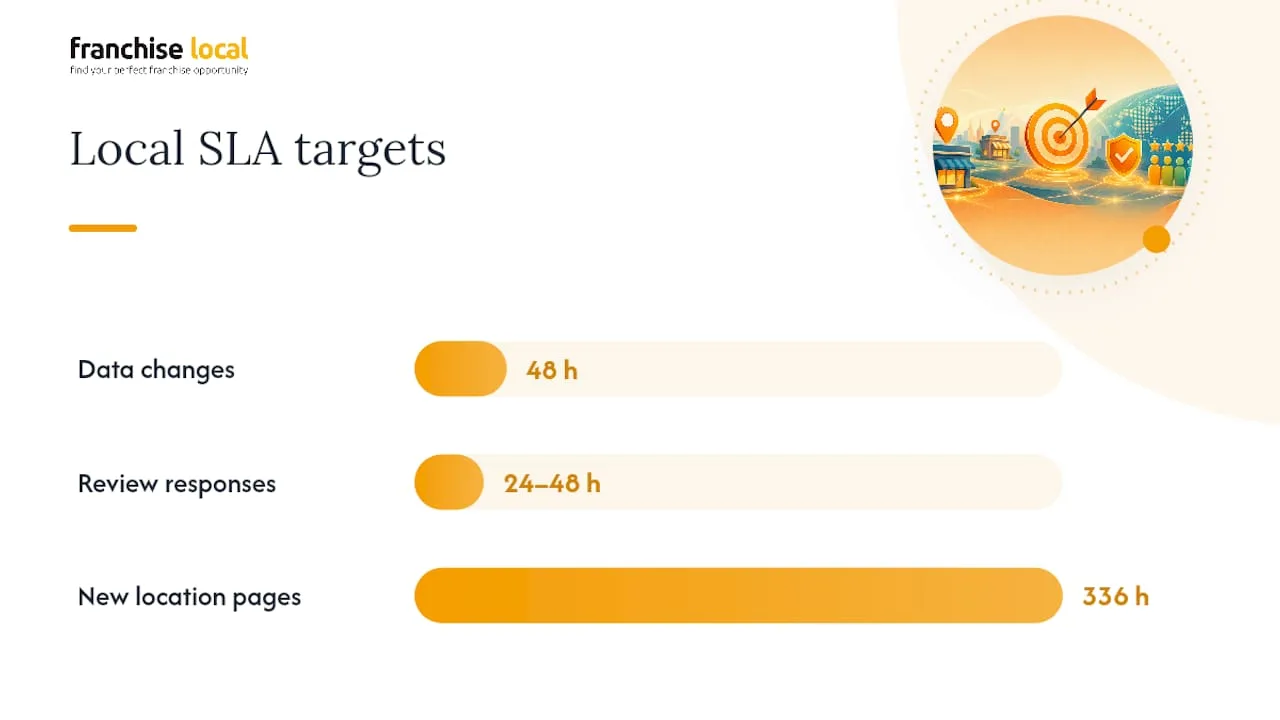
Set service-level agreements that are specific enough to audit. A reasonable starting point: data changes (address, hours) updated within 48 hours of a franchisee request; review responses within 24 to 48 hours; new location pages published within two weeks of a branch opening. Build a quarterly audit checklist covering GBP category accuracy, NAP consistency across the top ten citation sources, and review response rates by location.
Training makes the SLAs stick. Every new franchisee onboarding should include a short local SEO module: what they can and cannot edit on GBP, how to respond to a review, and who to contact for anything outside their remit. Franchiselocal’s guide on improving franchise visibility is a useful reference point to share during onboarding.
Pro Tip: Resourcing usually falls into three models: fully in-house, a managed agency retainer, or a hybrid where central strategy sits in-house and execution is outsourced. Hybrid tends to scale best past 20 locations, since it keeps brand control centralised while outsourcing the repetitive listing and citation work.
Quick wins: a prioritised 30/90/180‑day checklist
A staged rollout stops the programme collapsing under its own scope. Three phases, each building on the last:
- First 30 days: Claim and verify GBP for your highest-traffic locations first. Fix the most glaring NAP mismatches across your top 10 citation sources. Publish or rewrite your top 10 location pages with unique local content.
- 90 days: Roll out a network-wide review collection process. Finalise your location page template and build a rolling local content calendar. Begin outreach for local link opportunities in your priority markets.
- 180 days: Automate reporting dashboards for location-level KPIs. Run A/B tests on page templates (CTA placement, testimonial format). Formalise governance with documented SLAs and a recurring audit schedule.
Managing local citations and directories specific to each franchise location
Citations, the mentions of your business name, address, and phone number across directories, still shape local trust signals, even for franchises with strong websites. The problem at scale isn’t building citations; it’s controlling them once dozens of franchisees, previous owners, and third-party directories have all created their own versions over the years.
Start with an audit of the major citation sources relevant to your sector, not just the generic ones. Every discrepancy, an old phone number, a previous address, a slightly different business name format, dilutes the trust signal Google assigns to that location. Prioritise fixing the top 10 to 15 citation sources per location rather than chasing every obscure directory; the returns drop off sharply after the well-known ones.
Centralise this with a single source-of-truth spreadsheet or data feed that syncs to citation platforms, rather than relying on individual franchisees to update listings themselves. When a franchise changes hands, hours change seasonally, or a branch relocates, that update should propagate from one place, not require chasing forty separate directory logins.
Sector-specific directories carry more weight than generic ones for certain categories, so identify which two or three niche directories matter most for your industry and treat those with the same rigour as Google and Bing. A franchise listing optimisation guide is worth reviewing if you’re deciding which listings deserve the most attention first.
Local link building strategies for franchises
Link building for a single-location business is straightforward: build relationships in one town. For a franchise network, the challenge is doing that dozens of times without it becoming unmanageable or, worse, spammy in Google’s eyes.
The strongest local links come from genuine community involvement, not manufactured outreach. Local sports sponsorships, chamber of commerce membership, school fundraisers, and charity partnerships each generate a natural, relevant backlink from a source Google already trusts for that geography. These links convert better too, since they usually sit on pages local customers actually read.
Local press coverage matters more than most franchises use it. A branch opening, a milestone, or a community initiative is genuinely newsworthy to a local paper or hyperlocal news site, and one feature article can outperform months of generic outreach.
Avoid the trap of buying identical link packages for every location from the same directory or blog network. Google’s algorithms are tuned to spot unnatural, templated link patterns, and a franchise doing the same outreach fifty times over is exactly the pattern that gets flagged. Vary the approach by market: what works for a branch in a university town (student media, local blogs) won’t work for a branch in a retail park (local business associations, trade press).
Give franchisees a simple brief for pursuing their own local links (sponsor one event a quarter, join one local business group) rather than centralising every single outreach effort, since local relationships are genuinely local.
Franchisee training and guidelines for consistent local SEO practices
Franchise local SEO breaks down fastest when franchisees don’t understand why the rules exist, not because they’re careless. A one-page policy document gets ignored. A short, practical training module gets followed.
Cover four things in every onboarding session: what franchisees can edit directly on their GBP listing (photos, posts, Q&A responses), what requires central approval (business name, category, address changes), how to respond to a review using the approved template, and who to contact when something looks wrong (a suspended listing, a duplicate profile, an unexpected data change).
Refresh this training periodically, not just at onboarding. Google’s guidelines and interface change often enough that a franchisee trained two years ago may be working from outdated assumptions about what’s allowed.
Guidelines work best as a living reference, not a static PDF. A shared document with screenshots of the current GBP dashboard, examples of approved review responses, and a clear escalation contact reduces the ad hoc edits that damage brand-wide performance. Pair this with light oversight: a monthly spot-check of a handful of locations catches drift before it becomes a pattern across the network.
Handling duplicate listings and location data across multiple platforms
Duplicate listings are one of the most common, and most damaging, problems in franchise local SEO. They usually appear when a franchisee creates a new GBP profile without realising one already exists, when a location rebrands after a change of ownership, or when a third-party data aggregator pulls in an old address alongside the current one.

Duplicates split review counts, dilute ranking signals, and confuse customers who land on the wrong profile with outdated hours or a disconnected phone number. Google’s own system sometimes merges obvious duplicates automatically, but franchise-specific duplicates (same brand, similar address, different suite number) often need manual reporting and resolution.
Run a dedicated audit specifically hunting for duplicates, separate from the general NAP consistency audit. Search your brand name plus each location’s town or postcode and check every result that appears, not just the first one, since duplicates frequently rank below the primary listing rather than competing directly with it.
Once identified, request removal or merging through Google’s official process, and cascade the same check across the other platforms your network relies on. The fix isn’t glamorous, but a franchise carrying ten duplicate listings across its network is effectively splitting its own local authority ten times over, and no amount of content or link work compensates for that.
Leveraging local paid advertising in conjunction with organic local SEO
Paid and organic local search aren’t competing budgets; they solve different timing problems. Organic local SEO builds durable visibility over months. Local paid advertising fills the gap immediately, particularly for a new branch opening with no review history or ranking signal yet.
Google’s Local Services Ads and location-targeted Search campaigns let a new franchise location appear in relevant local searches from day one, while the organic location page and GBP listing build authority in the background. Once organic rankings stabilise, typically after the first few months of consistent citation and review activity, paid spend for that location can often be scaled back rather than eliminated.
Retargeting works particularly well at the local level. Someone who visited a location page but didn’t convert is a strong candidate for a geo-targeted display or social ad reminding them of the branch’s offer or booking link.
Coordinate the messaging between paid and organic rather than running them separately. If a location page promotes a specific local offer, the paid ad for that postcode should mirror it, not run a generic brand-wide promotion. This consistency reinforces the same trust signals that organic SEO depends on, rather than sending mixed messages to the same searcher across different channels.
Integrating social media with local SEO efforts for franchises
Social media doesn’t directly move rankings, but it feeds the signals that do. A locally active social profile drives the kind of engagement, reviews, and local mentions that compound into stronger local search performance over time.
Each location benefits from its own local social presence, or at minimum, its own tagged content within a central brand account, rather than every branch being represented by one generic corporate feed. Customers searching for a specific branch often check social profiles for recent activity, opening hours, or photos before they check the website, especially on platforms like Facebook and Instagram.
User-generated content, a customer’s check-in, a tagged photo, a local influencer’s mention, functions similarly to a review: it’s third-party validation Google and customers both notice. Encourage branches to actively engage with and reshare this content rather than only posting centrally produced brand material.
Link social profiles back to the specific location page, not the homepage, so any traffic or link equity flows to the page that needs it most. And treat social review sections (Facebook reviews, in particular) with the same response discipline as Google reviews, since customers checking a branch’s social presence before visiting will judge unanswered complaints just as harshly as an unanswered Google review.
How Franchiselocal can complement your local SEO programme
Everything above builds long-term organic visibility, and none of it replaces the value of being found by people actively researching franchise opportunities right now. A directory like Franchiselocal serves as a UK franchise directory, built specifically for that different kind of discoverability: prospective franchisees filtering by industry, investment level, and lifestyle to find their next opportunity, rather than customers searching for a branch to visit.
A listing on Franchiselocal works alongside your technical SEO and GBP work, not instead of it. Where your location pages and reviews build trust with customers, a directory presence builds trust with the next generation of franchisees evaluating whether to join your network. The platform’s trending franchise opportunities page and tools for estimating affordability and ROI give prospective franchisees the practical detail they need before making contact, which means the enquiries reaching you are already better qualified.
If you’re weighing up how a directory listing fits into your broader growth plan, start by browsing the UK’s largest franchise directory to see how your category is currently represented, and where a stronger listing could sit.
Sources
- Consumer search behaviour — BrightLocal
- Manage multiple locations — Google Business Profile Help
- Guidelines for representing your business on Google — Google Business Profile Help
FAQ
How much should I pay for local SEO?
Costs vary widely depending on network size, ranging from a few hundred pounds a month for a single-location audit to substantial ongoing retainers for networks managing fifty-plus branches. The right benchmark is spend per location relative to enquiry value, not a flat industry rate, since a franchise with high-ticket services can justify far more per branch than one with low-margin transactions.
Is SEO dead now with AI?
No. AI-generated search summaries have changed how results are presented, but the underlying signals, accurate business data, genuine reviews, and structured data, still determine whether a franchise location appears in those summaries at all. If anything, the consistency and structured data practices that strong local SEO already demands have become more important, not less, as AI tools rely on the same clean data to generate answers.
Can I do local SEO myself?
Yes, for a single location or a small network, provided you commit to the ongoing work of GBP management, review response, and content updates rather than treating it as a one-off task. Beyond ten or fifteen locations, most franchises move to a hybrid model, keeping strategy and governance in-house while outsourcing repetitive execution like citation building and listing audits.
What is the 80/20 rule in SEO?
Chasing minor technical tweaks or obscure directory listings before those fundamentals are solid rarely moves the needle for a multi-location network.