

Franchise investment recovery is the process of recouping invested capital from an underperforming or failed franchise through targeted operational, financial, and legal strategies. The industry term for this process is “franchise turnaround,” though recovery encompasses both salvaging an existing unit and reclaiming losses after exit. The median payback period for a franchise is 6.2 years, with successful units targeting break-even within 6–18 months. That benchmark matters because it defines the window in which recovery is still viable. This guide covers franchise investment recovery explained in full, from operational fixes to legal remedies and the mindset that separates investors who recover from those who do not.
What are the main strategies to recover a franchise investment?
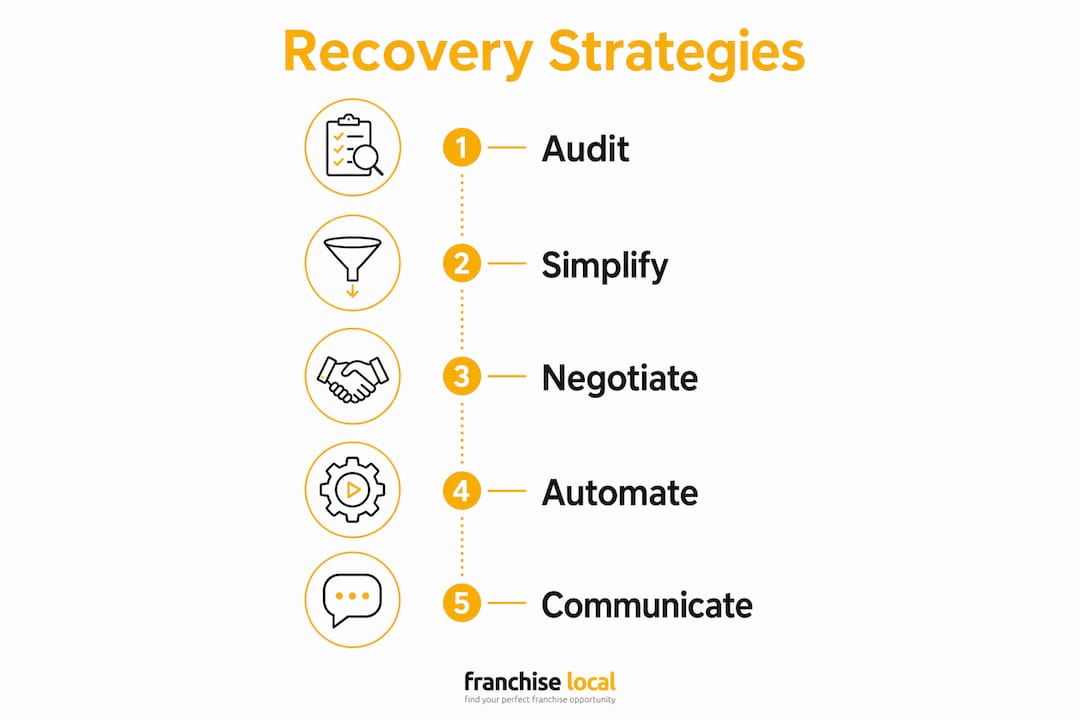
Franchise recovery strategies begin with a rigorous profit and loss audit, not a renovation. Most failing franchises are unoptimised rather than fundamentally broken. That distinction matters enormously because it means the path to profitability runs through operational discipline, not capital expenditure.

1. simplify the product or service offering
Operational turnarounds that cut menu items or service lines by 20–30% lower inventory costs and reduce prime costs by roughly 7% within the first 60 days. That is a material improvement achievable without spending a single pound on refurbishment. For a food franchise, this means removing low-margin items and concentrating on the top sellers. For a service franchise, it means cutting peripheral offerings that consume staff time without generating proportionate revenue.
2. treat your lease as a variable cost
Experienced operators facing financial pressure negotiate lease terms proactively rather than waiting for a crisis. Treating a lease as a variable cost means approaching the landlord early, presenting current trading figures honestly, and requesting a rent reduction or deferral tied to revenue performance. Landlords generally prefer a renegotiated agreement to an empty unit. Acting early gives you leverage. Waiting until you have missed payments removes it entirely.
3. renegotiate supplier contracts
Supplier contracts are often signed at the outset of a franchise and left untouched. A struggling unit has every reason to revisit payment terms, volume commitments, and pricing tiers. Even a 3–5% reduction in cost of goods sold can shift a unit from loss to marginal profit. Combine this with the menu simplification above and the compounding effect on margins is significant.
4. automate administrative functions
Shifting administrative tasks from costly salaried managers to automation and lower-cost systems is one of the most direct ways to control labour cost bloat. Scheduling software, digital invoicing tools, and cloud-based reporting platforms reduce the hours a senior manager must spend on back-office work. The saving is not trivial. Labour is typically the largest controllable cost in any franchise unit, and administrative labour is the least revenue-generating component of it.
5. focus on unit-level metrics, not brand-level averages
Brand-level performance data from your franchisor is useful context, but it will not tell you why your specific unit is underperforming. You need granular data: revenue per hour, average transaction value, staff cost as a percentage of sales, and waste figures. These numbers tell you exactly where the problem sits.
Pro Tip: Review your unit’s prime costs weekly, not monthly. Prime cost is the sum of food or product cost and labour cost. Keeping it below 60% of revenue is the standard benchmark for a viable franchise unit. If yours is above that figure, you have a specific, solvable problem.
How can legal and financial remedies support recovery?
Legal recovery is a legitimate avenue for franchise investment loss recovery, but it applies in specific circumstances. The standard industry term here is “franchise dispute resolution,” and it covers everything from mediation to litigation. Understanding when legal action is appropriate, and when it is not, saves both time and money.
When legal action is worth pursuing
Legal counsel is most relevant when you have suffered losses due to franchisor misrepresentation, unsuitable advice from a broker, or outright fraud. Reputable legal firms that specialise in franchise disputes often work on a contingency fee basis, meaning no upfront costs to you. That structure aligns the solicitor’s incentive with your outcome. If there is no recovery, there is no fee.
The key conditions that support a viable legal claim include:
- Documented misrepresentation in the franchise disclosure document or pre-sale conversations
- Breach of contract by the franchisor, such as failure to provide promised support or territory protection
- Negligent advice from a franchise broker or financial adviser who recommended an unsuitable investment
- Fraudulent trading by the franchisor, including falsified earnings claims or manipulated accounts
What legal action cannot do
Legal recovery is not a guaranteed route to recouping losses. Success rates in complex fraud cases, particularly those involving financial instruments, remain very low. The lesson for franchise investors is that legal action is a last resort for clear-cut cases, not a standard recovery mechanism for a business that simply underperformed.
Pro Tip: Before engaging any legal firm, verify their credentials through the Solicitors Regulation Authority (SRA) register. Franchise dispute specialists such as Ashtons Legal or Stephens Scown have established track records in UK franchise law. Avoid any firm that cannot provide verifiable case histories.
Financial restructuring options
Beyond legal routes, financial restructuring is often the more practical path. Options include refinancing existing business loans at lower rates, negotiating extended repayment terms with lenders, and applying for a Time to Pay arrangement with HMRC if tax liabilities have accumulated. The British Franchise Association (BFA) also maintains a list of approved franchise finance providers who understand the specific risk profile of franchise businesses. Reviewing your cost management approach before approaching lenders strengthens your case considerably.
What operational best practices drive a franchise business turnaround?
A successful franchise business turnaround rests on a small number of high-impact operational decisions. The table below compares the approaches that consistently produce results against the cosmetic fixes that consume capital without improving performance.
| Approach | What It Involves | Typical Impact |
|---|---|---|
| Prime cost reduction | Cutting food/product and labour costs below 60% of revenue | 7% margin improvement within 60 days |
| Menu or service simplification | Removing 20–30% of low-margin lines | Reduced waste, faster service, lower inventory |
| Admin automation | Replacing manager hours with scheduling and reporting software | Labour cost reduction without service impact |
| Lease renegotiation | Approaching landlord proactively with trading data | Reduced fixed costs aligned to current revenue |
| Proactive franchisor communication | Regular updates and requests for support resources | Access to recovery tools and franchisor goodwill |
| Cosmetic renovation | Repainting, refitting, or rebranding without fixing costs | Capital expenditure with no margin improvement |
The contrast between the top five approaches and the final row is the central lesson of franchise financial recovery. Turnarounds that fail in 2026 do so because operators invest in visible improvements while ignoring the labour and food cost inefficiencies that are actually destroying margin.
Communicating with your franchisor
Proactive communication with your franchisor increases your chances of recovery by unlocking support and resources that are simply not available to franchisees who go silent. Franchisors have a direct financial interest in your unit’s success. Most have dedicated support teams, marketing funds, and operational consultants whose job is to help struggling units recover. You cannot access those resources if you are not asking for them.
Going dark from your franchisor during a difficult period is one of the most damaging errors a franchisee can make. It signals instability, reduces goodwill, and eliminates your access to the network’s collective knowledge. Transparent, regular communication does the opposite. It positions you as a franchisee who is managing a challenge, not hiding from one.
Value pricing and menu engineering
For food and retail franchises, value pricing is a specific technique worth understanding. It means identifying the items with the highest gross profit margin, not the highest selling price, and making those items the most visible and promoted on your menu or display. A £6 item with a 75% gross margin contributes more to recovery than a £12 item with a 40% margin. Franchises like McDonald’s and Subway have used menu engineering systematically for decades. The same logic applies at the individual unit level.
How to spot and avoid pitfalls during investment recovery
Mitigating franchise investment risks during recovery requires as much vigilance as the original investment decision. Two categories of risk are particularly damaging: internal operational errors and external recovery scams.
External scams to avoid
Recovery scams are a genuine threat in 2026. They typically follow a predictable pattern:
- An unsolicited contact claims to specialise in recovering franchise or investment losses
- They request an upfront fee before any work begins, often framed as a “registration” or “processing” charge
- They provide vague guarantees of recovery with no verifiable track record
- They operate through anonymous online channels rather than registered legal firms
Legitimate recovery operations work through established law firms, not anonymous online contacts or upfront-fee solicitors. Any firm that cannot provide a verifiable SRA registration number and documented case outcomes should be avoided entirely. Reading the guidance on legal advice before franchise decisions is a practical first step before engaging any external adviser.
Internal operational errors
The most common internal pitfalls during franchise recovery include:
- Ignoring unit-level data in favour of brand-wide benchmarks, which masks the specific problem
- Delaying lease renegotiation until arrears have accumulated and leverage is gone
- Cutting marketing spend as a first cost-saving measure, which accelerates revenue decline
- Over-relying on the franchisor to solve problems that require the franchisee’s own operational decisions
- Going dark from the franchisor network, which removes access to support and signals instability to the brand
Understanding why franchises fail in the first place is directly relevant here. Many recovery failures repeat the same errors that caused the original decline. Franchise due diligence, which Franchiselocal covers in detail, applies equally to recovery decisions as it does to initial investment choices.
Pro Tip: Before committing to any recovery adviser or legal firm, run their company name through Companies House and the SRA register. A legitimate firm will have a clear registration history. An unregistered contact asking for upfront fees is a scam, regardless of how professional their communications appear.
The mindset that actually determines recovery outcomes
I have spent years watching franchise investors approach financial setbacks in two fundamentally different ways. One group treats a struggling unit as evidence of failure and responds emotionally, either by throwing money at cosmetic fixes or by withdrawing from the situation entirely. The other group treats it as a data problem and responds with precision.
The second group recovers. The first group rarely does.
Effective franchisees view difficulties as strategic development phases, using granular data to identify and address problems before the damage compounds. That framing is not motivational language. It is a practical description of what recovery actually requires. You cannot fix a prime cost problem you have not measured. You cannot renegotiate a lease you have not reviewed. You cannot access franchisor support you have not requested.
The investors I have seen recover most successfully share one specific habit: they plan using midpoint investment figures, not the minimum figures quoted in franchise marketing materials. That discipline means their financial models are realistic from the outset, and their recovery targets are grounded in actual capital exposure rather than optimistic projections.
My honest view is that the operational fixes described in this article are not complicated. Simplifying your offering, controlling prime costs, renegotiating fixed expenses, and communicating with your franchisor are all within reach of any franchisee. The barrier is not knowledge. The barrier is the willingness to act decisively before the situation becomes irreversible. Recovery is almost always possible earlier than investors think, and almost always harder than they expect once they have waited too long.
— Will
How Franchiselocal can help you find the right path forward
Whether you are working through a franchise turnaround or considering a fresh investment after a setback, Franchiselocal connects UK investors with opportunities that match their current position and capital. The directory covers sectors with strong recovery track records, including financial business franchises and loans franchises, both of which offer structured, lower-risk models suited to investors who want a clear path to profitability. Franchiselocal’s listings include full investment details, territory information, and direct franchisor contacts, giving you the data you need to make a grounded decision rather than a hopeful one.
FAQ
What is franchise investment recovery?
Franchise investment recovery is the process of recouping capital from an underperforming or failed franchise through operational improvements, financial restructuring, or legal remedies. The industry term for active recovery is “franchise turnaround.”
How long does franchise investment recovery typically take?
The median payback period across 124 franchise brands is 6.2 years, with successful units reaching break-even within 6–18 months. Recovery timelines depend on how early intervention begins and how decisively operational changes are made.
Can i recover franchise losses through legal action?
Legal recovery is viable when losses stem from franchisor misrepresentation, breach of contract, or fraud. Reputable franchise solicitors often work on a contingency fee basis, meaning no upfront costs, but success depends on the strength of documented evidence.
What is the biggest mistake franchisees make during recovery?
Going dark from the franchisor is the single most damaging error. Transparent communication unlocks support resources and preserves the goodwill needed to negotiate solutions that a silent franchisee will never access.
How do i avoid recovery scams when seeking help?
Avoid any adviser who requests upfront fees or cannot provide a verifiable SRA registration number. Legitimate recovery firms operate through registered legal channels with documented case histories, not through anonymous online contacts or unsolicited approaches.