

In the UK, a franchise gives you a full business format, an intellectual property licence, and ongoing support from the franchisor. A licence, by contrast, is either a narrower permission to use specific intellectual property or a statutory permit issued by a regulator. Choose franchising when you want a proven, supported system. Choose a licence only when you need specific rights, or when the law requires a regulatory permit for what you’re doing.
- Want a turnkey, supported business? Franchising gives you an operations manual, training, and a brand system you didn’t have to build.
- Just need permission to use IP, or a legal permit? A standalone licence covers that, without the operational backup.
LegalVision UK confirms this distinction directly: a franchise agreement delivers a comprehensive business system, while a licence focuses narrowly on IP permission with far less oversight. Bodies like Franchiselocal and HMRC treat these as separate categories, and the British Franchise Association exists precisely because franchising, unlike licensing, needs a supporting professional body around it.
Franchise licence vs franchise UK: the practical contract differences
Here’s where the confusion usually starts. Prospects search for “franchise licence” expecting a single, distinct legal product. It doesn’t quite exist that way. As Sprintlaw points out, the term is often used colloquially, but the document you’ll actually sign is a franchise agreement, and buried inside it is an IP licence covering the brand name, trademarks, and systems.
A typical franchise package includes:
- An IP licence granting you rights to the trademark, branding, and proprietary processes.
- An operation manual dictating exactly how the business runs, day to day.
- Training and onboarding, often including a period at the franchisor’s own site.
- Supplier arrangements, sometimes mandatory, tying you into approved wholesalers.
- A defined territory, protecting you from a rival branch opening two streets away.
- Ongoing quality control, meaning the franchisor can audit and enforce standards.
A standalone IP licence strips most of that away. You get permission to use a logo, a formula, or a piece of software, and that’s usually where the relationship ends. Ashfords frames it well: licensing hands you more day-to-day operational freedom, while franchising trades that freedom for a tested format and continuing support.
Then there’s a second, completely different meaning of “licence” that trips people up: the statutory business licence. This is a permission granted by a public body, not a private franchisor. Examples include:
- An alcohol licence from the local council for a pub or off-licence franchise.
- A street trading licence for a mobile catering or market-stall concept.
- A waste carrier’s licence for cleaning or environmental franchises.
These sit entirely outside your franchise agreement. Your franchisor can’t grant them, and holding a franchise doesn’t excuse you from applying for them yourself. Enforcement also differs sharply: a franchisor audits your operations against its own manual, while a regulator enforces public law, with penalties that can include fines or closure regardless of what your franchise contract says.
The legal reality: no franchise statute, and what that means for you
Here’s the fact most prospective franchisees don’t expect: the UK has no franchise-specific statute and no mandatory disclosure document. Unlike the United States, where the Federal Trade Commission mandates a Franchise Disclosure Document, franchising in England and Wales runs on general contract law, intellectual property law, and competition law, according to ICLG’s franchise regulation guide. No regulator checks a franchisor’s figures before it starts selling franchises.
That absence of a statutory net is exactly why due diligence sits on your shoulders. Pinsent Masons notes that most UK franchise agreements are long-term, binding relationships, and personal guarantees are common. Sign one, and you may be personally on the hook if the business fails and the franchisor pursues outstanding fees.
A handful of clauses deserve particular scrutiny before you sign anything:
- Personal guarantees that expose your personal assets, not just the business.
- Post-termination restrictions, which can stop you trading in the same sector for years after you leave.
- Trade mark ownership, which almost always sits with the franchisor, not you.
- Territorial limits, which define where you can operate and where you can’t.
There’s also a tax angle worth knowing before any resale or exit. HMRC’s internal manual treats rights under a franchise or licence as distinct assets from goodwill, and any sale price needs to be apportioned between the two. Get that apportionment wrong, and you risk an unwelcome conversation with HMRC over your capital gains calculation. None of this changes if you’re operating under a business licence rather than a franchise: council and regulator permissions still apply on top, and non-compliance can mean closure regardless of your franchise standing.
What each route actually costs you
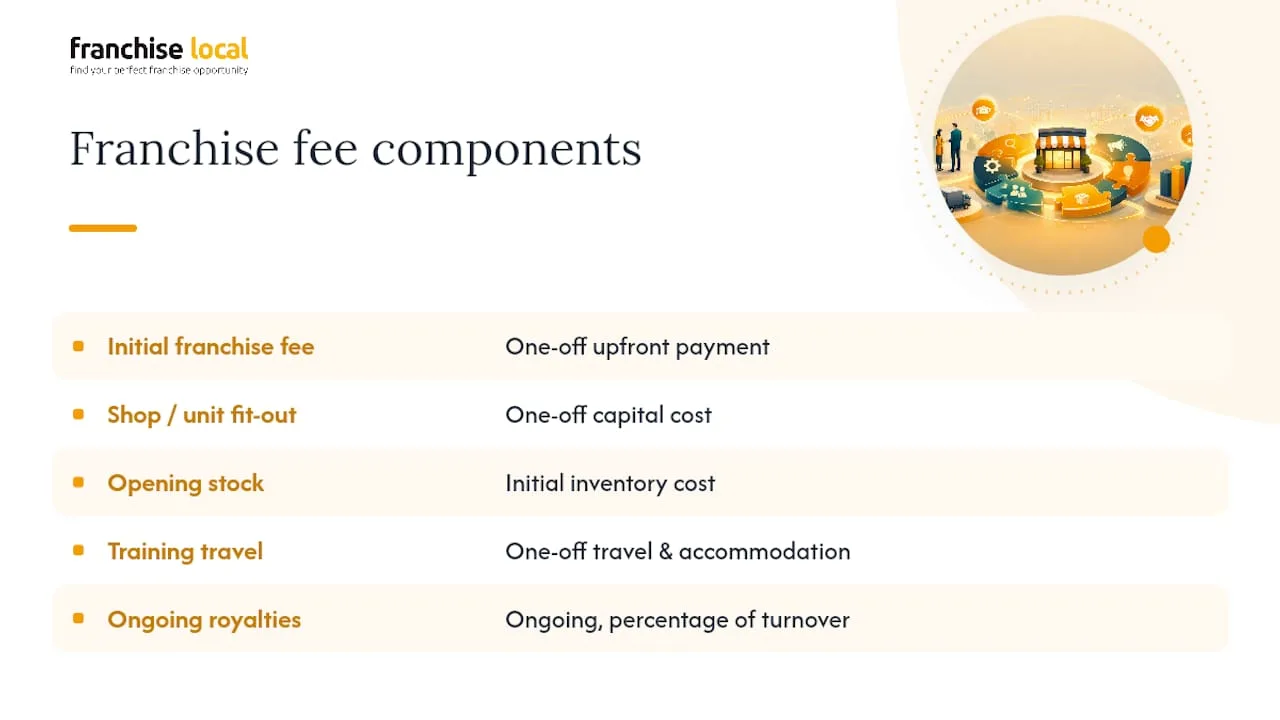
Franchise fees follow a fairly predictable shape. Expect an initial franchise fee, shop or unit fit-out costs, opening stock, and travel or accommodation for training. After launch, most agreements charge an ongoing royalty, usually a percentage of turnover, plus a contribution to a central marketing fund.
Licensing tends to be cheaper to enter. Goldstein Legal’s comparison notes that licensing is usually simpler and less expensive to set up than franchising, but that lower cost shifts responsibility elsewhere. Without a franchisor’s ongoing quality-assurance system, you carry more of the burden yourself to protect the brand you’re licensing, and that’s a real cost even when it isn’t a line on an invoice.
Personal guarantees complicate borrowing too. Lenders view a guarantee-backed franchise agreement differently from an unsecured licence arrangement, and it directly shapes how much cashflow headroom you need to plan for.
Pro Tip: Before you sign anything, find the audit clause, the renewal refurbishment obligation, and the termination penalty schedule. These three sit quietly in most agreements and are where unplanned costs tend to surface years later, not at the point of signing.
Explore how franchising stacks up against building something from scratch in our piece on franchise vs startup costs for UK entrepreneurs.
Your due diligence checklist before signing
Work through these four checkpoints in order, and don’t skip ahead because a franchisor seems trustworthy on the phone.
- Review the contract itself. Check the IP scope, your territory, renewal terms, exit conditions, and any personal guarantee wording line by line.
- Verify the financials. Ask for audited accounts, not projections, and understand exactly how royalties are calculated before you model your own cashflow, including a worst-case scenario.
- Talk to existing franchisees. Ask about the support you’ll actually receive, not the support promised in the brochure, and probe how reliable the supply chain has been.
- Confirm regulatory requirements separately. Check whether your specific trade needs a council or regulatory licence, and clarify who handles GDPR and employment obligations from day one.
A well-prepared franchisor will typically have invested heavily in pilot operations, manuals, and recruitment before ever selling a single franchise. Ask how the system was tested and how long the pilot ran. Our breakdown of what a franchise agreement covers goes deeper into clause-by-clause obligations if you want to check your own draft against it.
Pro Tip: Ask a franchisor for two references from franchisees who left the network, not just current ones. What went wrong for them tells you more than what’s going right for the success stories.
Where Franchiselocal fits into your research
Once you understand the legal shape of what you’re signing, the next step is finding real opportunities to compare. Franchiselocal runs a searchable UK franchise directory with filters for investment level, industry, and location, so you can shortlist options that match your budget rather than scrolling endlessly.
- Filter by price band to find franchises within your actual capital.
- Browse curated industry pages to compare formats side by side.
- Read the ultimate guide to franchising for a fuller walkthrough before you contact anyone.
- Check trending UK franchise opportunities to see what’s gaining traction right now.
Use it as a research tool alongside proper legal advice, not a replacement for it.
Sources
- Licence vs Franchise Agreements in England and Wales | LegalVision UK
- Franchise licence vs business licence: key legal differences in the UK | Sprintlaw
- Franchising in the UK | Pinsent Masons out-law guide
- HMRC internal manual: capital gains and intangible assets (franchise/licence treatment)
- What is the difference between franchising and licensing? | Ashfords