

The most reliable way to value a franchise resale is to triangulate three methods: an earnings multiple applied to adjusted SDE or EBITDA, an asset-based floor, and market comparables from recent UK resales. As the British Franchise Association makes clear, the final price is ultimately what a willing buyer will pay, and competing bids can move that figure in either direction.
Your immediate next step: gather three years of adjusted accounts, the franchise agreement showing remaining term and transfer fee, and a full list of fixed assets. Those three items are the foundation of every credible valuation.
- Earnings-based value: adjusted SDE or EBITDA multiplied by a sector-appropriate factor (typically 1x–4x for UK franchises)
- Asset floor: the liquidation or book value of physical assets, which sets the minimum a seller should accept
- Market comparables: recent resale prices for similar franchises, used to calibrate the multiple up or down
- Franchisor factors: remaining contract term, transfer fee, and approval process all affect what buyers will pay
- Franchiselocal’s resale listings provide a practical starting point for sourcing UK comparables
What to gather before you start valuing a franchise resale
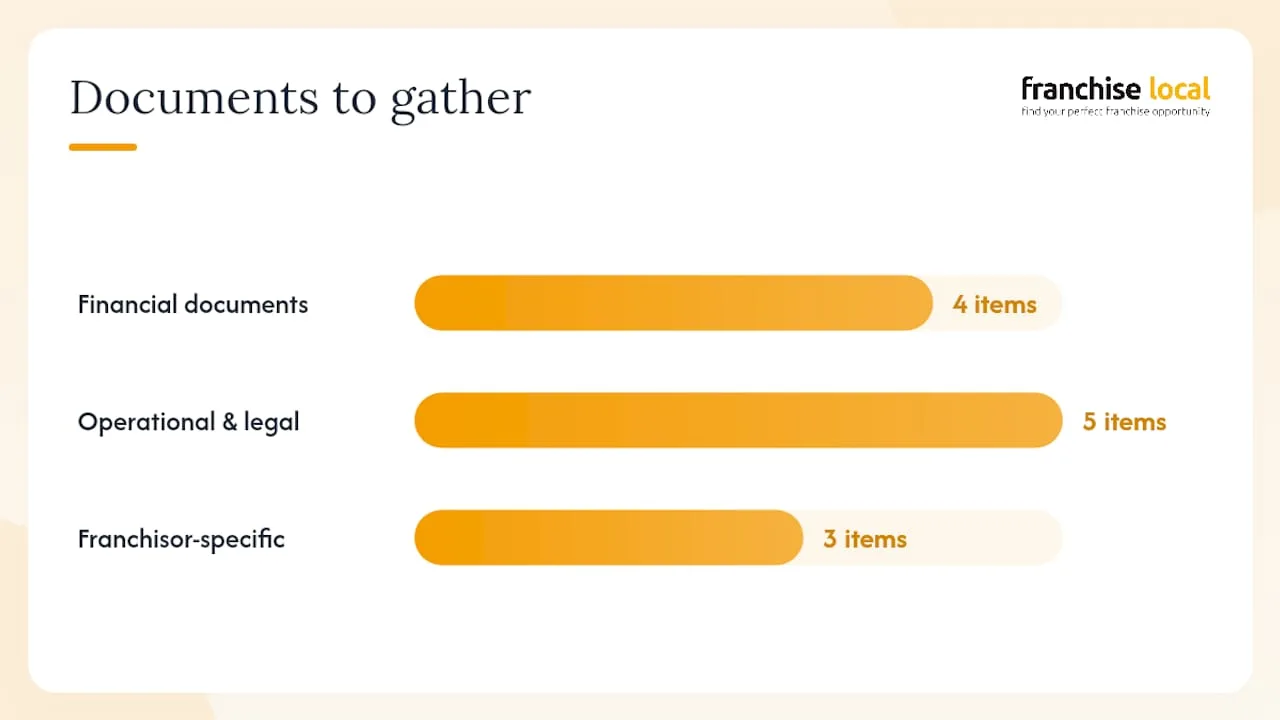
A credible valuation stands or falls on the quality of the documents behind it. Lenders, buyers, and franchisors will all ask for the same core set, so assembling it early saves time and avoids last-minute gaps.
Financial documents:
- Three years of filed accounts (profit and loss, balance sheet)
- Recent management accounts (ideally within the last three months)
- Detailed royalty and marketing fee schedules showing the exact percentages charged
- Any VAT returns or HMRC correspondence relevant to trading history
Operational and legal documents:
- The franchise agreement, including remaining term, renewal rights, territory definitions, and transfer clauses
- Transfer fee amount and the franchisor’s approval process in writing
- Lease or property details: term remaining, rent review dates, and any dilapidation obligations
- Staff contracts and an org chart showing who is employed and on what terms
- A full list of fixed assets with approximate current values
Franchisor-specific items buyers will request:
- Confirmation of whether the franchisor will approve the proposed buyer
- Any outstanding obligations or disputes with the franchisor
- Renewal rights and whether renewal is at the franchisor’s discretion
According to Franchise Business Brokers, an independent valuation covering at least three years of accounts, assets, and non-financial factors is the standard lenders expect and the format that eases negotiation with buyers.
Pro Tip: Reconcile owner drawings before you share any figures. Show adjusted profit with clearly documented add-backs — owner salary, personal expenses run through the business, and one-off costs. Buyers and lenders will apply their own adjustments if you do not, and theirs will almost always be more conservative than yours.
The three core approaches to franchise resale valuation
BFA guidance recommends starting from adjusted maintainable profit and applying a multiple, then cross-checking with asset value and comparable sales. No single method gives the full picture.
Earnings-based valuation
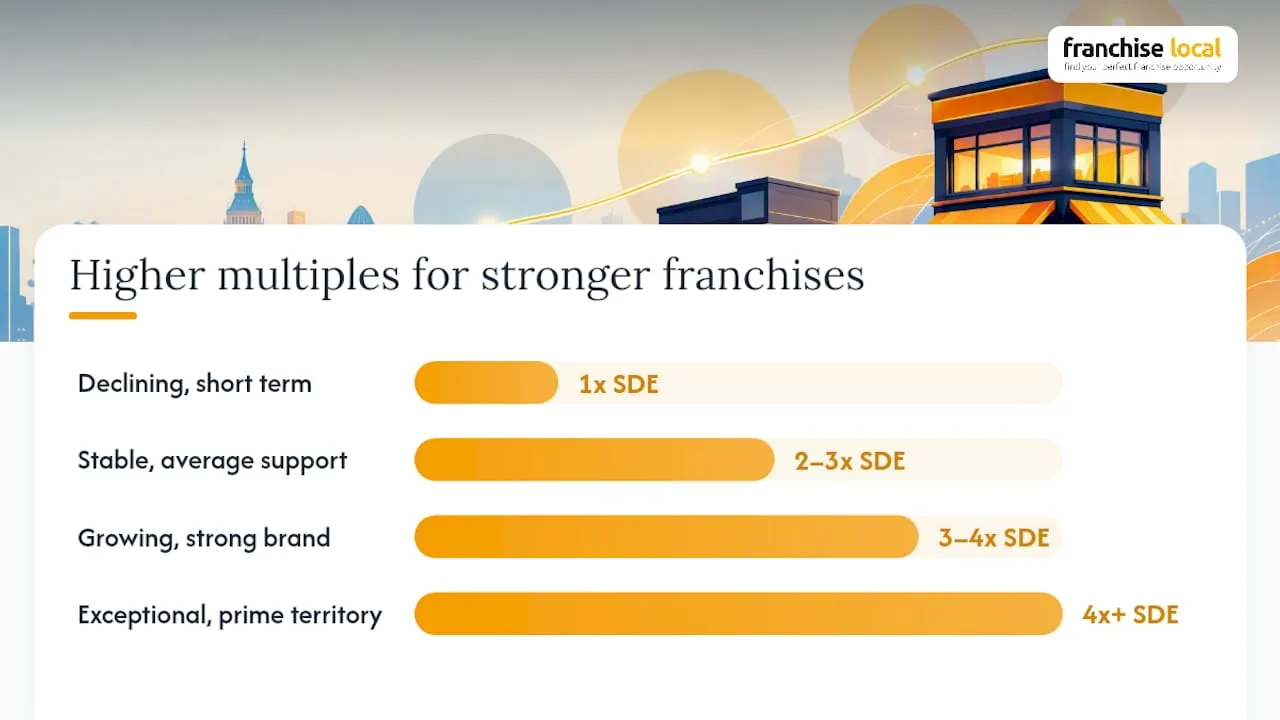
This is the primary method for most UK franchise resales. Calculate adjusted SDE (Seller’s Discretionary Earnings) or EBITDA, then apply a multiple. The multiple reflects the risk profile of the business: a stable, growing franchise with strong franchisor support commands a higher multiple than one with declining revenue or a short remaining term.
Typical UK multiplier ranges by scenario:
| Scenario | Typical multiplier |
|---|---|
| Declining revenue, short term remaining | 1x SDE |
| Stable revenue, average franchisor support | 2x–3x SDE |
| Growing revenue, strong brand, long term | 3x–4x SDE |
| Exceptional performance, prime territory | Up to 4x+ SDE |
Asset-based valuation
Book value or liquidation value sets the floor. For asset-heavy franchises such as vehicle-based or equipment-intensive operations, the asset floor can be close to or even exceed the earnings-based figure. It prevents a seller from accepting less than the tangible value of what they own. Nomora’s analysis of franchise vehicle costs illustrates how fleet and equipment values can represent a meaningful portion of total resale value for mobile franchises.
Market comparables
Xero’s UK business valuation guide recommends using recent, sector- and location-close sales alongside other methods. Apply the sale multiples from those transactions to your adjusted earnings figure to see whether your earnings-based estimate sits within the market range.
Pro Tip: When sourcing comparables, weight recent sales (within 18 months) more heavily than older ones. Franchise resale markets shift with interest rates and consumer confidence, so a 2021 multiple may not reflect what buyers will pay today.
How to adjust reported earnings for franchise specifics
Reported net profit rarely reflects what a new owner will actually earn. The adjustments below convert it into a maintainable earnings figure that buyers and lenders will accept.
Common add-backs (items that increase adjusted profit):
- Owner salary and discretionary drawings above a market-rate replacement cost
- One-off repairs or capital expenditure unlikely to recur
- Personal expenses run through the business (mobile phones, vehicles, travel)
- Non-recurring professional fees (litigation, one-off consultancy)
- Related-party transactions at non-market rates
Adjustments that reduce profit:
- Any owner benefit that a new owner would need to replace with paid staff
- Deferred maintenance costs that will fall due after sale
Royalties and marketing levies are never added back. As Buy a Business notes, franchise resales are modelled on adjusted maintainable profit after franchisor fees. A buyer inherits those costs on day one.
Adjusted SDE formula:
Reported net profit + owner benefit + selected add-backs = Adjusted SDE
Adjusted SDE × chosen multiple = Indicative earnings-based value
Statistic callout: UK franchise multipliers commonly range within a factor usually applied to adjusted SDE or EBITDA, with stable franchises typically attracting a moderate multiple according to BFA industry guidance.
How lender underwriting shapes the practical purchase price
A valuation tells you what a business is worth. Debt serviceability tells you what a buyer can actually afford to pay for it. The two figures often differ, and the lower one usually wins.
Lenders assess the post-royalty cash flow remaining after all franchisor costs to determine how much debt the business can support. That figure, divided by the required debt-service coverage ratio, sets the maximum loan. Add the buyer’s deposit, and you have the effective price ceiling. BFA guidance on franchise resales explicitly flags debt serviceability as a critical constraint on what buyers can pay.
The key inputs lenders model:
- Maintainable net cash flow after royalties and marketing contributions
- Prevailing interest rate and loan term (typically 5–7 years for franchise lending)
- Required personal income for the buyer’s living costs
- Loan-to-value ratio the lender will accept (often 50%–70% for franchise purchases)
Pro Tip: Build a simple annual debt-service schedule before you set an asking price. Divide the projected loan by 12, add interest, and check whether the monthly payment leaves the buyer with enough post-debt cash flow to live on. If it does not, the asking price is too high for most buyers to finance, regardless of what the earnings multiple says.
For buyers exploring franchise finance options, modelling this schedule early avoids wasted time on deals that cannot be funded.
Franchise-specific levers that raise or lower resale value
Beyond the numbers, several franchise-specific factors shift the multiple a buyer will apply.
- Contract term: A remaining term of five years or more with clear renewal rights supports a full multiple. A term of one to two years without guaranteed renewal materially reduces saleability, as the BFA notes in its resale buyer guidance.
- Territory quality: A large, exclusive territory in a high-density area commands a premium. Overlapping or shrinking territories reduce buyer confidence.
- Franchisor support and brand strength: Documented training programmes, a strong national brand, and a franchisor with a track record of supporting resales all reduce buyer risk and justify a higher multiple.
- Owner dependency: A business that only works because of the current owner’s personal relationships or skills attracts a discount. Buyers cannot be confident the revenue will transfer.
Sellers who codify procedures, create staff manuals, and demonstrate a management team willing to stay after sale materially improve buyer confidence and the achievable multiple, according to BFA resale guidance. Reviewing your franchise risk profile before listing is a practical way to identify and address these discount factors early.
Pro Tip: Start reducing owner dependency at least 12 months before you plan to sell. Document every process, delegate client relationships to staff, and ensure the business runs for at least one month without your direct involvement. That evidence alone can shift a buyer’s multiple by half a point.
What to expect from the process, fees, and timeline
A UK franchise resale typically follows these steps: valuation, marketing and listing, buyer identification, franchisor approval, due diligence, and exchange and completion. Timeframes vary. Fees for independent valuers depend on complexity, broker commissions typically amount to a percentage of the sale price, legal fees cover both sides, and franchisor transfer fees vary by brand and are usually paid by the seller, though this can be negotiable.
Presenting clear financial projections and explaining the franchisor’s transfer process reduces buyer risk and helps preserve value, as Azibiz’s UK valuation guide advises.
When should you bring in a professional valuer or adviser?
DIY valuation works for straightforward resales with clean accounts and a simple lease. Bring in a professional when any of the following apply:
- The business has a significant leasehold or freehold property component
- Goodwill forms the majority of the asking price and needs independent support
- You need a lender-acceptable valuation report
- Accounts are disputed, incomplete, or show unusual patterns
- The deal involves an earn-out or deferred consideration structure
Selection checklist for advisers:
- Chartered accountancy qualification (ICAEW, ACCA, or ICAS) or a recognised valuation credential (RICS for property-heavy franchises)
- Demonstrable franchise resale experience, not just general business sales
- References from a franchisor or recent resale clients
- Clear methodology: ask how they source comparables, how they treat royalties in their model, and whether their report format is accepted by high-street franchise lenders
A worked example of earnings-based franchise resale valuation
This is an illustrative example. Exact results depend on verified accounts and the specific terms of your franchise agreement.
- Reported net profit: £42,000
- Add back owner salary above market rate: £18,000 (owner pays themselves £48,000; market-rate manager costs £30,000)
- Add back one-off repair: £4,000
- Add back personal mobile and vehicle: £2,500
- Adjusted SDE: £42,000 + £18,000 + £4,000 + £2,500 = £66,500
- Apply a 2.5x multiple (stable revenue, mid-range franchisor support): £66,500 × 2.5 = £166,250
- Check asset floor: fixed assets at liquidation value = £35,000. The earnings-based figure exceeds this, so the floor does not bind.
- Lender affordability check: at 6% interest over 6 years on a £120,000 loan (buyer contributes £46,250 deposit), monthly debt service is approximately £1,990. Post-debt cash flow from adjusted SDE: £66,500 ÷ 12 = £5,542 per month, leaving £3,552 after debt service. This passes a standard lender stress test.
Indicative asking price range: £155,000–£175,000, subject to comparable sales and franchisor transfer fee.
Sources
Trusted sources for franchise resale valuation in the UK:
- Navigating Franchise Resales: Top Tips for Buyers – British Franchise Association
- How to value a franchise business before a potential sale
- How to Buy or Sell a Franchise in the UK | Buy a Business
Your next step: if your accounts are clean and the franchise agreement is straightforward, prepare your adjusted SDE figure using the add-backs above and run the worked example with your own numbers. If the deal involves a significant property element, disputed accounts, or a large goodwill component, book an independent valuation before you set an asking price or make an offer.
Browse financial business franchises for sale on Franchiselocal to see current market pricing and identify sector comparables for your valuation.