

Franchisee autonomy is defined as the degree to which a franchisee can make independent operational decisions while remaining within the brand standards set by their franchisor. As independent business owners, franchisees hold their own liabilities and are not employees of the franchisor. That distinction matters enormously. It means you carry real entrepreneurial risk and deserve a genuine say in how your business runs. Understanding franchisee autonomy before you sign any agreement is the single most important step in choosing the right franchise investment.
What is franchisee autonomy explained in practice?
Franchisee autonomy describes the space between what a franchisor mandates and what you are free to decide yourself. The industry term for this concept is “operational independence within brand standards,” and it sits at the heart of every franchise relationship. The franchise agreement is the primary governing document that defines royalty rates, territory, term length, and the precise boundaries of your autonomy. Get this document wrong and you will spend years operating inside a box that does not fit you.
The most useful framework for understanding these boundaries is the “structured zones of freedom.” This model divides franchise operations into three layers: untouchable elements that must never change, recommended practices that the franchisor prefers but does not enforce, and flexible areas where you have genuine discretion. Knowing which layer each decision falls into tells you exactly how much autonomy franchisees have before you commit capital.
Successful franchise systems treat the relationship as a two-way partnership, not a one-sided licensing deal. That framing changes everything. A franchisor who sees you as a partner will build feedback loops into the system. One who sees you as a licensee will hand you an operations manual and expect compliance.

What do franchisors control versus what franchisees decide?
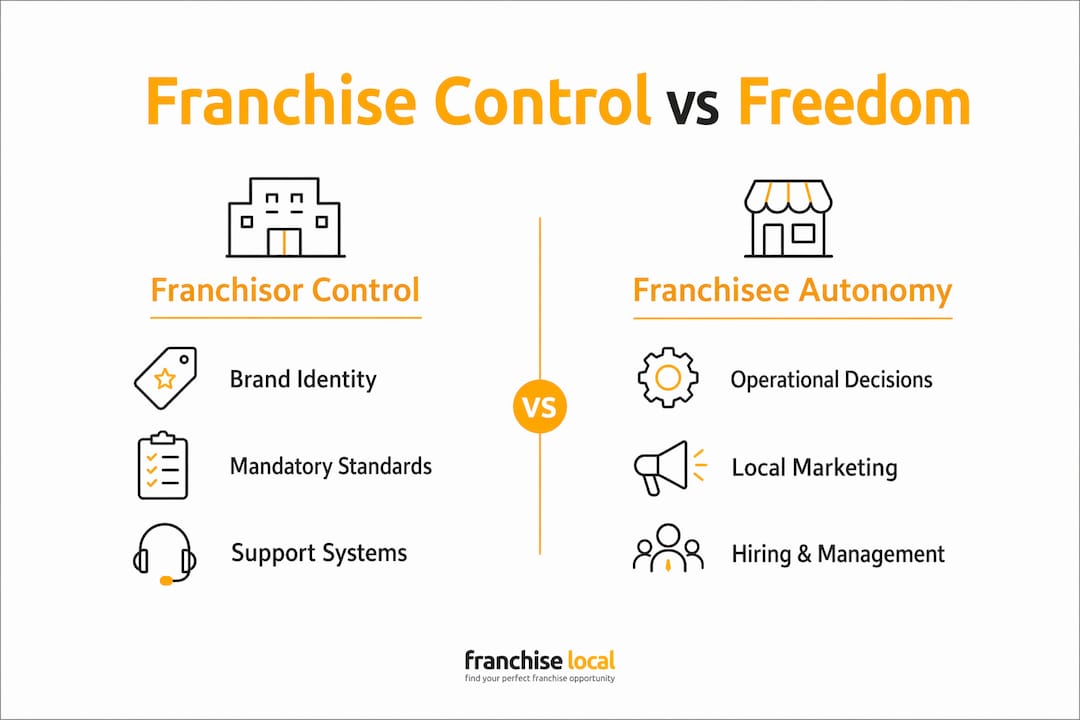
The split between franchisor control and franchisee freedom is rarely 50/50. It varies by sector, brand maturity, and the individual agreement. The table below shows the most common division.
| Area | Franchisor control | Franchisee discretion |
|---|---|---|
| Brand identity | Logos, colours, signage | None |
| Core products or services | Fixed menu or service list | Local additions (where permitted) |
| Quality and safety standards | Non-negotiable | None |
| Pricing | Often set or capped | Sometimes flexible locally |
| Local marketing | Brand guidelines apply | Channel choice, spend level |
| Opening hours | Minimum hours may be set | Extended hours often permitted |
| Staff recruitment | Hiring standards defined | Selection and pay rates |
| Supplier relationships | Approved supplier lists | Negotiating volume with approved suppliers |
The untouchable layer covers brand identity, core products, and safety standards. No credible franchisor will compromise on these because they protect every franchisee in the network. A single outlet serving substandard food or providing unsafe services damages the brand for thousands of other operators.
The flexible layer is where franchisee decision-making genuinely matters. Local marketing spend, staff selection, community engagement, and extended opening hours are areas where your knowledge of the local market gives you a real edge. A franchisee running a cleaning business in rural Yorkshire will market differently from one operating in central Manchester. That local intelligence is an asset the franchisor cannot replicate from head office.
- Untouchable: logos, core product specifications, safety protocols, brand tone
- Recommended: preferred suppliers, suggested pricing tiers, training schedules
- Flexible: local advertising channels, staff rotas, community partnerships, extended hours
How does franchisee independence affect performance and motivation?
Autonomy is a direct driver of franchisee motivation. When you feel like an entrepreneur rather than a manager following a script, you invest more energy, more creativity, and more personal commitment into the business. Excess franchisor control without autonomy negatively affects motivation and suppresses the innovation that keeps franchise networks competitive.
The risk cuts both ways, though. Too much autonomy without clear brand standards produces inconsistency. A customer who visits your outlet expecting the same experience they had in another location will be disappointed if your interpretation of the brand differs significantly. Brand inconsistency erodes trust faster than almost any other operational failure.
Franchisees’ local knowledge and initiative often drive the most valuable innovations for the wider network. McDonald’s Filet-O-Fish sandwich originated with a franchisee responding to local demand. The best franchise systems have formal channels for franchisees to submit ideas, and the best franchisors act on them. When you evaluate a franchise, ask directly how the franchisor collects and responds to franchisee feedback.
Pro Tip: Before signing, ask the franchisor for three examples of franchisee-suggested changes that were adopted network-wide. A franchisor who cannot name any is telling you something important about how much your operational input will matter.
Discipline in implementing the operating model is equally vital. Consistent execution protects the brand even when franchisees have wide discretion in other areas. The franchisees who perform best are those who master the non-negotiables first, then apply their local knowledge within the flexible zones.
What contractual and financial terms shape your operational freedom?
The franchise agreement is not a formality. Every clause either expands or restricts your operational freedom, and some clauses can trap you for a decade. Key contractual red lines include mandatory remodel obligations, personal guarantees, and territory relocation rights. Each of these can override your autonomy in ways that are not obvious at the point of signing.
Royalty fees are the most visible financial constraint on franchisee decision-making. Royalties typically range from 4% to 12% of gross sales. That percentage comes off the top, before you pay staff, rent, or suppliers. A higher royalty rate is only justified if the franchisor delivers proportionally stronger brand support, marketing spend, and operational infrastructure.
The table below maps key financial terms to their impact on operational autonomy.
| Financial term | Typical range | Impact on autonomy |
|---|---|---|
| Royalty fee | 4%–12% of gross sales | Reduces margin available for local investment |
| Marketing levy | 1%–4% of gross sales | Limits local marketing budget control |
| EBITDA margin (year two) | 12%–22% (healthy) | Indicates whether the model leaves room for franchisee investment |
| Cash-on-cash return | Above 12% (benchmark) | Signals financial sustainability of the autonomy model |
| Remodel obligation | Varies by agreement | Can force capital spend without franchisee consent |
| Personal guarantee | Common in UK agreements | Restricts exit options and financial flexibility |
A healthy EBITDA margin in year two sits between 12% and 22%, with a cash-on-cash return above 12%. These benchmarks matter because they tell you whether the financial model leaves you enough margin to actually exercise your autonomy. A franchisee operating on 5% EBITDA has no budget for local marketing, staff development, or community investment. Understanding royalties in franchising before you negotiate is therefore not optional.
How can you evaluate autonomy levels before investing?
Evaluating franchisee control over operations requires structured due diligence, not gut instinct. Prioritising brand popularity over unit economics is one of the most common and costly mistakes prospective franchisees make. A well-known brand with a restrictive agreement and thin margins will limit your autonomy and your income simultaneously.
Use this checklist when assessing any franchise opportunity:
- Request the Franchise Disclosure Document or equivalent. Read every clause relating to operational requirements, supplier restrictions, and territory rights before attending any sales event.
- Attend Discovery Day with prepared questions. Ask specifically which decisions are yours to make and which require franchisor approval.
- Apply the structured zones of freedom test. Map every major operational decision to one of the three zones: untouchable, recommended, or flexible. If the franchisor cannot answer clearly, that is a warning sign.
- Speak to at least five existing franchisees. Ask them directly whether they feel they have enough autonomy and whether the franchisor acts on their feedback.
- Instruct a franchise solicitor to review red-line clauses. Personal guarantees, mandatory remodels, and territory relocation rights deserve specific legal scrutiny.
- Stress-test the unit economics. Simulate a 20% revenue drop and check whether the business remains viable. If it does not, the financial model constrains your autonomy before you even open the doors.
- Use the cooling-off period. A 7-day cooling-off period after Discovery Day exists precisely to separate the excitement of the sales process from the discipline of sound judgement. Use every day of it.
Pro Tip: Ask the franchisor to show you the operations manual before you sign. A manual that reads like a rigid rulebook with no room for local adaptation signals a low-autonomy system. A manual that distinguishes between mandatory and recommended practices signals a franchisor who understands the value of franchisee independence.
Franchise relationship success depends on alignment of values and transparent communication between both parties. If the franchisor is evasive about autonomy boundaries during due diligence, that behaviour will not improve after you have signed and paid your franchise fee. Evaluate the franchise agreement thoroughly and treat any reluctance to answer direct questions as a red flag.
Finding the right franchise fit with Franchiselocal
Franchiselocal connects UK entrepreneurs with franchise opportunities across dozens of industries, investment levels, and autonomy models. Whether you are drawn to financial business franchises with structured operational frameworks or flexible working opportunities that give you greater day-to-day control, the directory filters by sector, investment size, and lifestyle preference. Franchiselocal also signposts franchise service providers including legal and financial advisers who can review agreement clauses and autonomy terms before you commit. The ultimate guide to franchising on the platform covers investment considerations in depth, giving you a grounded starting point for every conversation with a franchisor.
FAQ
What is franchisee autonomy?
Franchisee autonomy is the degree to which a franchisee can make independent operational decisions within the brand standards defined by their franchisor. It covers areas such as local marketing, staff management, and opening hours, while excluding core brand elements like logos and product specifications.
How much autonomy do franchisees typically have?
The level of autonomy varies by franchise system and is defined in the franchise agreement. The structured zones of freedom framework identifies three layers: untouchable brand elements, recommended practices, and flexible operational areas where franchisees have genuine discretion.
What contractual clauses most restrict franchisee freedom?
Personal guarantees, mandatory remodel obligations, and territory relocation rights are the clauses that most severely restrict franchisee autonomy and exit options. A franchise solicitor should review these before you sign any agreement.
What royalty fees do franchisees typically pay?
Franchise royalties typically range from 4% to 12% of gross sales. Higher royalty rates are only justified when the franchisor provides proportionally stronger brand support, marketing infrastructure, and operational guidance.
How do I assess autonomy levels before buying a franchise?
Speak to existing franchisees, request the operations manual before signing, map every major decision to the structured zones of freedom framework, and use the full cooling-off period after Discovery Day to make a considered decision rather than an emotional one.