

Improving franchise visibility in the UK comes down to one core principle: combine a strong national brand with targeted local marketing. Franchise marketing strategies that work hardest operate on two levels simultaneously, building authority across the country while driving real enquiries street by street. The most visible franchise networks do not choose between national and local. They run both in parallel, with clear roles, shared tools, and consistent measurement.
Here is what that looks like in practice:
- National branding builds credibility, trust, and recognition across every UK region
- Local marketing drives direct leads through Google Business Profile, geo-targeted pay-per-click (PPC) ads, and location-specific landing pages
- Franchisee involvement turns each location into a community-facing brand ambassador
- Brand consistency keeps messaging uniform from Croydon to Carlisle
- KPI tracking ensures budgets go where they perform
1. Build a national brand with clear positioning
Consistent brand positioning across every UK location is the foundation of franchise visibility. Every franchisee must present the same core values, tone of voice, and visual identity, whether they are operating in Glasgow or Guildford. That uniformity is what separates a recognisable brand from a collection of loosely related businesses.
Positioning is not just a logo. It is a repeatable value proposition that every franchisee can deploy confidently. Brand guidelines should cover approved colour palettes, typography, photography styles, and messaging templates. National campaigns built on this foundation create the trust that supports both customer acquisition and franchise recruitment.
- Define what is fixed (logo, core messaging, brand colours) and what can flex locally
- Provide crystal-clear brand guidelines covering tone, imagery, and values
- Run national awareness campaigns to build credibility across the UK
- Use consistent positioning to differentiate from local competitors in every territory
Pro Tip: Franchisees who understand the reasoning behind brand rules are far more likely to follow them. Build a short “why we do it this way” explainer into your onboarding materials.
2. Execute local marketing to generate franchise leads
Local marketing drives direct action in ways that national campaigns simply cannot. A prospect searching “coffee shop near me” in Bristol is not responding to a TV advert. They are responding to a well-managed Google Business Profile, a location-specific landing page, or a geo-targeted PPC ad.
Each franchise location needs its own Google Business Profile listing with accurate contact details, high-quality images, and regular posts. Location-specific landing pages, optimised with local keywords, capture search intent at the territory level. Geo-targeted PPC ads extend that reach to prospects who have not yet searched by name.
- Claim and optimise a Google Business Profile for every franchise location
- Create location-specific landing pages with local keywords and directions
- Run geo-targeted PPC campaigns focused on “near me” search intent
- Use social media to share local events, promotions, and community content
- Encourage customer reviews on Google to support local SEO rankings
Effective franchise recruitment also benefits from local content. Educational webinars, live Q&As, and discovery days help prospects self-qualify before any sales conversation begins, saving time on both sides.
3. Build marketing infrastructure that supports franchisees
Franchise marketing works best when it is treated as a shared system, not a series of disconnected campaigns. Franchisors set the strategy and provide the tools. Franchisees execute locally with confidence. That division of responsibility only works when the infrastructure is genuinely useful.
A central marketing toolkit should include editable templates, a shared asset library, messaging banks, and pre-approved advertising copy. Technology platforms that manage brand approvals and asset access prevent off-brand activity before it happens, rather than correcting it afterwards.
- Provide ready-to-use templates for social posts, email campaigns, and local ads
- Centralise complex or cost-intensive channels such as national PPC and PR
- Set up a shared asset hub so franchisees can access approved materials instantly
- Build feedback loops so franchisors can spot underperformance and offer support
- Include marketing support guidance in franchisee onboarding from day one
4. Protect your brand through trade mark registration and legal compliance
UK trade mark registration is not optional for franchisors who want long-term visibility. Registering core brand elements gives you the legal standing to stop copycats, control how the brand is used across the network, and licence it to franchisees with confidence. An unregistered brand is an unprotected one.
The Franchise Agreement is where marketing expectations become enforceable. It should cover approval workflows for local ads and social posts, minimum local marketing spend, rules for local websites and social handles, and consequences for non-compliance. Aligning all marketing activity with the CAP Code, UK GDPR, and the Consumer Protection from Unfair Trading Regulations keeps the whole network on the right side of the law.
- Register trade marks for your core brand elements and key logos
- Include detailed marketing, intellectual property, and compliance clauses in the Franchise Agreement
- Standardise Privacy Policy and cookie consent language across all franchise websites
- Require ASA-compliant disclosures for any influencer or creator campaigns
- Conduct periodic brand audits to catch asset drift before it becomes a reputational issue
5. Use social media to grow franchise brand awareness
Social media gives franchises a rare opportunity: national storytelling and hyper-local community building on the same platform. The most effective franchise promotion on social media combines both. National accounts carry brand campaigns and recruitment content. Local franchisee accounts share community events, local promotions, and user-generated content that feels genuinely relevant to the area.

Platforms like Facebook, Instagram, and TikTok each serve different audience segments. LinkedIn has become particularly valuable for reaching prospective franchisees, with tools like Sales Navigator allowing development teams to identify entrepreneurial candidates by professional profile and behaviour. Franchisors should provide pre-approved post templates for each platform so local content stays on-brand without requiring central approval for every update.
Reputation management sits alongside social media activity. In 2026, online brand reputation feeds directly into how AI-powered search tools surface franchise results. Responding to reviews promptly and managing negative feedback efficiently protects visibility across both traditional and AI-driven search.
6. Measure marketing effectiveness with KPIs and the right tools
Tracking campaign performance is what separates franchise networks that grow predictably from those that guess. Key metrics to monitor include cost per lead, conversion rate from enquiry to signed franchise agreement, average customer value, and local brand awareness by territory. Without these figures, budget decisions are based on instinct rather than evidence.
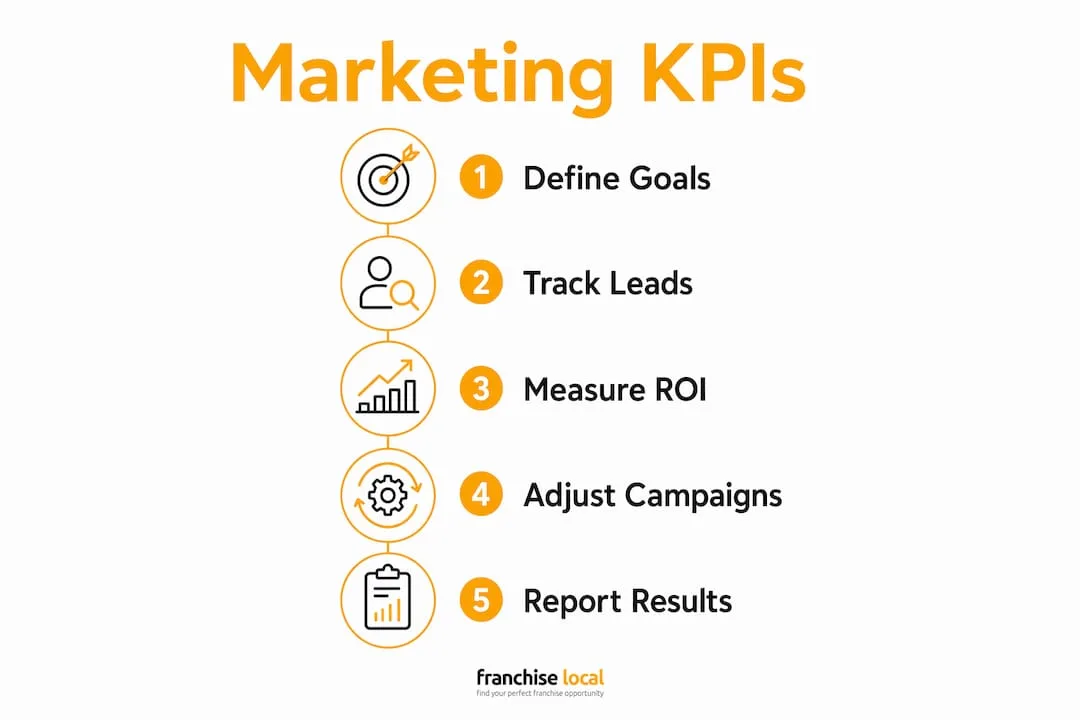
CRM systems and marketing dashboards give franchisors network-wide visibility. They show which territories are generating leads, which channels are converting, and where drop-offs occur in the recruitment pipeline. Regular reviews, monthly at minimum, allow both franchisors and franchisees to adjust spend and messaging before poor performance compounds. The goal is a feedback loop where data from every location informs the next campaign across the whole network.
7. Build local presence through PR and community engagement
PR is one of the most underused tools in the franchise marketing strategies toolkit. National media coverage builds brand credibility and supports franchise recruitment. Local PR drives direct enquiries for individual territories, often at a lower cost than paid advertising.
Community engagement works best when it is specific rather than generic. Sponsoring a local park run in Inverness, supporting a school fair in Kent, or partnering with a local charity in Cardiff gives each franchise location a genuine community presence. That presence builds the kind of trust that no national campaign can replicate. Franchisors should provide guidance on PR activity and community events as part of the central marketing toolkit, so franchisees know what is supported and what requires approval.
8. Expand local presence through collaborations and partnerships
Local partnerships extend a franchise’s reach without proportionally increasing its marketing spend. Cross-promotions with complementary local businesses, referral arrangements with community organisations, and sponsorships of local events all put the brand in front of relevant audiences who may not have encountered it through digital channels alone.
The most productive partnerships share a customer base without competing for the same sale. A fitness franchise partnering with a local sports retailer, or a children’s education franchise working with a nursery group, creates mutual benefit and genuine community credibility. Franchisors should identify partnership categories that work across the network and provide franchisees with a simple framework for approaching and formalising local arrangements.
9. Train franchisees in brand messaging and customer experience
Consistent customer experience is what makes a franchise brand worth choosing over a local independent. Every customer interaction, whether in person, on the phone, or online, should reflect the same values and standards. That consistency does not happen by accident. It requires structured training from the moment a franchisee joins the network.
Training should cover brand messaging, approved language for customer communications, complaint handling, and the standards expected at every touchpoint. Prospective franchisees in 2026 value personal engagement and transparency above all else. Franchisees who embody those qualities in every customer interaction become the most powerful marketing asset the brand has. Ongoing refresher training, brand audits, and peer learning sessions keep standards high as the network grows.
Ready to find a franchise opportunity that already has the brand infrastructure, marketing support, and local visibility tools in place? Explore business services franchises and hundreds of other opportunities across every industry on Franchiselocal, the UK’s most comprehensive franchise directory.