

Five categories decide whether a franchise is worth your money: costs, support and training, the legal contract, financial performance, and references. Ask these first.
- What is the total investment, including fit-out and working capital?
- What training is included, and who pays for travel and accommodation?
- What ongoing support does head office provide once I’ve opened?
- How was the financial projection calculated, and is it average or median?
- How many units have closed in the last five years, and why?
- What territory protection do I get, and does it cover online sales?
- Can I see the franchise agreement and operations manual before paying a deposit?
- What happens to my deposit if the site or lease falls through?
- Who owns the customer data I generate?
- Can I speak to at least three former franchisees?
Your single immediate ask, before anything else: “May I see the franchise agreement and a list of franchisee contacts?” Everything else follows from what those two documents reveal.
Commercial and operational questions to ask a franchisor
Once you’ve got the paperwork, the real conversation starts. This is where you separate a franchisor that runs a genuinely supported network from one that’s really just selling a licence and hoping for the best.
Start with the business model itself. Ask how the franchisor makes money from you specifically, not just from customers. Some earn most of their income from franchise fees and royalties; others rely heavily on supplier rebates or mandatory equipment purchases, which changes their incentive to help you succeed long term.
Questions on support and training:
- Who delivers pre-opening training, where does it happen, and how many days does it run?
- Is travel and accommodation included in the franchise fee, or an extra cost?
- What ongoing support exists after launch, monthly calls, an area manager, an annual conference?
- Is there a dedicated support contact, or does everyone route through a general helpline?
- What happens if I need extra training six months in? Is that chargeable?
Marketing is where vague answers cause the most financial pain later. Ask precisely what’s covered by any national marketing levy, whether local marketing spend is mandatory on top of that, and what launch support (leaflets, signage, a grand opening campaign) is actually included in the initial fee rather than billed separately. The British Franchise Association recommends probing this alongside the franchisor’s tenure and any history of franchisee failures, since weak marketing support and network attrition often travel together.
Supplier arrangements deserve equally blunt questions. Are you required to buy from named suppliers? Does the franchisor take a commission or rebate on those purchases? Who owns any equipment once it’s paid for, you or the franchisor? These details rarely appear in glossy brochures but sit in the operations manual, so ask to see that document alongside the agreement itself.

Finally, pin down timing. Ask for a realistic timeline from signing to opening day, and how much practical help you’ll get with site selection, lease negotiation, and initial recruitment. A franchisor with a genuine track record will have this mapped out in weeks, not vague promises.
Pro Tip: Ask for the timeline in writing, with named milestones. A franchisor who can’t produce this hasn’t opened enough units to know how long it actually takes.
Costs and financial performance: what figures to demand
Get the full cost breakdown before you get attached to the opportunity. That means the initial franchise fee, shop or unit fit-out, equipment, any refundable deposits, and a realistic working capital figure to cover the first three to six months of trading.
- What exactly does the initial franchise fee cover, and what’s billed separately?
- Which deposits are refundable, and under what conditions?
- What working capital should I hold back beyond the headline investment figure?
- Are there financing partnerships, and what are the typical repayment terms?
Ask for historical performance data or an Item 19-style disclosure covering existing units, not just a forecast built for prospective buyers. If the franchisor won’t share real trading figures from current franchisees, treat that reluctance as information in itself.
The averages trap: franchisors often quote an average turnover figure with no sample size attached. A projection built from five thriving flagship units looks nothing like the experience of unit forty, in a smaller town, with less footfall. Due-diligence guidance for UK franchise buyers urges caution here specifically: ask whether figures are average or median, how many units the sample includes, and whether underperforming locations were excluded.
The practical fix is simple. Take every projection to an accountant and ask them to stress test it against a conservative, moderate, and optimistic scenario before you commit a deposit.
Legal and contract questions for a specialist solicitor
Never rely on your own reading of a franchise agreement, however careful. A solicitor who specialises in franchise law will spot clauses that look standard but aren’t, and knows what “typical” looks like across the sector.
- Confirm which legal entity you’re actually contracting with, and who owns the trade marks and licence rights you’re being granted.
- Ask which documents together form the full contract package: the agreement, the operations manual, and any side letters covering verbal promises.
- Establish the term length, renewal mechanics, and every ground on which the franchisor can terminate the agreement.
- Get clarity on territory and exclusivity wording, including whether online sales are carved out of your protected area.
- Ask about transfer and resale conditions, and how any linked lease interacts with the franchise term.
A franchise agreement review by a specialist solicitor should cover exactly these points: term, renewal, territory rights, restrictions on sale, and grounds for termination. If a franchisor makes a verbal promise about support, marketing spend, or territory, ask for it in writing. Verbal assurances are notoriously difficult to enforce, so insist on a side letter or a specific clause instead of a handshake. This single habit, from reviewing the legal documents properly before signing, catches more problems than any other step in the process.
Verifying what the franchisor tells you
Don’t take claims at face value. Search Companies House for the franchisor’s legal entity, check filed accounts for revenue trends and debt levels, and note any frequent director changes or previously dissolved companies linked to the same people. Franchise due-diligence guidance treats this as a baseline check, not an optional extra.
- Request a reference list and aim to speak with 10 to 15 franchisees, not the two or three the franchisor volunteers.
- Include long-tenured franchisees, others trading in similar markets to yours, and at least three who left the network in the past year.
- Compare what the sales meeting promised against the actual agreement and operations manual, and flag every discrepancy in writing.
Pro Tip: Curated references are rarely representative. Broadening the sample to include people who left is the fastest way to hear what the brochure won’t tell you.
Red flags and the questions that expose them
Certain patterns should stop you before you go further. Frequent unit closures, a franchisor who dodges requests for former franchisee contacts, vague deposit and refund terms, or financial figures that shift depending on who’s asking: all of these are warning signs worth taking seriously.
Put the uncomfortable questions directly. Ask: “How many franchised units have closed in the last five years, and why?” Ask: “Can I speak to a franchisee who left in the last 12 months?” A confident, established franchisor answers both without flinching, often naming specific reasons for each closure.
- Evasive answers about closures usually mean there’s something worth hiding.
- Refusal to provide former franchisee contacts is one of the strongest signals to walk away.
- Inconsistent numbers between the sales pitch and the written disclosure should never be waved off as a rounding error.
If a franchisor won’t put an answer in writing, insist on it before paying anything, or treat the silence as your answer. That single habit filters out the weakest opportunities faster than any amount of desk research.
Franchisee obligations and expected workload
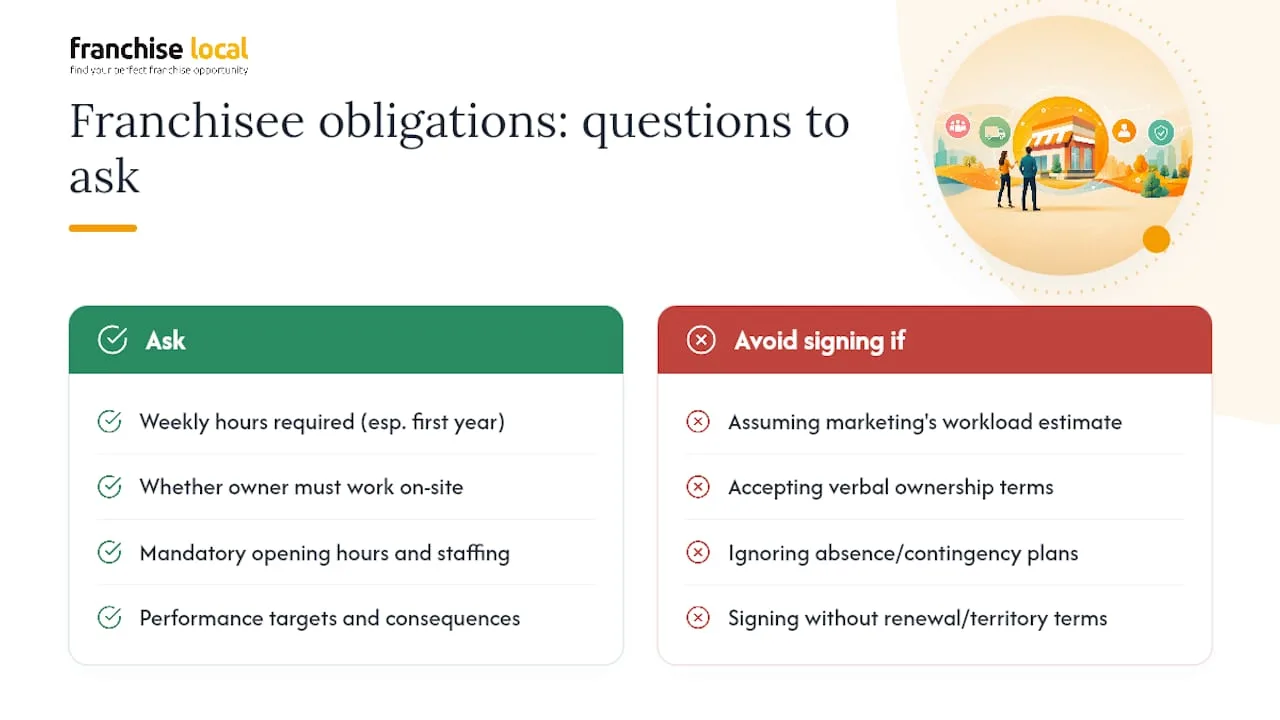
Every franchise agreement sets out what you’re required to do, and those obligations are usually more demanding than the marketing suggests. Ask exactly how many hours a week the business realistically needs from you, especially in the first year, and whether that’s manageable alongside any other commitments.
Clarify whether you’re required to work in the business yourself or whether you can run it as a manager from day one. Some franchisors insist the owner works full time on-site for the first twelve months; others are relaxed about absentee ownership from the start. Get this in writing, because it changes your staffing costs and your personal life significantly.
Ask about mandatory operating hours, minimum staffing levels, and any requirement to hit performance targets to retain your territory or renewal rights. Some agreements include clauses letting the franchisor step in, or even terminate, if you consistently underperform against benchmarks you may not have negotiated.
Finally, ask what happens if you’re unwell or want time away from the business. A franchise with no contingency for owner absence puts significant strain on you personally, and that’s worth knowing before you sign rather than after.
Dispute resolution and legal protections for franchisees
Ask how disagreements get resolved before you’re in one. Most UK franchise agreements specify mediation or arbitration as a first step rather than court action, and some name a specific arbitration body. Find out which, and ask what it costs to trigger that process.
Establish whether the agreement is governed by English law (or the relevant jurisdiction for Scotland or Northern Ireland) and where any hearing would take place, since a clause naming a distant jurisdiction can make disputes prohibitively expensive to pursue.
Ask specifically what happens if the franchisor breaches its own obligations, missed support commitments, failure to deliver promised marketing, and whether you have a genuine remedy or just a right to complain. A solicitor specialising in franchise law can flag whether the termination and remedy clauses are balanced or heavily weighted towards the franchisor, which is common in poorly drafted agreements.
UK franchisees don’t currently have bespoke statutory protection equivalent to some other markets, so the agreement itself is your main safeguard. That makes the quality of the contract, and the solicitor who reviews it, more important than in almost any other kind of business purchase.
Franchisor’s growth strategy and market positioning
Ask where the franchisor sees the brand in five years, and whether that growth plan changes your own position. A franchisor aggressively opening new territories nearby, even outside your protected area, can still affect your local brand recognition and supplier pricing power.
Find out how many units they plan to add annually, and in which regions. Rapid, poorly resourced expansion is a genuine risk signal: a franchisor stretching training and support teams across dozens of new openings a year may struggle to give you the attention promised in the pitch.
Ask how the brand positions itself against competitors, and whether that positioning has shifted recently. A brand pivoting from budget to premium, or widening its product range significantly, may be a sign of a business finding its feet, or one masking weaker unit economics with a change of story. Either way, you deserve a straight answer about which it is.
Marketing support and brand advertising contributions
Ask exactly what the marketing or brand fund pays for, national television and digital campaigns, local search advertising, or mostly head-office salaries. Franchisors rarely volunteer this breakdown unprompted, so ask for a summary of how last year’s fund was actually spent.
Establish whether you’re required to spend additional money locally on top of the central levy, and what minimum that typically runs to. Ask whether you have any say in local campaigns, or whether all creative and media buying is dictated centrally regardless of your specific market.
Finally, ask what launch marketing support is included in your initial fee versus billed as an extra. A franchisor who bundles a generous local launch campaign into the fee is investing in your first months trading; one who charges separately for every leaflet is signalling where their priorities sit.
Typical timeframes to break even or reach profitability
Ask the franchisor directly how long it typically takes new units to break even, and request that figure alongside the number of units it’s based on. A answer drawn from three flagship locations tells you far less than one drawn from twenty units opened in the last three years.
Timeframes vary enormously by sector: a low-cost, home-based franchise might reach profitability within months, while a franchise requiring a leased premises, fit-out, and staff can take a year or more before it turns a genuine profit. Ask the franchisor to explain why their sector sits where it does on that spectrum.
Push for the range, not just the average. Ask what the slowest unit to break even actually experienced, and why. That answer, more than any glossy projection, tells you what you’re really signing up for. Then take the figures to an accountant and ask them to model your own likely timeline against your specific costs, location, and starting capital, rather than accepting the franchisor’s number as gospel.
Use Franchiselocal to shortlist and screen UK opportunities faster
Running every one of these checks against dozens of franchisors by hand takes weeks. Franchiselocal exists to shorten that legwork: a searchable UK directory filtered by industry, investment level, and lifestyle fit, so you’re only spending your due-diligence time on opportunities that genuinely suit your budget and circumstances.
Before you draft a single email to a franchisor, run your numbers through the affordability calculator to see what investment level is realistic, then use the ROI estimator to sanity-check any projections a franchisor sends you against your own assumptions. Browse trending franchise opportunities to see which brands are attracting genuine interest right now, then take your shortlist and work through the checklist above, franchise agreement, financial figures, and franchisee references, before any deposit changes hands. None of this replaces a solicitor or an accountant. It simply means you walk into those conversations with the right questions already answered.
This article is general information, not a substitute for advice from a qualified lawyer. Consult a qualified legal professional about your own circumstances before acting on anything here.
FAQ
What is the single most important question to ask a franchisor?
Ask to see the franchise agreement and a full list of current and former franchisee contacts. Everything else you learn depends on how readily and completely they provide both.
How many franchisees should I speak to before deciding?
Aim for a balanced number, including long-tenured owners, franchisees in similar markets to yours, and some who have recently left the network.
Should I hire a solicitor even for a low-cost franchise?
Yes. Franchise agreements carry the same structural risks regardless of the initial fee, term length, territory wording, and termination clauses matter whether you’re investing £5,000 or £50,000.
What financial disclosure questions to ask franchisors should I prioritise?
Ask how any performance projection was calculated, whether it reflects average or median outcomes, and how many units the sample includes. Then have an accountant stress test the figures.
Are franchise disclosure questions different from general franchise agreement questions?
They overlap significantly. Disclosure questions focus on financial performance and network history; agreement questions focus on contract terms, territory, and termination. A thorough due diligence process covers both.