

A good franchise enquiry form does two jobs at once. It makes it easy for a serious candidate to get in touch, and it gives you enough information to decide who deserves a first call. Aim for seven to ten fields, split across two or three short steps. Ask for contact details first, then budget, location and timing, and finish with one open question. Add plain-English privacy wording beside the submit button.
This guide covers the fields to use, the order to put them in, how to word qualifying questions, and what UK data protection rules mean for the form. It is written for franchisors and franchise brokers building or rebuilding a franchisee enquiry page.
What your enquiry form is really for
Most templates treat the form as a contact box. For a franchisor it is the first stage of a selection process.
The numbers explain why. According to The Franchise Consultant, conversion from first enquiry to signed agreement is typically a low single-digit percentage. In a sector such as care, a realistic benchmark can be around 1 in 110 enquiries. If that is your funnel, the form has to help you spend time on the candidates most likely to complete.
That changes the design brief. A form that is too short fills your inbox with people who have not thought about money, territory or timing. A form that is too long loses the good candidates. The aim is a form that is brief enough to finish in about two minutes and specific enough to sort people.
The discipline matters beyond the form. Entrepreneur UK argues that networks struggle when recruitment is left to hope rather than run as a system. Strong franchisors are prepared to turn away applicants who do not fit a replicable model, even when those applicants could pay the fee. Your form is where that system starts.
The fields that earn their place
Every field has a cost. Each one you add lowers completions, so each needs a reason. Here is a practical set, with the reason behind each.
| Field | Type | Why it is there |
|---|---|---|
| First name and surname | Text | Lets the first call be personal |
| Email address | Email, validated | Primary channel for the information pack |
| Mobile number | Telephone | Most first conversations are by phone |
| Postcode or town | Text | Maps to available territories |
| Investment range | Dropdown of bands | Filters on affordability without asking for exact figures |
| Funding source | Dropdown | Cash, savings, remortgage, bank loan or not sure |
| Time to start | Dropdown | Separates active buyers from early browsers |
| Business background | Short dropdown | Employed, self-employed, business owner, other |
| Why this franchise? | Optional text | Shows how much thought they have given it |
| Privacy and contact preference | Checkbox and notice | Records what they agreed to and how you may contact them |
That is ten fields, and several are single clicks. Name, email and phone are typed, but the rest can be answered in seconds.
Fields to leave out at the first stage
Some questions belong later, in a conversation or a formal application.
- Exact net worth or bank details. Ranges are enough at this point. Asking for precise finances in a web form feels intrusive and creates data you must then protect.
- Date of birth, education history and similar personal detail. Some older paper forms ask for these. They add friction without improving your decision.
- Long essay boxes. One optional free-text field is useful. Three are a barrier.
- Anything you will not use. If nobody reads the answer, remove the question.
If you want to think about the whole candidate journey after the form, how franchise lead forms work is a clear primer, and the franchise enquiry form best practices guide goes deeper on lead quality.
Order, length and layout
The order of the questions affects how many people finish. A sensible principle is easy first, sensitive last.
A three-step layout
- Step one: who you are. Name, email, mobile. Three fields feel quick, and a candidate who has typed them is more likely to continue.
- Step two: your plans. Postcode, investment range, funding source and time to start. These are all selections, so they feel light even though they carry the most qualifying value.
- Step three: your story. Background, the optional “why this franchise” box, the privacy notice and the submit button.
A progress indicator such as “Step 2 of 3” helps. If you prefer a single page, keep the same grouping with clear sub-headings and keep the whole form visible without long scrolling on a phone.
Design details that matter on mobile
Many first enquiries are made on a phone, so check the basics.
- Use one column. Side-by-side fields are hard to tap and read on a small screen.
- Set the right keyboard for each field: numeric for phone, email layout for email.
- Put labels above fields, not inside them as placeholder text that disappears once typing starts.
- Make tap targets large and spaced apart.
- Make the submit button say what happens: “Request your information pack” is clearer than “Submit”.
- Do not use a CAPTCHA that asks people to identify blurry images. A hidden honeypot field catches most spam without annoying real candidates.
Qualifying questions that do not put people off
The best qualifying questions feel helpful to the candidate. They show that the franchise has real requirements, which is reassuring to a person about to invest their savings.
Investment range
Use bands that match your model. If your total investment is, say, in a mid five-figure range, offer bands around it, with a lower band such as “Under what the franchise costs” avoided. Instead, a simple band set works: a few steps below your minimum, your own range, and above it. People below your range can then be pointed politely to a lower-cost opportunity rather than sitting unanswered in a queue.
If you are not sure where candidates sit, the client-side tool Franchise Affordability Calculator is the kind of thing a candidate can use before they fill in your form, which means the people who reach you have already tested their numbers.
Funding source
Asking how the investment will be funded tells you more than asking for a figure. Savings, a remortgage, redundancy payment or a bank loan each imply a different timeline and a different conversation. Include “not sure yet” as an option. It is honest, and it flags someone who needs more guidance rather than less.
Time to start
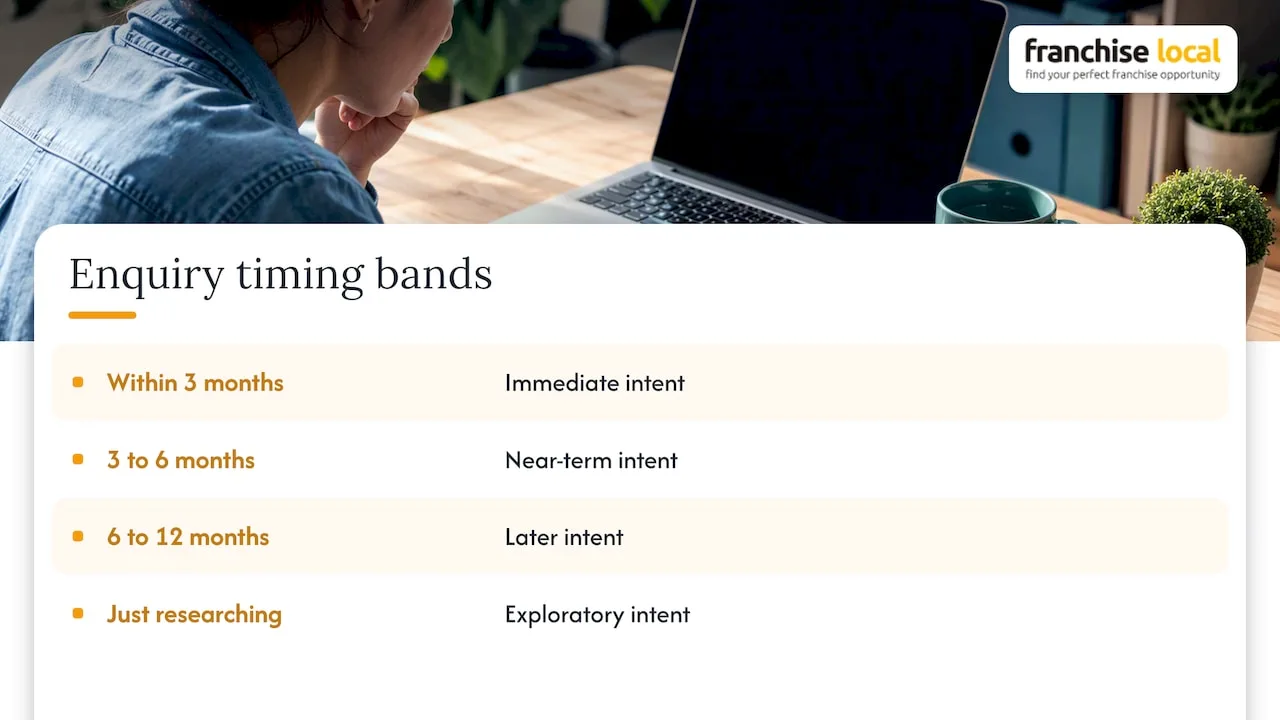
Bands such as “within 3 months”, “3 to 6 months”, “6 to 12 months” and “just researching” let you prioritise follow-up without judging anyone. A researcher is not a bad lead. They simply need a different sequence of emails from an active buyer.
Territory
A postcode lets you check availability before you call. If the area is taken, you can say so in the first message and offer the nearest alternative. That honesty saves both sides time. Our regions page shows how candidates often start by browsing by area, so territory is on their minds from the beginning.
The open question
One optional box: “What attracts you to this franchise?” The answers are revealing. A candidate who mentions your training, your product or their own local market has done homework. A blank box is not a reason to reject someone, but a thoughtful answer is a useful signal when you are choosing whom to call first.
For a fuller treatment of scoring and sorting, see franchise lead qualification strategies.
Wording, labels and error messages
Copy is part of design. The words on a form decide whether it feels like a conversation or an interrogation.
- Headline above the form. Say what the candidate gets: “Request your franchise information pack”. Avoid vague headings such as “Contact us”.
- A line of reassurance. For example, “We reply within one working day”, but only if you do. Do not promise a speed you cannot match.
- Plain labels. “Mobile number” beats “Telephone (primary contact)”.
- Explain why you ask. A short hint under the investment field, such as “This helps us match you with the right opportunity”, reduces drop-off on sensitive questions.
- Helpful errors. “Please enter an email address like [email protected]” is better than “Invalid input”. Keep what the user has already typed when an error appears.
- A real confirmation page. Tell the candidate what happens next, who will contact them and roughly when. Include a link to a useful next step, such as a download or a video.
Keep the tone confident and welcoming. A franchise enquiry is a moment of optimism for the candidate, and the form should match it.
Data protection on the form
A franchise enquiry form collects personal data, and in the UK that brings legal duties. This is not an optional design layer.
The Information Commissioner’s Office (ICO) says that when you collect information for direct marketing, you must tell people you intend to use it that way, be clear about what you will do, and make your privacy information easy to understand. In practice, that translates into several design choices.
- Put privacy information at the point of collection. A short notice directly beside the submit button, linking to your full privacy policy, is better than a footer link nobody sees.
- Say who you are and what you will do. For example: who the franchisor is, that you will use the details to reply about the franchise, and whether you will send further marketing.
- Keep marketing choices separate. If you want to send newsletters or offers beyond the enquiry reply, ask separately and make the choice clear. Do not pre-tick boxes.
- Make it easy to opt out later. Every follow-up message needs a way to stop receiving it.
- Collect only what you need. The fewer fields you include, the less you have to justify and protect.
- Record what was shown. Keep a note of the wording and the date the candidate saw it, so you can demonstrate what they were told.
A useful test: if you cannot explain your use of the data in plain language beside the form, the plan itself may need a rethink. The ICO also publishes a direct marketing checklist that you can work through before launch. For the wider paperwork, our guide to making your franchise ICO ready lists the core documents. If your form passes data to a broker or directory, your privacy notice should say so. If you are unsure about your lawful basis, speak to a data protection adviser or solicitor before going live.
What happens after the click
The best-designed form wastes its value if the follow-up is slow or generic. Treat the submission as the start of a sequence.
- Instant confirmation by email. Repeat what the candidate asked for and set expectations.
- Route by answers. Active buyers with matching budget and an available territory go to a person quickly. Researchers go into an information sequence. Candidates outside your range receive a courteous reply.
- First call. Use the form answers so you are not asking the same questions again. Candidates notice when you have read what they wrote.
- Log everything. A CRM entry per enquiry shows which fields predict later success. Over time, use that data to change the form.
The UK franchise sales funnel guide covers directories and CRM tools for this stage, and the franchise recruitment guide puts the form in the context of your whole recruitment plan.
How to test and improve the form
Change one thing at a time and measure. Useful metrics are completion rate, the share of enquiries that reach a first call, and the share of those that reach a second meeting. Review the form every quarter. If many unsuitable candidates get through, tighten the investment bands. If good candidates abandon at step two, ask whether a question is too sensitive or poorly worded.
Where to find serious candidates
A well-built form needs candidates who arrive with intent. Franchise Local is a UK directory where people search franchises by investment level, industry, lifestyle and location, so the visitors who send an enquiry have usually compared options first. Browse the UK franchise opportunities to see how listings are presented, or see what candidates are currently looking at on the trending franchises page.
Common mistakes to avoid
- Copying a generic template without editing it. Free templates are a starting point. They often ask for details that suit another model or another country.
- Asking for everything at once. A wall of fields on one screen puts people off.
- Hiding the privacy notice. It must be visible and understandable where data is collected.
- No territory check. Candidates waste time on areas you have already sold.
- Vague confirmation. “Thanks, we’ll be in touch” gives no timing and no next step.
- Never reviewing the data. The form should evolve with what your closed deals show.
FAQ
How many fields should a franchise enquiry form have?
Seven to ten is a good range for most UK franchisors. Include contact details, location, investment range, funding source, timing and one optional open question. Several of these can be dropdowns, which are quick to complete. Add fields only when you will use the answers.
Should I ask about budget on the first form?
Yes, but ask for a range rather than an exact figure. Bands let you filter fairly without making candidates uncomfortable. Add a short note explaining that the question helps match them with the right opportunity.
Do I need consent for a franchise enquiry form under UK rules?
You must give clear privacy information at the point you collect data, and be transparent about any direct marketing, as the ICO guidance explains. Whether you need consent depends on what you plan to do, such as sending marketing emails. Check your position with a data protection adviser or solicitor.
Is a short form or a long form better?
Short forms get more submissions, long forms get fewer but better-qualified ones. A multi-step form with about ten light questions is a sensible middle. Test both against how many enquiries reach a first call, not just how many arrive.
What should the confirmation page say?
Say who will contact the candidate, how, and roughly when. Add one useful next step, such as a short video or information download. It reassures the candidate and reduces repeat enquiries.