

Franchise listing photos should show the real business: the premises or van, the service in use, the team at work and the equipment. They should also be legally cleared for use. For franchisors, that means original or properly licensed images. For buyers, it means treating photos as a first screen, never as proof that a franchise will make money.
This guide covers both sides. If you list a brand, you will find the shot list, the rights checks and the caption rules. If you are searching for a franchise, you will find what a gallery can tell you, what it cannot, and the questions to ask next.
Why photos matter on a franchise listing
A buyer scanning a directory makes fast decisions. Price, sector and territory narrow the field. Photos then answer a different question: what would my working day look like?
A good gallery helps a reader picture the operation. Is it a shopfront, a mobile van, a home office or a commercial kitchen? Is the franchisee on site, on the road or at a desk? Those details affect lifestyle fit as much as the investment figure does.
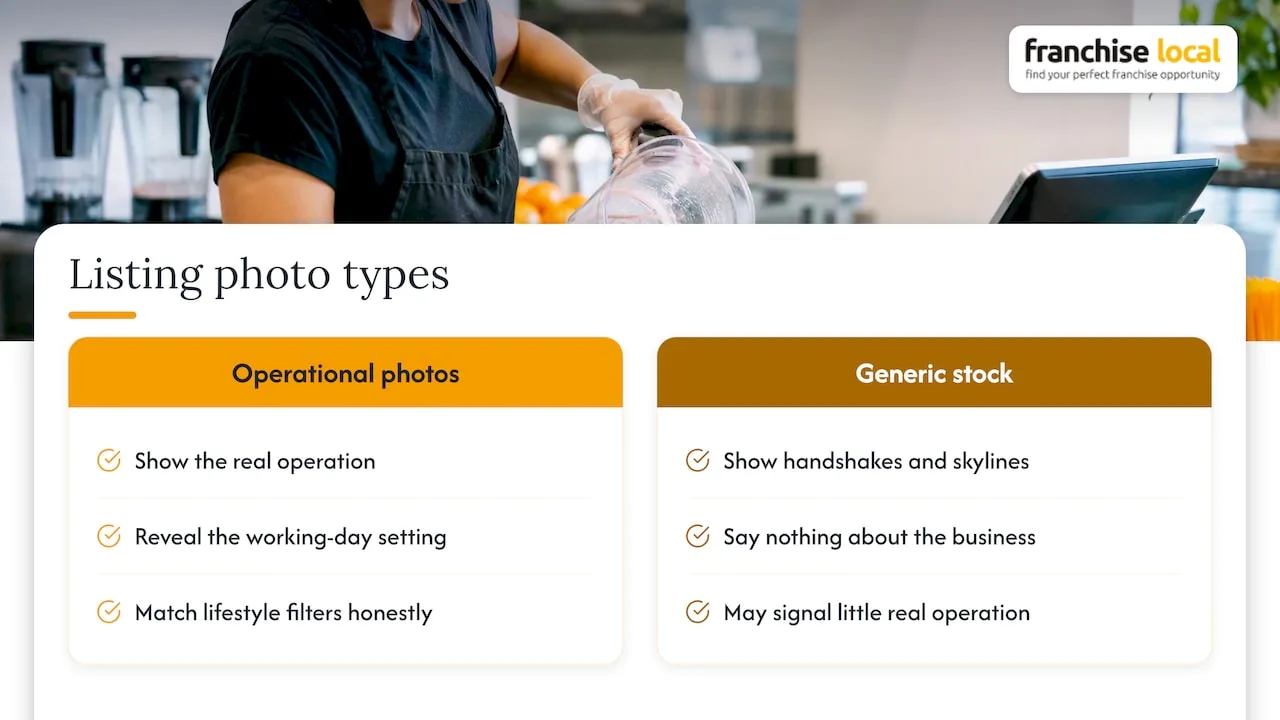
Photos are also where trust is won or lost. Generic stock images of handshakes and skylines say nothing about the business. A buyer cannot learn anything from them, and many will read them as a sign that the franchisor has little real operation to show.
On Franchise Local, listings sit beside filters for price, industry, lifestyle and location. The images work best when they match those filters honestly: a listing tagged “Home Based” should show what home-based work actually involves.
The shot list: what a complete photo set includes
There is no official image count. The set below is an editorial practice built around one aim: representing the real franchise accurately. Aim for six to ten images that cover these areas.
- Brand or storefront. A clear image of the brand in its real setting: signage, a vehicle livery or a unit exterior.
- Real premises or mobile-service context. Show where the work happens. For a van-based franchise, show the van loaded and ready. For a retail unit, show the interior.
- The product or service in use. A cleaned kitchen, a delivered parcel, a completed job. Show the result a customer pays for.
- A franchisee or team at work. Real people doing the job, not posed models.
- Equipment and delivery method. Machines, tools, software screens and the training kit supplied. Buyers want to know what they are buying into.
- A location-neutral operational image. One shot that shows the process without tying it to a single territory, so it stays accurate across the network.
How each image earns its place
| Image type | What the buyer learns | Common mistake |
|---|---|---|
| Storefront or livery | Brand visibility and set-up style | Showing a flagship site that new franchisees will not resemble |
| Premises or vehicle | Working environment and space needs | Using a rendered or staged image |
| Service in use | The customer proposition | Generic stock imagery |
| Franchisee at work | Day-to-day reality, owner-operated or management-led | Models rather than real franchisees |
| Equipment | Start-up kit and training demands | Close crops with no context |
| Process image | How the business runs anywhere | Over-edited visuals that hide real conditions |
The aim is evidence, not decoration. If an image does not help a buyer understand the business, replace it.
Photo rights: why “found online” is never a licence
This is where many listings go wrong. A photo from Google Images, a social network or another website is not free to reuse. GOV.UK explains that photographs and online images will generally be protected by copyright, and that permission is normally needed to copy or share them online. The Copyright Hub takes the same line on images taken from search engines, social media and books.
An image credit does not replace permission. For each photo on a listing, you need documented consent to use it in that way.
Commissioned photography: licence or assignment
Paying a photographer does not automatically hand you unlimited rights. GOV.UK’s guidance on licensing copyright material explains that a licence can be limited by the rights granted, by time or in other ways. The creator is generally the first owner of the copyright, subject to employment and contractual circumstances.
So agree the following in writing before the shoot:
- whether copyright is assigned to you or licensed to you
- whether website and directory use is covered
- whether paid advertising and social media are covered
- whether cropping and editing are allowed
- how long the permission lasts, and in which territory
- whether group companies, agencies and franchisees can use the images
- whether the photographer may use the images in a portfolio
Keep a rights file
Treat image rights as an ongoing process, not a one-off upload. For every image, keep together:
- the licence or contract
- the invoice
- the source URL, if it came from a library
- the approved uses
- the expiry or review date
- the exact version of the image used
Without the right version on file, a website redesign or a reused social thumbnail can leave you unable to prove permission. That matters more for a franchisor than for most businesses, because the same images often flow out to every franchisee and every directory that carries the brand.
People, premises and trade marks
Copyright ownership is only one check. LexisNexis legal guidance on commercial photography flags further risks: identifiable people, children, private premises, third-party artwork, packaging and trade marks. Each needs its own release or permission.
In practice:
- Get written consent from franchisees and staff who appear in a photo, and say where it will be used.
- Avoid children unless you have proper guardian consent.
- Check the background for other brands, artwork and packaging.
- Never imply that a person or another brand endorses the franchise unless that is authorised.
If you have any doubt about a particular image, ask an IP solicitor before publishing it. It is cheaper than a takedown demand.
Captions and alt text that describe what is shown
Captions and alt text should say what the picture actually shows. “Franchisee cleaning a commercial extraction canopy” is useful. “Best franchise opportunity UK” is keyword stuffing and tells a screen-reader user nothing.
A few rules for a clean listing:
- Describe the subject, the setting and the action in a short phrase.
- Say whether the image shows a company-owned site, a franchisee’s site or a training environment.
- Do not describe an image as a typical result unless it is one.
- Avoid “stock” imagery claims. If a picture is illustrative, label it as illustrative.
That last point links to a wider issue: a familiar brand does not always tell you who owns the outlet.
Why visual clarity on ownership matters
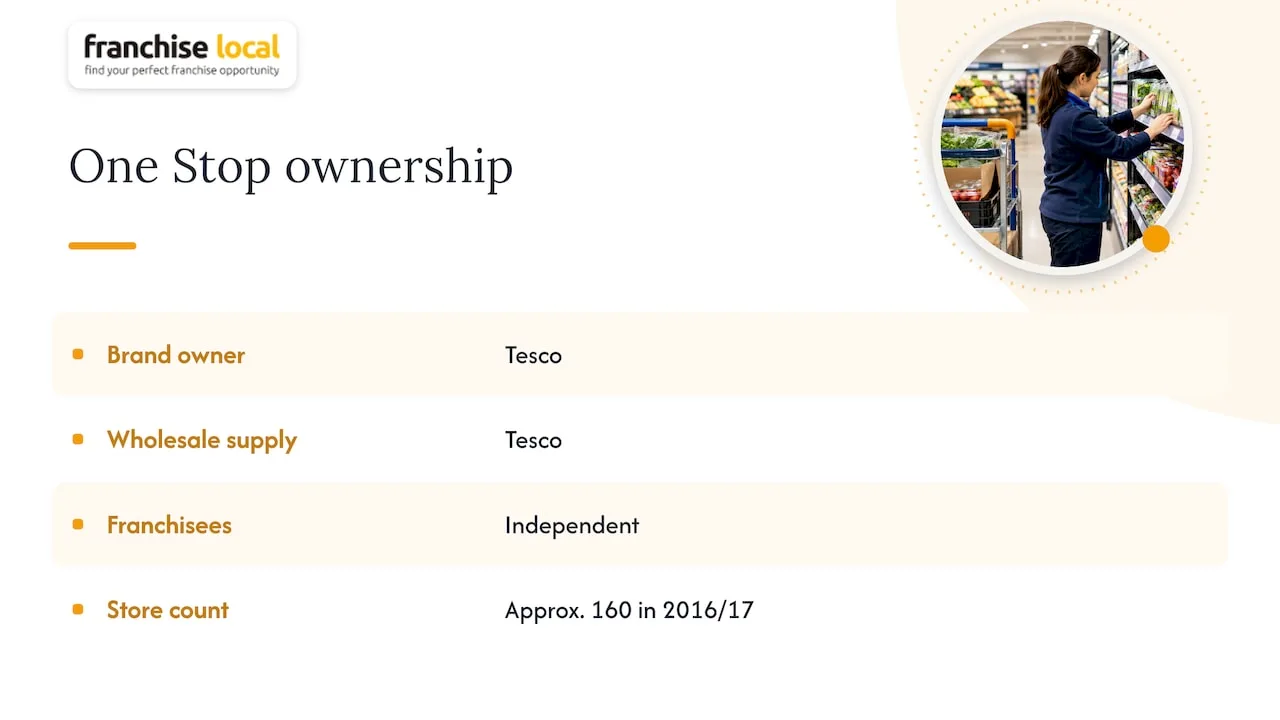
The grocery trade shows the problem well. The Competition and Markets Authority’s summary of the Tesco and Booker merger describes One Stop as a franchise in which Tesco owns the brand and provides wholesale supply, while the franchisees stay independent. The same document puts the number at approximately 160 stores in its 2016/17 evidence. That is a historical figure, not a current count.
So is Tesco a franchise? Mostly not: Tesco is primarily a corporate retailer, but it has operated franchise arrangements. A shopper looking at a familiar fascia cannot tell which kind of outlet it is. BBC reporting from 2017 on Booker described the wholesaler’s wider network of affiliated convenience brands in the same way, as a mix of ownership models behind familiar names.
For listing photos, the lesson is simple. Show images that match the business model you are selling. If the opportunity is an independent franchise under a supplier’s brand, say so in the caption or the listing text. Distinguish the franchisor, the franchisee, any symbol-group affiliation and any company-owned sites.
How buyers should read franchise listing photos
If you are searching rather than listing, here is a practical way to use the images.
What a gallery can tell you
- Working environment. Van, unit, office or home. Check it against the lifestyle you want.
- Equipment. Does the kit look like something you can learn and afford to maintain?
- Owner-operated or management-led. Are the people in the photos doing the work, or supervising?
- Brand consistency. Do the images show a coherent, professional system across several locations?
What a gallery cannot tell you
A photograph is promotional material. It cannot show profit, churn, hidden costs or how support works once you have signed. The British Franchise Association’s advice is to go well beyond that material. Its questions to ask your franchisor cover the financial fit, initial fees, working capital, training, ongoing support and the franchise agreement itself. It also recommends speaking to existing franchisees.
Use photos to generate questions. If you see a premium storefront, ask what the fit-out cost and who pays. If you see a van, ask who supplies it and what it costs to brand. If you see a team, ask how many franchisees have left the network and why.
Next steps after the first screen
- Shortlist three to five franchises using filters for price, sector, lifestyle and location.
- Read each listing’s cost, territory, support and franchise type alongside the photos.
- Request the franchisor’s information pack and a copy of the franchise agreement.
- Speak to several existing franchisees, not only those the franchisor suggests.
- Take the agreement to a specialist franchise solicitor.
The last step matters because, according to GOV.UK Business Academy, UK franchising has no dedicated franchising statute. That makes the agreement the key document. It governs fees, support, territory, renewal, resale and exit. No gallery can stand in for it.
Our own guides go deeper on each stage: the franchise due diligence checklist, the seven legal considerations for UK buyers, and a 30 day background check plan. To understand what happens when the contract ends, read about franchise renewal terms and agreement termination.
Where to look for UK franchises
Photos are only one input. The British Franchise Association describes itself as the UK sector’s self-regulatory body. Its 2026 guidance says the member directory holds more than 350 members, a dated figure that may change. It also advises due diligence and using a franchise solicitor. Franchise exhibitions are another route, and they let you meet franchisors in person.
Online, a directory lets you compare many brands at once. Use sector pages to understand the market before you narrow down. Our guide to franchise industry sectors explains how the categories are defined, and the industries page lets you browse by sector.
Find your next franchise on Franchise Local
We list UK franchise opportunities across industries, investment levels and lifestyle types. You can filter by price, sector, lifestyle and location, from home-based options to larger investments, and see which brands are trending now. If you want a wider view, browse our list of the best UK franchise opportunities. Some listings also carry video, such as the FiltaTech franchise videos, which show the operation in a way a still image cannot.
Searching is free for buyers. Franchisors and brokers who want to reach qualified buyers can list with us, and a complete, properly licensed photo set is the best way to make a listing work.
A quick checklist for franchisors
Before you upload a gallery, run through this list.
- Every image is original, commissioned under a written licence or assignment, or licensed from a library for this use.
- The rights file holds licence, invoice, approved uses, review date and the exact image version.
- Releases cover every identifiable person, and no third-party brands appear by accident.
- The set shows premises or vehicle, service in use, team, equipment and process.
- Captions and alt text describe what is shown, in plain words.
- Nothing implies guaranteed earnings or a typical result you cannot support.
- The listing text states the ownership model, so a familiar brand name does not mislead.
FAQ
What photos should a franchise listing include?
Include a clear brand or storefront image, the real premises or mobile-service context, the service in use, a franchisee or team at work, the equipment, and one location-neutral operational image. This is an editorial practice, not a legal requirement. Choose images that help a buyer understand the business.
Can I use photos from Google Images on my listing?
No, not without permission. GOV.UK says photographs and online images will generally be protected by copyright, so you normally need consent or a licence. Keep that documentation on file for every image.
Is Tesco a franchise?
Tesco is primarily a corporate retailer, but it has operated franchise arrangements. The CMA described One Stop as a franchise in which Tesco owns the brand and provides wholesale supply while franchisees remain independent. So the accurate answer is that Tesco has franchise operations, not that every store is franchised.
How can a photographer make money selling stock photos in the UK?
A photographer normally licenses the copyright rather than selling an image outright. GOV.UK explains that a licence can be limited by rights, time or other conditions. Income depends on those terms and on demand, and official guidance gives no reliable earnings figure.
Where can I find and buy a franchise in the UK?
Use a directory such as ours to compare franchises by sector, cost and support. Add the British Franchise Association’s member directory and franchise exhibitions. Then speak to existing franchisees and have a specialist franchise solicitor review the agreement before you sign.
Sources
- Copyright notice: digital images, photographs and the internet, GOV.UK
- License, sell or market your copyright material, GOV.UK
- Commercial use of photographs in the UK, LexisNexis
- Anticipated acquisition by Tesco PLC of Booker Group plc, CMA summary
- What does Booker Group do? BBC News
- Questions to ask your franchisor, British Franchise Association
- Advice for individuals, British Franchise Association
- The Franchise Agreement, GOV.UK Business Academy