

Many entrepreneurs assume that becoming a franchisor simply means licensing a brand and collecting royalties. That assumption is dangerously incomplete. A franchisor’s role spans legal architecture, operational governance, ethical leadership, and continuous people development. Every decision a franchisor makes ripples through the entire network, shaping whether franchisees thrive or struggle. If you are evaluating a franchise opportunity in the UK, understanding what franchisors actually do, and what they are obligated to deliver, will sharpen your due diligence and protect your investment from day one.
Key Takeaways
| Point | Details |
|---|---|
| Franchisor’s real scope | The franchisor designs, operates, and supports the business system, not just the brand. |
| Legal and ethical duties | UK franchisors must navigate complex contract law, compliance, and adhere to ethical codes. |
| Support drives success | Ongoing training and operational help from franchisors are vital for franchisee profitability. |
| UK market context | Franchising in the UK is robust, profitable, and governed by clear, contract-based expectations. |
| Emerging challenges | Balance of support versus control is the key challenge facing franchisors—get it right early. |
What is a franchisor? Defining the foundational role
A franchisor is the originating business owner who grants third parties, known as franchisees, the right to operate under their brand, systems, and processes in exchange for fees or royalties. But that one-line definition barely scratches the surface. In practice, a franchisor is the architect of an entire business ecosystem, responsible for designing the rules, maintaining the standards, and nurturing the people who deliver the brand promise every single day.
One of the most common misconceptions held by prospective franchisees is that the franchisor’s job ends once the franchise agreement is signed. In reality, that moment is just the beginning. Franchisors draft and provide franchise agreements outlining rights and obligations, provide initial and ongoing training, support, and guidance to franchisees. The agreement is a living relationship, not a transaction.
To understand the breadth of the role, consider what a franchisor is typically responsible for:
- Developing and protecting the brand identity, including trademarks and intellectual property
- Creating the operational manual that governs how every unit is run
- Recruiting and vetting franchisees who are the right cultural and commercial fit
- Setting quality standards and conducting regular audits to maintain consistency
- Providing a replicable business model that a franchisee can follow without reinventing the wheel
- Evolving the system in response to market changes, consumer behaviour, and regulation
The franchise model explained in detail reveals that the relationship is fundamentally interdependent. A franchisor’s commercial success is directly tied to franchisee performance. When franchisees fail, the brand suffers. When the brand suffers, every franchisee in the network feels the impact.
“The franchisor is not a landlord collecting rent. They are a partner invested in every unit’s performance, because the network is only as strong as its weakest location.”
This interdependency is why serious franchisors invest heavily in selection, training, and ongoing support. It is also why prospective franchisees should scrutinise the franchisor’s track record just as carefully as the financials.
Core responsibilities: Legal, operational, and support duties
Building on the foundational definition, let us look at what responsibilities franchisors carry in practice. The scope is broader than most people expect, and it touches every stage of the franchisee journey.
Franchisors develop the business system, brand, and standards; franchisees operate the system. This division sounds clean on paper, but in practice it requires constant communication, documentation, and refinement. Here are the core duties in sequence:
- Designing the business system with documented processes for every operational function
- Drafting the franchise agreement with clear terms on fees, territories, renewal rights, and exit conditions
- Providing a pre-launch training programme covering operations, marketing, compliance, and customer service
- Supplying ongoing training as products, regulations, or systems evolve
- Offering field support through dedicated franchise development managers or support teams
- Managing national marketing and brand campaigns that benefit the whole network
- Updating the operations manual to reflect best practices and legal changes
Pro Tip: Before signing any agreement, ask the franchisor for a copy of their operations manual index. A well-structured, regularly updated manual signals a mature, well-run franchisor. A thin or outdated manual is a red flag.
The table below illustrates how responsibilities are typically divided between franchisor and franchisee:
| Responsibility | Franchisor | Franchisee |
|---|---|---|
| Brand development and protection | ✓ | |
| Franchise agreement drafting | ✓ | |
| Initial and ongoing training | ✓ | |
| Day-to-day unit management | ✓ | |
| Local marketing execution | ✓ | |
| Staff recruitment and HR | ✓ | |
| National supplier negotiations | ✓ | |
| Compliance with local regulations | ✓ | |
| System updates and innovation | ✓ |
Understanding this split helps you assess whether a specific franchisor is genuinely investing in the network or simply offloading risk onto franchisees. Robust franchise agreement importance cannot be overstated; every duty listed above should have a contractual basis. Equally, franchisee support systems should be clearly defined before you commit. Some franchisors also provide franchise website design support to ensure digital presence is consistent across the network, which is an increasingly important operational consideration.

Legal landscape: UK regulation, contracts, and ethics
Understanding practical duties is important, but knowing the governing laws is crucial for risk management. The UK franchise sector operates in a distinctive legal environment that every prospective franchisee should understand.
No specific UK franchise law exists; the sector is governed by contract law, competition law, and intellectual property law. The British Franchise Association (BFA) Code of Ethics is voluntary but carries significant weight. BFA membership requires accreditation and promotes transparency and ethical conduct across the network.
| Dimension | UK franchise business | Standard UK business |
|---|---|---|
| Governing legislation | Contract, competition, IP law | Company, employment, contract law |
| Ethical code | BFA Code of Ethics (voluntary) | No sector-specific code |
| Relationship documentation | Franchise agreement required | Standard commercial contracts |
| IP protection | Central to franchise structure | Optional depending on sector |
| Dispute resolution | Often specified in franchise agreement | Standard civil courts |
BFA accreditation audits financial stability, manuals, support structures, recruitment practices, and ethics, promoting sustainable networks. This matters enormously for prospective franchisees. A BFA-accredited franchisor has been independently assessed, giving you an additional layer of confidence beyond what the franchise agreement alone provides.
The absence of dedicated franchise legislation also means that courts interpret disputes through contract law principles. In recent years, UK courts have begun implying duties of good faith into franchise agreements, particularly where significant power imbalances exist. This is a meaningful shift. It signals that franchisors cannot rely solely on the written contract to justify conduct that a court might find unconscionable.
For anyone evaluating an opportunity, checking UK franchise legal requirements is a practical first step. Understanding the legal framework helps you ask sharper questions during due diligence and identify franchisors who operate to a higher standard than the legal minimum.
UK franchising contributes £19.1 billion to the economy with 1,009 systems, 50,421 units, 770,000 jobs, 89% of units profitable, and a failure rate of just 0.5%. Those numbers reflect a sector where strong franchisor governance genuinely produces results.
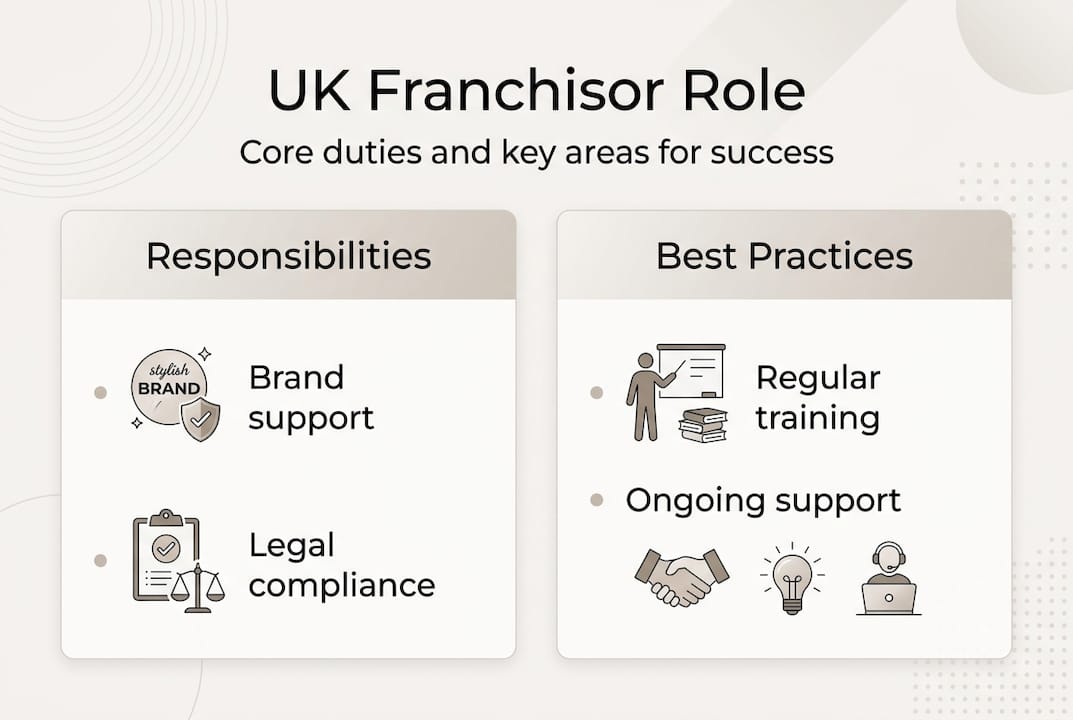
Support, training, and the real value of the franchisor relationship
Regulation alone cannot foster successful franchises. Practical support systems are equally vital, and this is where the quality of a franchisor truly reveals itself.
The scope of franchisor support extends well beyond handing over an operations manual. Strong franchisors provide:
- Structured pre-opening training covering every aspect of the business
- Dedicated launch support including stock, marketing materials, and local PR
- A named franchise development manager as the franchisee’s primary contact
- Regular field visits to review performance and provide coaching
- Access to a peer network of other franchisees for shared learning
- Updated training modules as the business model evolves
The data on this is compelling. Franchisors provide initial training, stock, and launch advice; 90% of franchisees contact their support team monthly, and 79% rate that support as good or excellent. That level of engagement is not accidental. It reflects franchisors who have built support infrastructure as a strategic priority, not an afterthought.
“The quality of franchisor support is the single biggest predictor of franchisee satisfaction and long-term profitability. A low royalty rate means nothing if the support behind it is hollow.”
The sector’s resilience reinforces this point. 66% of franchisors reported performing better after COVID-19, and 82% of franchisees expressed satisfaction with their franchisors. These figures reflect networks where support systems held firm under pressure.
Pro Tip: When evaluating a franchisor, ask to speak directly with existing franchisees, ideally those who have been in the network for three or more years. Ask them specifically about the quality of ongoing support, not just the initial training. The honest answers will tell you more than any brochure.
The impact of support systems on franchisee profitability is well documented. Networks with structured support programmes consistently outperform those that leave franchisees to navigate challenges alone. Understanding franchisee support needs from both sides of the relationship helps you assess whether a specific opportunity is genuinely set up for your success. Some networks also use compliance verification services to ensure standards are consistently upheld across all units.
Emerging trends and challenges for UK franchisors
With the vital importance of support clear, it is crucial to understand the ongoing challenges and trends shaping the franchisor role in 2026 and beyond.
The central tension for any franchisor is the balance between consistency and autonomy. Franchisors need uniformity to protect the brand. Franchisees need flexibility to respond to local market conditions. Getting that balance wrong in either direction creates problems.
More control risks joint liability through mechanisms such as TUPE transfers and misconduct claims. When franchisors exercise excessive operational control, courts and employment tribunals may treat franchisee staff as employees of the franchisor, creating significant financial and legal exposure. The lesson is clear: support franchisees robustly, but do not micromanage.
The courts are also sending a strong signal on good faith. The High Court in 2025 implied good faith obligations in a driving school franchise due to dependency and control, finding that abusive conduct and unilateral changes constituted a repudiatory breach. This is a landmark development. It means franchisors cannot simply point to the written contract if their conduct has been fundamentally unfair.
Key emerging challenges for UK franchisors include:
- Digital transformation: Franchisees expect technology platforms, CRM tools, and digital marketing support as standard
- Sustainability obligations: Consumers and regulators increasingly expect ethical supply chains and environmental accountability
- Recruitment and retention: Labour market pressures mean franchisors must help franchisees attract and keep quality staff
- Data compliance: GDPR obligations require franchisors to manage data governance across entire networks
- Dispute resolution: As good faith duties expand, franchisors need robust internal processes to resolve grievances before they reach court
Pro Tip: If you are assessing a franchisor’s readiness for 2026 challenges, ask them directly how they handle franchisee disputes and what their process is for updating the system when market conditions change. A franchisor who has a clear, documented answer is far more trustworthy than one who improvises.
Staying informed about franchise industry trends 2026 is essential for anyone entering the sector, whether as a franchisee or a franchisor building a network.
The franchisor’s shift: Lessons and realities overlooked by most guides
Most guides focus on what franchisors must do. Fewer address what franchisors must become. The most underestimated challenge in franchising is the identity shift required when a successful business owner transitions into a franchisor.
Franchisors shift from operational founder to strategic system overseer; underestimating this transition leads to network fractures through informal system changes and inconsistent standards. A founder who built a brilliant café concept by personally perfecting every detail will struggle if they try to run a franchise network the same way. The skills that built the business are not the same skills that scale it.
This matters for prospective franchisees too. When you evaluate a franchisor, look for evidence that they have made this transition successfully. Do they have dedicated support staff, or is the founder still doing everything personally? Do they have documented systems, or does institutional knowledge live in one person’s head?
The franchisors who build lasting networks are those who invest in UK franchise success drivers like governance, culture, and communication infrastructure. The ones who struggle are those who treat franchising as a passive income stream rather than a second, more complex business to run. If you are considering franchising as a franchisee, this distinction will tell you more about your future than any financial projection.
Connecting you to franchise success in the UK
Armed with a clear understanding of what franchisors do and what they owe you as a franchisee, your next step is to put that knowledge into practice. The essential UK franchising guide on Franchise Local covers everything from evaluating agreements to understanding investment levels, giving you the foundation to make a confident, informed decision. When you are ready to explore specific opportunities, you can browse UK franchises across dozens of sectors, filtered by budget, lifestyle, and operational model. The right franchisor is out there. Knowing what to look for means you will recognise them when you find them.
Frequently asked questions
What is a franchisor responsible for in the UK?
A franchisor is responsible for developing the business system, setting standards, providing the franchise agreement, and supporting franchisees with training and ongoing guidance. As confirmed by legal analysis of the role, these obligations are ongoing, not limited to the point of sale.
Is there a specific franchising law in the UK?
No, UK franchising is governed by contract law, competition law, and IP law, with the BFA Code of Ethics providing a voluntary ethical framework rather than statutory regulation.
How do franchisors support new franchisees?
UK franchisors provide initial and ongoing training, operational support, and resources to help franchisees launch and run their businesses. Data shows 90% of franchisees contact support monthly, with 79% rating that support as good or excellent.
What legal risks do franchisors face in the UK?
Franchisors must balance support and control carefully. Excessive control risks joint liability through TUPE and employment law, while UK courts can now imply duties of good faith in franchise relationships.
Why is the franchisor-franchisee relationship important?
A strong relationship drives profitability and network resilience. UK franchising contributes £19.1 billion to the economy, with 89% of units profitable and a failure rate of just 0.5%, figures that reflect the power of well-managed franchisor-franchisee partnerships.