

Most people approaching franchise ownership assume a franchise broker is a free, impartial guide working in their corner. That assumption is understandable. But it is not quite accurate. Understanding what is a franchise broker, and more specifically how one gets paid, changes how you should work with them. Brokers are typically compensated by franchisors, not buyers, which creates incentives worth knowing about before you take their recommendations at face value. This guide explains what brokers do, how the commission model works, what questions to ask, and how to use broker services to your genuine advantage.
What is a franchise broker and how do they work?
A franchise broker, also widely known in the industry as a franchise consultant, is a specialist who helps prospective buyers identify and connect with franchise opportunities that suit their goals, skills, and budget. Unlike a franchise salesperson, who represents a single brand and is employed by the franchisor directly, a broker works across multiple brands. And unlike a business broker, who helps buyers purchase existing independent businesses, a franchise broker focuses on new franchise agreements.
The typical broker workflow follows four broad stages:
- Goal clarification. The broker interviews you about your financial position, lifestyle preferences, management style, and long-term ambitions. This is genuinely useful. A good broker will ask questions a first-time buyer might not think to ask themselves.
- Franchise education. The broker explains how franchising works, what fees to expect, and what the commitment looks like operationally. For buyers new to franchising, this education stage alone can save weeks of independent research.
- Option comparison. Based on your profile, the broker presents a shortlist of franchise brands from their network. This is where the commission model starts to matter, as we cover in the next section.
- Franchisor connection. The broker facilitates introductions, arranges discovery days, and helps you begin formal due diligence, including reviewing the Franchise Disclosure Document (FDD).
The FDD is the legal document a franchisor must provide prospective buyers. It covers fees, obligations, territory rights, and financial performance representations. Compliance requires brokers to direct buyers to qualified solicitors and financial advisers for interpretation of the FDD rather than offering their own legal or financial opinions. This is a meaningful boundary. A broker who confidently summarises what the FDD “means for you” without recommending independent legal review is overstepping their role.
That said, brokers who operate professionally add real value in helping you choose the right franchise by narrowing thousands of options down to a considered shortlist aligned to your profile.

Pro Tip: Ask any broker early in your first conversation: “How many brands are in your network?” A professional broker will answer this clearly and without hesitation. If they are vague, treat that as a red flag.
Broker commissions and conflicts of interest
Here is the part most introductory guides gloss over. Franchise brokers are paid by franchisors, not by buyers. The fee structure means that when a broker places you with a franchise, they receive a commission from the franchisor, typically 40 to 50 percent of the initial franchise fee. This is not a separate charge on your invoice. It is embedded within the fees you already pay.
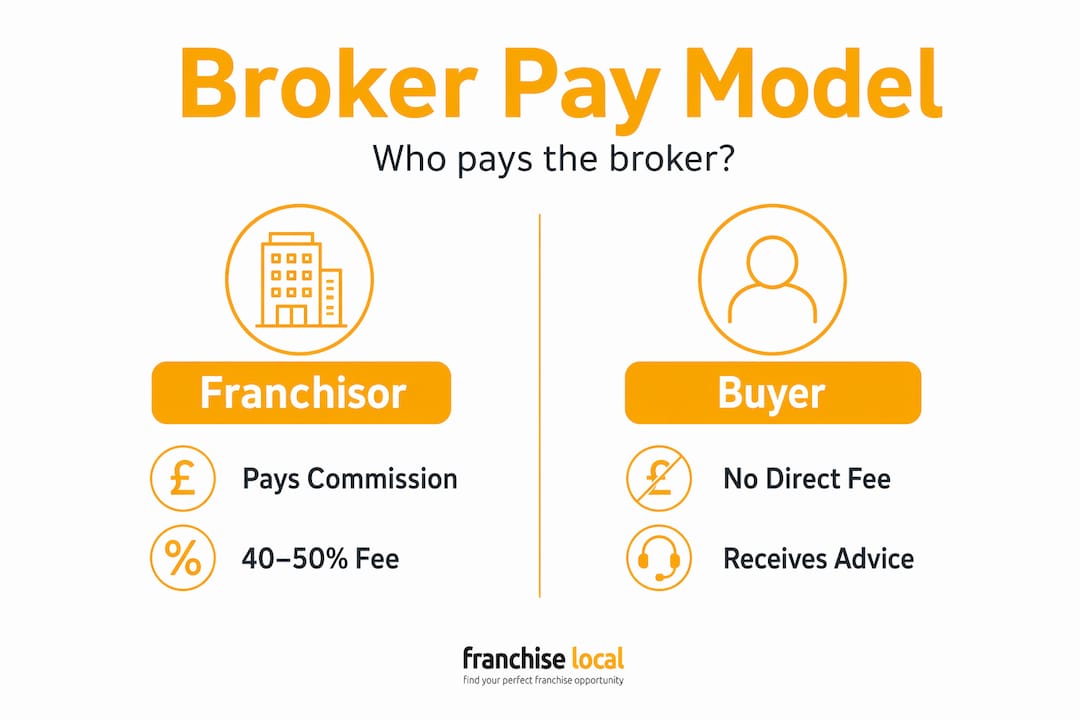
To put concrete numbers on it:
| Franchise fee paid by buyer | Typical broker commission (40–50%) | Broker earns |
|---|---|---|
| £10,000 | 40–50% | £4,000–£5,000 |
| £25,000 | 40–50% | £10,000–£12,500 |
| £50,000 | 40–50% | £20,000–£25,000 |
Beyond the initial fee, broker commission payments are sometimes tied to first-year royalties and advertising contributions as well, which means the total payout can exceed the initial percentage considerably. None of this appears as a line item in your agreement. You will not see “broker fee: £15,000” on any document you sign.
The structural consequence of this model is straightforward. Brokers are only paid after a franchise agreement is signed. If you walk away without buying, they earn nothing. This creates a natural motivation to close, not simply to advise. It does not make brokers dishonest, but it does mean their interests are not perfectly aligned with yours.
There is a second limitation worth understanding. The largest broker networks carry rosters of around 100 to 150 brands, drawn from the franchises that have agreed to pay commissions. There are thousands of franchise opportunities in the UK market. So the shortlist a broker presents you is not drawn from the full universe of possibilities. It reflects the brands that have agreed to pay that particular broker or network.
Pro Tip: Cross-reference any franchise a broker recommends against independent directories and industry publications. If a brand only appears through broker channels and lacks visible independent reviews, dig deeper before proceeding.
The alternative to a commission-based broker is a fee-for-service consultant, who charges buyers directly rather than receiving franchisor commissions. Because their income is not tied to which brand you choose, they can potentially offer more independent guidance and a wider range of options. The trade-off is that you pay upfront, regardless of outcome. For buyers who want unbiased guidance and are prepared to invest in it, this model is worth considering alongside the traditional broker route.
How to choose and use a franchise broker effectively
Knowing how the commission model works puts you in a much stronger position to use broker services well. The goal is to extract genuine value from their expertise and network access while maintaining your own independent judgement throughout.
Before you engage any broker, ask these questions directly:
- How are you paid? A credible broker will explain the commission model plainly. If they are evasive or claim to be entirely free with no explanation of how they earn, press further.
- How many brands are in your network, and which networks do you belong to? This tells you the scope of your shortlist.
- Do you represent all the brands equally, or do some pay higher commissions than others? You may not always get a direct answer, but asking signals that you understand the model.
- What happens if I do not find a suitable brand through you? A buyer-focused broker will point you elsewhere rather than pressure you into a second-choice option.
Once you begin working with a broker, there are practical steps that protect your interests throughout the franchise negotiation process.
- Use the broker to understand the structure of franchising, fee categories, support models, and operational requirements. This education is genuinely valuable and largely unaffected by commission incentives.
- Never rely on broker summaries for financial projections. Always go to FDD Item 6 and onwards for costs, recurring fees, transfer fees, and other financial obligations. Buyers who rely on what a broker says about projected earnings, without checking the FDD, routinely underestimate their total financial commitment.
- Verify earnings claims independently. Buyers should map all cost categories from the FDD rather than relying on broker summaries, which may omit significant fees.
- Engage a franchise solicitor before signing. The broker’s role ends at introduction and facilitation. Legal interpretation is entirely outside it. You can read more about the importance of legal advice before committing to any franchise agreement.
- Speak directly to existing franchisees. This is the single most reliable source of honest information about what running that brand actually looks like day to day.
The right broker can genuinely accelerate your search. The risk is not that brokers are unreliable. It is that buyers treat them as the whole process rather than one useful part of it.
Franchise brokers vs other franchise advisors
The advisory space around franchise buying includes several distinct roles, and it helps to know what each one actually does.
| Advisor type | Who they represent | How they are paid | Scope of brands | Best suited for |
|---|---|---|---|---|
| Franchise broker | Buyers (nominally) | Franchisor commission | Network only (100–150 brands typically) | Buyers wanting guided shortlisting |
| Franchise consultant (fee-based) | Buyers directly | Buyer fee | Wider, unrestricted | Buyers wanting independent advice |
| Franchise salesperson | Franchisor | Salary or commission from franchisor | Single brand only | Buyers already decided on one brand |
| Business broker | Seller of existing business | Seller commission | Existing businesses, not new franchises | Buyers seeking resale opportunities |
Multiple franchise advisory roles exist in the market, and it is common for buyers to conflate them, particularly brokers and consultants. The practical difference is meaningful. A franchise salesperson’s loyalty is entirely with the brand they sell. A business broker operates in a different category altogether, dealing in the sale of established trading businesses rather than new franchise licences. You can see the distinction clearly when you explore business broker franchises as a category in their own right.
A fee-based franchise consultant typically has no roster restrictions and no incentive to steer you towards one brand over another. Their value proposition is independence. The limitation is cost, which can feel prohibitive for buyers on tighter budgets. For those buyers, a commission-based broker used with clear-eyed awareness of the model can still provide solid value, particularly at the education and shortlisting stage.
In the UK specifically, the franchise advisory market is less regulated than in some other markets. There is no mandatory licensing for franchise brokers or consultants. That makes asking the right questions even more important. Anyone can describe themselves as a franchise broker or consultant without formal accreditation, so credentials, experience, and transparency about payment become your primary filters.
For a fuller comparison of how consultants and brokers differ in practice, the Franchiselocal guide on franchise consultants in the UK is a useful companion read.
My honest take on using franchise brokers
I have seen buyers approach franchise brokers with two very different mindsets, and the outcome tracks closely with the approach. The buyers who treat a broker as their primary decision-maker tend to end up in franchises that suit the broker’s network rather than their own goals. The buyers who treat a broker as a research tool, one useful input among several, tend to arrive at better decisions.
The commission model is not a scandal. It is just a business model with predictable consequences. Once you understand it, you can factor it in. The real problem is that many buyers do not find out until after they have signed, at which point the broker’s fee is already embedded in the investment they have committed to.
What I have found is that the most useful thing a broker offers is not their brand list. It is the structured process. Working through goal clarification with an experienced broker forces you to articulate what you actually want from a franchise business, which many first-time buyers have not done rigorously on their own. That process has value independent of which brands get recommended afterwards.
My view on the UK market specifically is that buyers should treat independent directories and franchise selection frameworks as equally important as broker conversations, not as a follow-up step. Run them in parallel. Do not let any single advisor, however experienced, become the only lens through which you evaluate your options.
The buyers I have seen make the sharpest decisions are those who approached brokers with a clear brief, verified everything independently, and used the franchise buying process as a structured, stage-gated exercise rather than a conversation that drifts towards a signature.
— Will
Start your franchise search with Franchiselocal
Understanding the broker model is one part of making a confident franchise investment. The next step is getting direct access to the opportunities themselves. Franchiselocal is the UK’s leading digital directory for prospective franchisees, offering curated listings across industries, investment levels, and locations. Whether you are exploring business services franchises, considering networking franchise opportunities, or weighing options in the loans and financial sector, Franchiselocal gives you direct access to verified listings without the filter of a commission-based broker. Use the platform to build your own independent shortlist, compare investment levels, and connect with franchisors at a pace that suits you.
FAQ
What does a franchise broker do?
A franchise broker helps prospective buyers clarify their goals, learn about franchising, and connect with franchise brands suited to their profile. They facilitate introductions to franchisors and support the early stages of due diligence, though legal and financial interpretation must be handled by qualified professionals.
Are franchise brokers free to use?
Franchise brokers do not charge buyers directly, but they are not free. They receive a commission of 40 to 50 percent of the initial franchise fee from the franchisor, which is embedded within the fees a buyer already pays.
What is the difference between a franchise broker and a franchise consultant?
A franchise broker is paid by franchisors on commission and typically works from a restricted network of brands. A fee-for-service franchise consultant charges buyers directly, which removes the commission conflict and can allow access to a wider range of franchise options.
Do I need a franchise broker to buy a franchise?
No. Brokers are one route into franchise research, not a requirement. You can research and approach franchisors directly, use independent directories such as Franchiselocal, and engage a franchise solicitor without using a broker at any stage.
How do I choose a good franchise broker?
Ask how they are paid, how many brands they carry, and whether any brands pay higher commissions than others. A credible broker will answer these questions directly. Always verify any financial claims against the official Franchise Disclosure Document rather than relying on broker summaries.