

Most people assume that launching your own business from scratch is the boldest, most rewarding path to entrepreneurship. The numbers tell a different story. Franchise units in the UK show an annual failure rate of just 0.5 to 1%, while roughly half of all UK startups collapse within five years. That is not a minor difference. It is a fundamental gap in risk and resilience that most aspiring entrepreneurs never consider when weighing their options. This article breaks down the practical, financial, and operational reasons why choosing a franchise over a startup could be the most informed decision you make in 2026.
Key Takeaways
| Point | Details |
|---|---|
| Franchises excel in success rates | UK franchises are far less likely to fail compared to independent startups. |
| Support systems boost results | Franchisees receive training and guidance, reducing new business risk. |
| Brand power speeds growth | Franchises offer instant market recognition and customer trust. |
| Predictable investment | Franchising offers clear costs and safer, scalable growth than many startups. |
Comparing risks and returns: Franchise versus startup
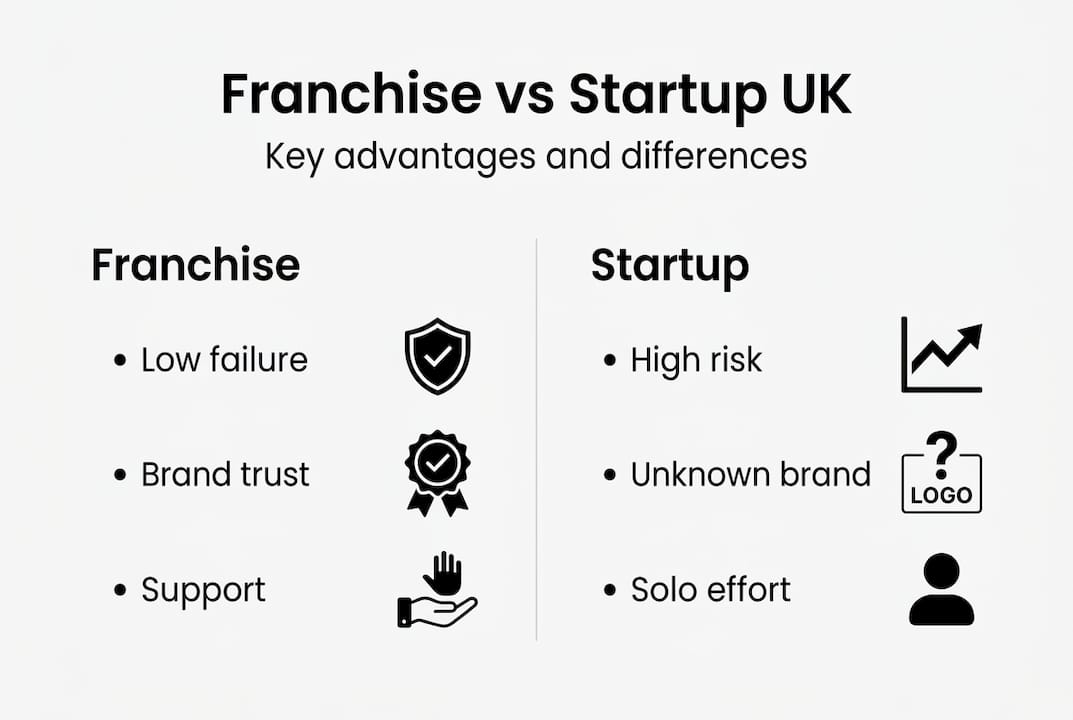
When you strip away the excitement of both paths, what you are really comparing is probability. The probability of surviving, turning a profit, and building something sustainable. A franchise versus startup comparison reveals starkly different odds from the very first year.
The headline figure is hard to ignore. UK franchise failure rates sit at just 0.5 to 1% annually, while approximately 50% of startups fail within five years. That means for every 100 franchise units operating in the UK, fewer than one closes each year due to business failure. For startups, roughly 50 out of 100 will not make it past year five.
| Factor | Franchise | Startup |
|---|---|---|
| Annual failure rate | 0.5 to 1% | Approx. 20% per year |
| 5-year survival rate | Over 90% | Around 50% |
| Profitability | 93% trade profitably | Varies widely |
| Upfront cost clarity | High (known fees) | Low (unpredictable) |
| Brand recognition | Immediate | Must be built |
These figures matter because they represent real money, real time, and real emotional investment. Understanding why franchises succeed is not just academic. It shapes how you plan your finances, manage your expectations, and approach growth.
For the average entrepreneur, the startup route often means spending the first two years simply trying to get noticed, build credibility, and find a repeatable way to generate revenue. A franchise compresses that timeline considerably. You inherit a proven model, an established customer base, and a set of processes that already work. The result is that franchise investment success tends to arrive sooner and with fewer costly detours.
Returns are also more predictable. Franchise agreements typically outline fee structures, territory rights, and expected revenue benchmarks. Startups rarely have that clarity. You might hit your targets in month three or month thirty. That uncertainty is not just stressful. It is genuinely dangerous for cash flow and long-term planning.
Operational support and training: The franchising advantage
Understanding the numbers is crucial, but the practical day-to-day experience is shaped by the level of support and training provided. This is where franchising genuinely separates itself from going it alone.
Operational support in franchising refers to the structured help a franchisee receives from the franchisor throughout the life of the business. This is not a one-off induction. It covers everything from pre-launch preparation to ongoing performance coaching. Franchise training pathways typically include:
- Initial training programmes covering operations, sales, and customer service
- Site selection and setup guidance for physical locations
- Marketing materials and campaign support from head office
- Access to a dedicated business development manager
- Regular performance reviews and improvement plans
- A peer network of fellow franchisees to share experience and solutions
Contrast that with the startup experience. When you launch independently, you are responsible for figuring out every process yourself. There is no manual, no mentor assigned to your account, and no network of peers who have already solved the problems you are facing. You learn by making expensive mistakes.
Industry research confirms that higher franchise success rates are closely linked to the quality of training and guidance provided. This is not coincidental. Structured support reduces the learning curve, shortens the time to profitability, and helps franchisees avoid the operational errors that sink so many independent businesses in their first year.
The franchise support systems available today are also increasingly sophisticated. Many franchisors now provide proprietary software, centralised purchasing power, and shared marketing budgets that individual startups simply cannot access.
Pro Tip: When evaluating a franchise, ask specifically about the support provided in months six to eighteen. The launch phase is well-covered by most franchisors. It is the middle period, once the initial excitement fades, where strong ongoing support makes the real difference to your results.
Brand power and customer trust: A shortcut to market entry
Beyond support, brand recognition plays a powerful role in early market momentum. When you open a franchise, you are not introducing yourself to the market. You are arriving with a reputation already in place.

Think about what that means practically. On day one, customers already know what you offer, what quality to expect, and whether they trust the brand. That trust has been built over years, sometimes decades, by the franchisor and every franchisee before you. A startup has none of that. You are asking people to take a chance on something unfamiliar, and that is a significant barrier to early revenue.
As a franchisee, you gain immediate access to:
- A recognised brand name with existing customer loyalty
- Proven products or services with established demand
- Marketing assets including logos, campaigns, and digital presence
- Supplier relationships that guarantee consistent quality
- Pricing structures and service standards that customers already accept
“93% of UK franchisees trade profitably, due in part to established brand support and market presence.”
That figure is remarkable. It means that nine out of ten franchise owners in the UK are running a profitable business. For startups, profitability in the early years is far from guaranteed, and many founders operate at a loss for extended periods while building their brand from zero.
The UK franchise success evidence consistently points to brand power as one of the primary drivers of franchisee performance. Customers choose familiar names, especially in competitive sectors like food, fitness, and retail. The key franchise model benefits extend well beyond the logo. They include the psychological shortcut that a trusted brand provides to every potential customer who walks through your door.
For a startup founder, building that level of trust can take five to ten years and significant marketing spend. As a franchisee, you start with it.
Investment requirements and pathways to growth
With strong brands and support, entrepreneurs also need to consider the actual investment and growth journey in each model. Cost clarity is one of the most underrated advantages of franchising.
When you invest in a franchise, you receive a detailed breakdown of what you will pay, when you will pay it, and what you will receive in return. Initial franchise fees, equipment costs, training fees, and ongoing royalties are all disclosed before you sign. Franchisees generally follow a structured investment with known returns and scaling potential.
| Investment factor | Franchise | Startup |
|---|---|---|
| Upfront cost range | £10,000 to £100,000+ | Highly variable |
| Cost transparency | High (franchise disclosure) | Low |
| Time to first revenue | Weeks to months | Months to years |
| Scaling model | Defined (add territories) | Self-designed, risky |
| Access to finance | Often easier (bank familiarity) | Harder without track record |
For startups, costs spiral in unpredictable directions. You might underestimate marketing spend, technology requirements, or staffing needs. Those surprises can drain your reserves before you reach breakeven.
The growth pathway in franchising is also more structured. Here is how most franchisees approach scaling:
- Establish your first unit and reach consistent profitability
- Build your local team and operational processes
- Approach the franchisor about additional territory rights
- Use proven systems to replicate your first unit’s success
- Leverage your track record to access further finance for expansion
Exploring franchise industry trends shows that multi-unit ownership is growing rapidly in the UK, with experienced franchisees expanding into two, three, or more territories using the same repeatable model. Solid franchise business planning makes this kind of growth far more achievable than the uncertain scaling journey most startup founders face.
Why the franchise model is often overlooked and what most guides miss
There is a persistent cultural narrative that franchising is somehow less legitimate than building a business from scratch. That franchisees are just following someone else’s rules, not really entrepreneurs. This view is both outdated and, frankly, costly to those who believe it.
Real entrepreneurship is about building something that works, creating value, and achieving financial independence. The franchise model delivers all three, often faster and with less personal risk than the startup route. The franchise model advantages that most guides underplay include access to peer networks of experienced operators, ongoing product and service innovation driven by the franchisor, and a level of emotional resilience that comes from knowing you are not navigating alone.
The emotional and financial toll of a failed startup is rarely discussed honestly. When a startup collapses, the founder often loses savings, relationships, and confidence. Franchising does not eliminate risk, but it reduces it substantially. That reduction has real human value.
Pro Tip: When assessing a franchise, evaluate the entire ecosystem, not just the product. Look at the quality of the franchisor’s existing network, how actively franchisees communicate with each other, and whether the brand is investing in innovation. A strong ecosystem is a far better predictor of your success than the product alone.
Explore your franchise opportunities in the UK
If the evidence in this article has shifted your thinking, the logical next step is to explore what is actually available to you. The franchising guide on Franchise Local is a practical starting point, covering everything from how franchising works to what questions to ask a franchisor before committing. You can also find franchises by industry to narrow your search to sectors that match your skills and interests. Whether you are drawn to food, fitness, cleaning, or professional services, the franchise directory gives you a clear view of what is available across the UK at various investment levels. Your next business does not have to start from zero.
Frequently asked questions
Are franchises actually safer than startups in the UK?
Yes, franchises have significantly lower failure rates, with just 0.5 to 1% failing annually compared to roughly 50% of UK startups within five years.
What support will I get as a franchisee?
You will receive structured training, ongoing business advice, and access to a network of fellow franchisees, all of which are closely linked to higher franchise success rates.
Can I still be innovative as a franchise owner?
Absolutely. Most franchises actively encourage local initiative within their proven framework and welcome franchisee feedback that can drive improvements across the entire network.
How much upfront investment does a UK franchise usually need?
Initial investments typically range from under £10,000 to over £100,000 depending on the brand and sector, but the costs are disclosed upfront and far more predictable than a typical startup budget.