

Franchising multiple locations is defined as a growth strategy where a single operator owns and manages two or more franchise units, typically under an area development agreement, to capture economies of scale and higher profitability than single-unit ownership allows. The industry term for this model is multi-unit franchising, and it represents the dominant expansion path for serious franchise investors in the UK today. FranchiseIQ reports that multi-unit operators achieve 15–25% higher EBITDA margins per unit than single-unit operators, with those gains materialising between the third and fifth units. That figure tells you something critical: the financial case for expanding is real, but it is not immediate. Understanding why franchise multiple locations makes strategic sense requires examining the financial mechanics, contractual structures, management demands, and practical steps involved before you commit capital.
What are the key business benefits of owning multiple franchise locations?
Multi-unit franchising delivers advantages that single-unit ownership structurally cannot replicate. The most significant is purchasing power. When you operate three or more units, you negotiate supplier contracts, marketing spend, and equipment leases at volume. A single McDonald’s franchisee in the UK operating five restaurants buys ingredients, packaging, and uniforms at a scale that a one-unit operator simply cannot access.
The financial benefits of franchising multiple locations include:
- Higher EBITDA margins per unit. The 15–25% margin improvement over single-unit ownership is the headline figure, but it requires operational discipline and a dedicated management layer to materialise.
- Back-office consolidation. Payroll, accounting, HR administration, and compliance functions can be shared across units rather than duplicated. One finance manager serving four locations costs far less than four separate admin functions.
- Marketing efficiency. Local advertising spend across multiple units in the same territory produces compounding brand recognition. Customers encounter your brand more frequently, which shortens the sales cycle.
- Stronger franchisor relationship. Franchisors prefer awarding territories to experienced multi-unit operators. Owning multiple locations positions you as a priority partner for future territory releases and support resources.
Brand visibility is an underappreciated advantage. Operating four units in a regional area means your brand appears across multiple high streets, retail parks, and search results simultaneously. For sectors like financial services or home care, that local saturation builds trust faster than any single-location operator can achieve. The advantages of multiple locations compound over time as each unit reinforces the others’ reputation.
Pro Tip: Before assuming back-office savings will appear automatically, map out your current single-unit costs line by line. Economies of scale in multi-unit franchising require deliberate consolidation. They do not happen by default.

How do area development agreements structure multi-location franchising?
An area development agreement (ADA) is the legal contract that grants a franchisee the exclusive right to open a specified number of units within a defined territory over a fixed period. Most ADAs in the UK span three to seven years and include a development schedule that sets out exactly how many units must open by which dates.
Understanding the structure of an ADA is non-negotiable before you commit. Here are the core components you must scrutinise:
- Development schedule. The agreement specifies the number of locations you must open and the timeline for each. Missing a milestone is not merely an administrative inconvenience.
- Territory exclusivity. The ADA defines your protected area. However, territory exclusivity depends heavily on the specific franchisor agreement, and encroachment by alternative channels or express formats can erode your market share even within a nominally exclusive zone.
- Penalties for missed milestones. Missed development milestones can lead to forfeiture of territory rights or contract termination if the agreement lacks proper cure provisions. This is the single most commercially dangerous clause in any ADA.
- Cure periods. A cure period gives you a defined window to remedy a missed milestone before penalties apply. Negotiate this clause explicitly. Without it, one delayed opening due to planning permission or supply chain issues could cost you your entire territory.
- Force majeure clauses. Events outside your control, such as economic disruption or regulatory changes, should trigger a force majeure provision that suspends your development obligations temporarily. Many standard ADA templates omit this, so you must request it.
The concentration risk in ADAs is real. You are committing capital and legal obligations to a single franchisor and a single territory. If the brand underperforms nationally or the territory proves less viable than projected, your entire portfolio is exposed. This is why area development agreements in the UK require careful legal and business scrutiny before signing.
Pro Tip: Instruct a solicitor who specialises in franchise law, not a general commercial lawyer, to review your ADA. The specific clauses around cure periods, force majeure, and territory definition are franchise-specific and require specialist knowledge to negotiate effectively.
What management challenges arise when scaling to multiple franchise units?
The shift from single-unit to multi-unit franchising is not a linear progression. It is a fundamental change in your role as a business owner. As a single-unit operator, your value comes from direct involvement in daily operations. As a multi-unit operator, your value comes from building and managing the people who run those operations.
Multi-unit ownership changes your weekly rhythm towards performance oversight: manager meetings, KPI reviews, and strategic planning replace the hands-on tasks you previously handled yourself. This shift requires skills in coaching, accountability, and recruitment rather than direct daily operations. Many operators underestimate how significant this transition is.
The operational challenges of scaling include:
- Building a management layer. You need at least one reliable general manager per location before you open the next unit. Opening a second location while still personally managing the first is a recipe for quality drift at both.
- Reporting infrastructure. Point-of-sale systems, HR platforms, and accounting software must be standardised across all units. Without consistent data, you cannot identify underperformance until it becomes a crisis.
- Avoiding overlapping openings. Many multi-unit operators face overlapping opening costs and operational strain that leads to cash compression and quality risks when openings are not scheduled carefully. Practitioners advise against stacking openings until management systems have stabilised at existing units.
- Maintaining brand standards. The further you are removed from daily operations, the greater the risk of inconsistency. Successful scaling demands systems that prevent quality drift and maintain a consistent customer experience despite your absence from daily tasks.
The leadership development requirement is the one most entrepreneurs overlook. You can hire managers, but you cannot hire your own judgement about people. Building the ability to recruit, develop, and hold managers accountable is the core competency of a successful multi-unit franchisee. Investing in management training before you open your second unit is not optional. It is the prerequisite.
How do the economics of multi-unit franchising differ from single-unit ownership?
The financial dynamics of owning multiple franchise units differ from single-unit ownership in ways that affect both your upside and your risk profile. The table below summarises the key differences:
| Factor | Single-unit ownership | Multi-unit ownership |
|---|---|---|
| EBITDA margin per unit | Baseline | 15–25% higher (units 3–5+) |
| Purchasing power | Limited to one unit’s volume | Consolidated across all units |
| Back-office costs | Duplicated per unit | Shared across portfolio |
| Management requirement | Owner-operator model | Dedicated management layer required |
| Capital requirement | Lower initial outlay | Substantially higher; lenders scrutinise portfolio performance |
| Risk concentration | Single location | Entire portfolio tied to one franchisor and territory |
| Franchisor relationship | Standard franchisee | Priority partner status |
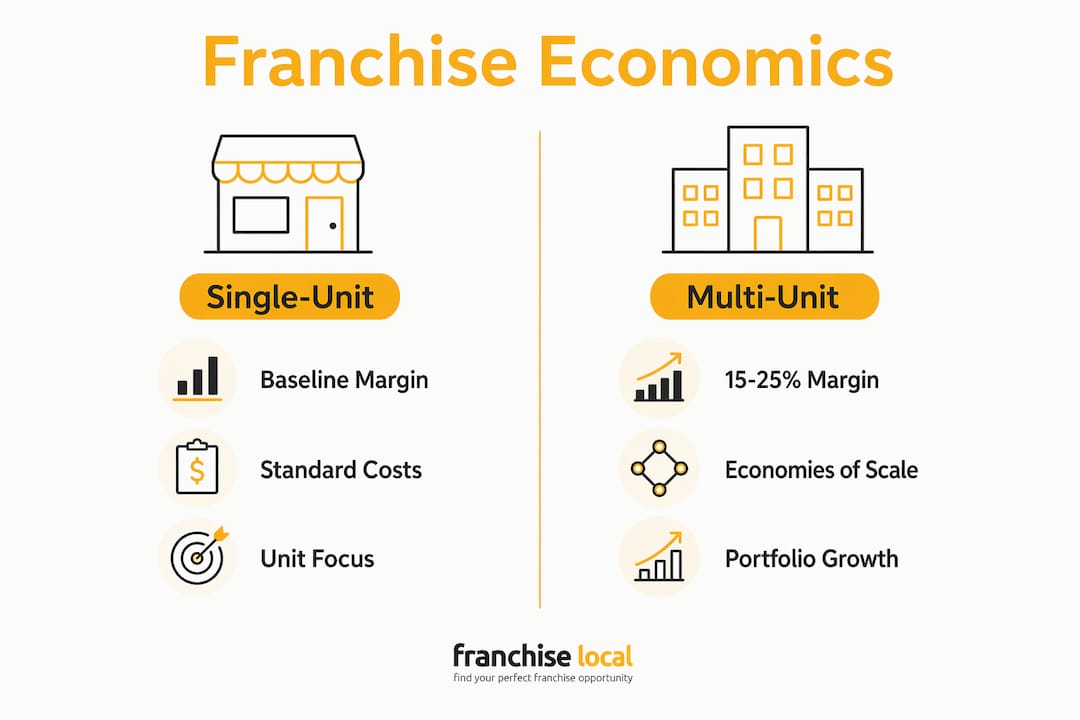
The timing of profitability improvements matters enormously. Economies of scale in multi-unit franchising are uneven across the portfolio, with meaningful margin improvements typically manifesting after establishing dedicated management layers across at least three units. Units one and two often operate at similar economics to a single-unit model because the management overhead has increased but the scale benefits have not yet arrived.
Financing is a distinct challenge. Lenders scrutinise existing portfolio performance, managerial capacity, and pipeline when assessing multi-unit franchise loans, making the financial planning process substantially different from a single-unit application. Your second and third unit loans will be assessed against the trading performance of your existing units, which means early underperformance can block your development schedule entirely.
The broader strategic rationale for multi-unit expansion aligns with how franchising works at a system level. Franchising scales sales throughput system-wide rather than maximising profit per individual unit, which is why the model rewards operators who build portfolios rather than those who optimise a single location. Understanding this distinction changes how you evaluate the return on your investment.
What practical steps should you take when planning to expand your franchise?
Planning a multi-unit franchise expansion requires more preparation than most entrepreneurs allocate. The following steps reflect what separates operators who scale successfully from those who stall at unit two.
-
Review the franchise disclosure document with a multi-unit focus. The FDD contains financial performance representations, franchisee contact lists, and litigation history. When evaluating multi-unit potential, pay specific attention to how many existing franchisees operate multiple units and what their attrition rate looks like. A franchisor with few multi-unit operators in their network has limited experience supporting your growth.
-
Validate franchisor support for multi-unit operators. Ask the franchisor directly what support they provide for operators opening their second and third units. Training programmes, field support visits, and technology infrastructure should all be explicitly documented. Franchisors who cannot answer this question in detail have not built the infrastructure you need.
-
Plan your capital requirements conservatively. Model your cash flow assuming each new unit takes six months longer to reach break-even than projected. Build a reserve that covers overlapping opening costs, management recruitment, and working capital for all units simultaneously. Entrepreneurs consistently underestimate overlapping obligations and cash flow demands when launching multiple units.
-
Hire and develop management before you need it. Identify your first general manager candidate before you sign the ADA. The time to build your management bench is before the development schedule creates pressure to open. Recruiting under deadline pressure produces poor hiring decisions.
-
Build your systems infrastructure at unit one. The POS system, HR platform, and accounting software you choose for your first location must be scalable to five or ten units. Migrating systems mid-portfolio is expensive and disruptive. Treat your first unit as the template for everything that follows.
-
Consult the franchise scaling strategies available for UK operators in 2026. Market conditions, lease terms, and staffing costs vary significantly by region and sector, and your expansion plan must reflect current UK-specific data rather than generic benchmarks.
The case for patience: what I have learned about scaling franchise portfolios
The most consistent mistake I observe among ambitious franchise investors is confusing speed with progress. The operators who build the most durable multi-unit portfolios are not the ones who open the most locations in the shortest time. They are the ones who build the management infrastructure, systems, and financial discipline at each unit before committing to the next.
The 15–25% EBITDA improvement that FranchiseIQ documents is real, but it is not a reward for opening locations. It is a reward for building an organisation. The distinction matters because it changes what you prioritise in years one and two. Your energy belongs in recruiting and developing your first general manager, not in negotiating your third territory.
I have also seen operators sign ADAs without adequate legal review and pay the price when a delayed planning application triggered a missed milestone. The contractual risks in multi-unit franchising are not hypothetical. They are the mechanism by which franchisors protect their network quality, and they will be enforced. Treat every clause in your ADA as a real commercial obligation, not a formality.
The final point I would make is about franchisee communication. The most successful multi-unit operators I have encountered maintain close relationships with their franchisor’s field support team and with other multi-unit franchisees in the network. The informal knowledge shared in those conversations, about which territories are performing, which suppliers are reliable, and which management structures work, is worth more than any formal training programme. Build those relationships before you need them.
— Will
Find your next franchise opportunity on Franchiselocal
If you are ready to explore multi-unit franchise opportunities in the UK, Franchiselocal’s directory connects you with hundreds of vetted franchise options across every investment level and sector. Whether you are evaluating your first location or planning a portfolio of five, the platform’s filters let you search by industry, budget, and region to identify franchises with proven multi-unit track records. Browse networking franchise opportunities suited to portfolio investors, or explore the full franchising guide to build your knowledge before you commit. Franchiselocal exists to help UK entrepreneurs make informed investment decisions at every stage of their franchise growth.
FAQ
What is multi-unit franchising?
Multi-unit franchising is defined as a model where a single franchisee owns and operates two or more franchise units, typically under an area development agreement that grants territorial rights in exchange for a committed development schedule.
When do the financial benefits of multiple locations appear?
Profitability improvements typically materialise between the third and fifth units, once a dedicated management layer is in place and back-office consolidation has been achieved.
What is an area development agreement?
An area development agreement is a contract granting a franchisee the exclusive right to open a set number of units within a defined territory over a fixed period, usually three to seven years, with penalties for missed development milestones.
How does financing differ for multi-unit franchise operators?
Lenders assess multi-unit franchise loan applications against the trading performance of existing units and the operator’s managerial capacity, making the process more complex than a standard single-unit franchise loan application.
What is the biggest operational risk when expanding to multiple locations?
Overlapping opening costs and management strain are the leading operational risks, particularly when operators open new units before existing locations have stable management systems and consistent performance metrics in place.