

Choosing the right franchise from hundreds of UK options creates decision paralysis for many aspiring business owners. Inconsistent information and hidden costs lead to expensive mistakes, with 60% of UK franchisees facing unexpected expenses threatening viability. This guide presents a clear, evidence-based comparison process. You will learn to align franchise choices with your budget, lifestyle, and goals using structured evaluation methods that work.=
Prerequisites: what you need before comparing franchises
Starting your franchise search without proper preparation wastes time and money. Most UK franchise opportunities require startup capital ranging from £20,000 to £50,000, but this figure only tells part of the story. You need a complete financial picture before evaluating any franchise opportunity.
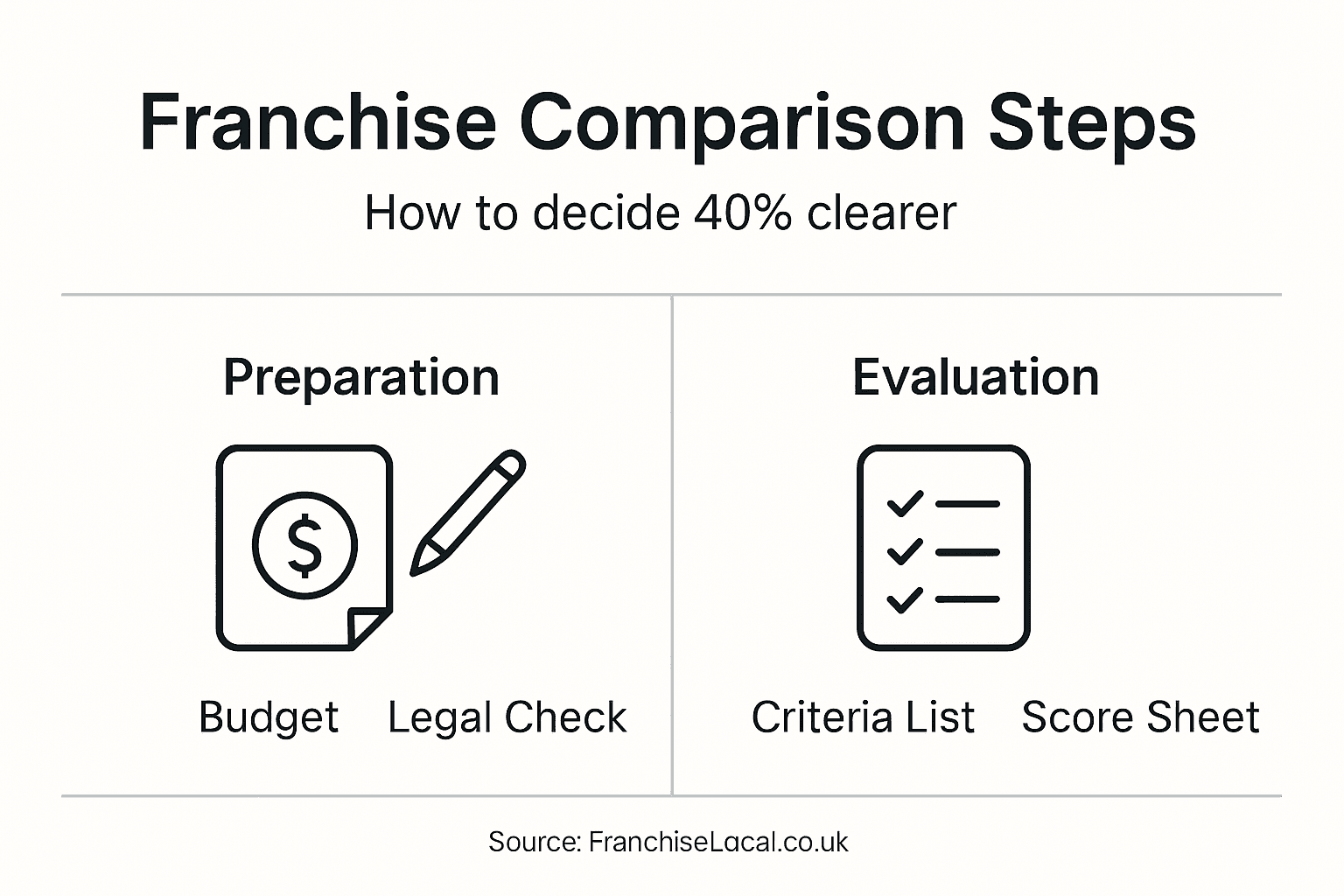
Creating a detailed financial plan covering all fees and working capital improves decision clarity by 40%. Your plan should include the initial franchise fee, ongoing royalty payments, marketing contributions, equipment costs, and at least six months of working capital. Many franchisees fail because they underestimate these combined expenses.
Legal preparation protects your investment. Arrange a consultation with a franchise solicitor who can review disclosure documents and franchise agreements before you begin serious comparisons. This early legal review identifies red flags in contract terms, helping you avoid franchises with unfavourable conditions.
Basic franchise knowledge speeds your evaluation process. Understanding different franchise models, typical fee structures, and common contractual terms lets you ask better questions and spot inconsistencies during research. Spend time reading industry reports and franchise guides to build this foundation.
Pro Tip: Create a master spreadsheet before starting research with columns for all anticipated costs, franchise requirements, and lifestyle factors. This template ensures you gather consistent information for every franchise you evaluate, making side-by-side comparisons much easier later.
Step 1: define your investment and lifestyle criteria
Clarity about your personal limits and preferences prevents wasted research time on unsuitable franchises. Start by calculating your maximum available investment, including funds you can access through savings, loans, or family support. This realistic budget figure becomes your primary filter for franchise opportunities.
UK franchises operate under several distinct models, each with different lifestyle implications:
- Home-based franchises require minimal physical premises, offering flexibility and lower overhead costs
- Mobile franchises involve travelling to customer locations, suiting those who prefer variety and active work
- High street franchises need retail premises, demanding longer hours and higher startup capital
- Management franchises focus on team coordination rather than hands-on service delivery
Your lifestyle goals matter as much as financial considerations. Consider your preferred working hours, desired income level, tolerance for physical labour, and family commitments. A franchise requiring 60-hour weeks damages work-life balance if you prioritise family time. Understanding these investment cost factors helps you evaluate total ownership expenses accurately.
Write specific criteria statements before researching franchises. Examples include “maximum investment £35,000”, “home-based operation”, “part-time manageable”, or “established brand with 10+ years operating history”. These statements become your filtering checklist.

Pro Tip: Rank your criteria by importance using a simple high, medium, low priority system. This ranking helps when making trade-offs between franchises that each meet some but not all of your requirements.
Step 2: research and shortlist franchises using structured tools
The UK franchise directory provides sophisticated filtering that narrows hundreds of options to a manageable shortlist matching your criteria. Use investment level filters first to eliminate franchises outside your budget. Then apply industry sector filters based on your interests and experience.
Operational model filters reduce your list further. If you selected home-based operations in step one, filter out high street and mobile franchises immediately. Geographic filters matter if you want to operate in specific UK regions with territorial restrictions.
Create a comparison table for your shortlist with these essential columns:
| Franchise Name | Total Investment | Ongoing Fees | Training Duration | Territory Size | Years Operating |
|---|---|---|---|---|---|
| Example A | £30,000 | 8% royalty + 2% marketing | 2 weeks | 50,000 population | 15 years |
| Example B | £45,000 | 6% royalty + 3% marketing | 4 weeks | 75,000 population | 8 years |
| Example C | £28,000 | 10% royalty + 1% marketing | 1 week | 40,000 population | 22 years |
Financial health checking protects you from joining struggling franchise systems. Request franchisor financial statements for the past three years. Look for consistent profitability, growing franchisee numbers, and low franchisee turnover rates. High franchisee turnover indicates operational problems or unsustainable business models.
Support services evaluation reveals how much assistance you receive after paying your initial fee. Compare training comprehensiveness, ongoing coaching availability, marketing support quality, and technology systems provided. Weak support systems leave franchisees struggling alone.
Pro Tip: Contact three current franchisees from each shortlisted franchise system. Ask specific questions about actual costs, support quality, and income reality. Their honest feedback reveals gaps between franchisor promises and operational reality.
Step 3: perform a weighted comparison and due diligence
Objective scoring eliminates emotional bias from franchise selection. Assign weights to each evaluation criterion based on your priorities. For example, if financial return matters most, assign costs and profitability 30% weight. If lifestyle fit dominates your decision, assign working hours and flexibility 30% weight.
Create a scoring matrix for systematic evaluation:
- List all criteria down the left column with assigned weights
- Score each franchise from 1 to 10 across criteria rows
- Multiply each score by its weight percentage
- Sum the weighted scores to calculate total franchise score
- Rank franchises by total score to identify top candidates
This weighted comparison approach produces clear rankings reflecting your specific priorities. A franchise scoring 8.2 objectively outperforms one scoring 6.7 based on your defined criteria.
| Criterion | Weight | Franchise A Score | Weighted A | Franchise B Score | Weighted B |
|---|---|---|---|---|---|
| Total Investment | 25% | 7 | 1.75 | 9 | 2.25 |
| Support Quality | 20% | 9 | 1.80 | 6 | 1.20 |
| Brand Strength | 15% | 8 | 1.20 | 9 | 1.35 |
| Lifestyle Fit | 25% | 9 | 2.25 | 7 | 1.75 |
| Profitability | 15% | 7 | 1.05 | 8 | 1.20 |
| Total Score | 100% | 8.05 | 7.75 |
Due diligence interviews provide qualitative validation of quantitative scores. Schedule video calls with franchisors to discuss support systems, growth plans, and contractual terms. Prepare specific questions about fee structures, territory protections, and exit clauses. Note how transparently and thoroughly they answer.
Franchisee interviews reveal operational reality. Ask about actual income achieved, unexpected costs encountered, support responsiveness, and whether they would buy the franchise again. Request contact details for both successful and struggling franchisees for balanced perspectives.
Pro Tip: Record detailed notes during all interviews using a standard template. This documentation helps you compare responses objectively later and provides evidence if disputes arise after purchase.
Common mistakes and troubleshooting in franchise comparison
Neglecting hidden and ongoing costs causes funding shortfalls that threaten business survival. Many franchisees focus only on the initial franchise fee, overlooking royalty payments, marketing levies, technology fees, and equipment replacement costs. These ongoing expenses often exceed initial expectations by 30% or more.
Build a complete cost model before finalising any franchise choice:
- Calculate total first-year costs including all fees, working capital, and contingency funds
- Project five-year costs accounting for fee increases and equipment replacement cycles
- Compare these projections against realistic revenue forecasts, not franchisor optimistic scenarios
- Ensure you can sustain operations through slower periods without additional capital injections
Rushing the decision process increases failure rates significantly. Franchisors create urgency through limited territory offers or special pricing deadlines. Resist this pressure. Taking three to six months for thorough evaluation produces better long-term outcomes than signing quickly to secure perceived deals.
Failing to check franchisor financial health risks joining a failing system. Request audited financial statements, franchisee count trends, and litigation history. Franchisors refusing this transparency hide problems. Systems losing franchisees or facing lawsuits indicate serious operational or ethical issues.
Ignoring lifestyle compatibility creates operational stress and personal unhappiness. A franchise requiring skills you lack, hours you cannot work, or activities you dislike becomes a burden rather than an opportunity. Honest self-assessment about your capabilities and preferences prevents these mismatches.
Expected outcomes: timelines, success metrics, and next steps
Realistic franchise comparison timelines span three to six months for thorough evaluation. Month one focuses on criteria definition and initial research. Months two and three involve shortlisting, scoring, and initial due diligence. Months four through six complete detailed investigations, franchisee interviews, and legal reviews.
Measure comparison success through clear indicators:
- Weighted scoring results showing significant point differences between top and lower-ranked franchises
- Consistent positive feedback from multiple current franchisees about support and profitability
- Legal review confirming fair contract terms without concerning restrictions or obligations
- Personal confidence that chosen franchise aligns with budget, skills, and lifestyle goals
Support system comparison directly impacts success probability. Franchises offering structured training programmes, dedicated business coaches, proven marketing systems, and responsive helpdesks produce higher franchisee satisfaction and profitability. Systems lacking these supports leave you solving problems alone.
Finalising your franchise choice requires several critical steps before signing agreements. Arrange a final legal review with your franchise solicitor to examine all contract terms. Confirm financing arrangements are approved and funds accessible. Complete a detailed business plan projecting realistic revenues and expenses for your first three years.
Schedule a discovery day visit to franchisor headquarters. This visit lets you meet the support team, observe operations, and ask final questions before commitment. Pay attention to team professionalism, facility quality, and culture fit during this visit.
Pro Tip: Create a franchise decision checklist including all evaluation steps, required documents, and approval confirmations. Work through this checklist methodically before signing any agreements to ensure nothing critical gets overlooked in the excitement of starting your business.
Explore franchise opportunities and expert guidance at FranchiseLocal.co.uk
Applying this comparison process requires access to quality franchise information and expert resources. FranchiseLocal.co.uk provides the UK’s most comprehensive franchise directory with advanced filtering by investment level, industry, and operational model. Browse hundreds of verified franchise opportunities matching your specific criteria.
Our ultimate guide to franchising complements your comparison process with detailed advice on franchise selection, financing options, legal requirements, and operational best practices. These expert guides help you make informed decisions backed by industry knowledge.
Connect with trusted franchise service providers offering specialist assistance with franchise finance, legal review, accounting, and business planning. Professional support reduces risk and accelerates your path to franchise ownership.
FAQ
What is the typical timeframe for completing a franchise comparison process?
Most thorough franchise comparisons require three to six months from initial research through final decision. This timeline includes criteria definition, shortlisting, weighted scoring, due diligence interviews, and legal reviews. Rushing this process to meet artificial deadlines increases the risk of costly mistakes.
How can I factor hidden costs into my franchise comparison?
Create a comprehensive cost model including initial franchise fees, ongoing royalty payments, marketing contributions, equipment purchases, property costs, and six months of working capital. Review franchise disclosure documents carefully for all required payments. Consult current franchisees about unexpected costs they encountered during operations.
What are the most common mistakes to avoid when comparing franchises?
Never rush the evaluation process under franchisor pressure or ignore ongoing operational costs beyond the initial fee. Failing to interview current franchisees means missing critical operational reality insights. Overlooking lifestyle compatibility leads to personal stress and business difficulties. Review our guide on common franchise mistakes for detailed prevention strategies.
How do weighted scoring systems improve franchise comparison decisions?
Weighted scoring creates objective rankings based on your specific priorities rather than emotional reactions or persuasive sales presentations. Assigning percentage weights to criteria like cost, support, and lifestyle ensures your most important factors drive the final decision. This systematic approach using weighted comparison methods produces clearer results with measurable confidence levels.