

Starting a business from scratch feels like a gamble, and for good reason. Most independent ventures struggle within the first few years, leaving aspiring entrepreneurs with little to show for their effort and investment. But franchising tells a very different story. Lower failure rates compared to independent startups make franchising one of the most evidence-backed routes into business ownership in the UK. This guide walks you through the core advantages, real sector data, expert perspectives, and a practical framework for choosing the right franchise for your budget and lifestyle.
Key Takeaways
| Point | Details |
|---|---|
| Lower risk profile | Franchises in the UK typically offer far lower failure rates than independent startups, backed by official surveys. |
| High profitability potential | Nearly nine in ten UK franchise units are profitable, and profitability improves the longer they operate. |
| Flexible options | Franchises can be selected to suit a range of budgets, lifestyles, and career ambitions. |
| Resilience and support | The franchise sector has shown remarkable resilience post-pandemic and provides robust support and resources. |
Understanding the core advantages of franchising
Franchising is not simply buying a job with a branded uniform. It is a structured business model where you operate under a proven system, with the backing of an established brand and ongoing support from the franchisor. That distinction matters enormously when you are weighing up risk.
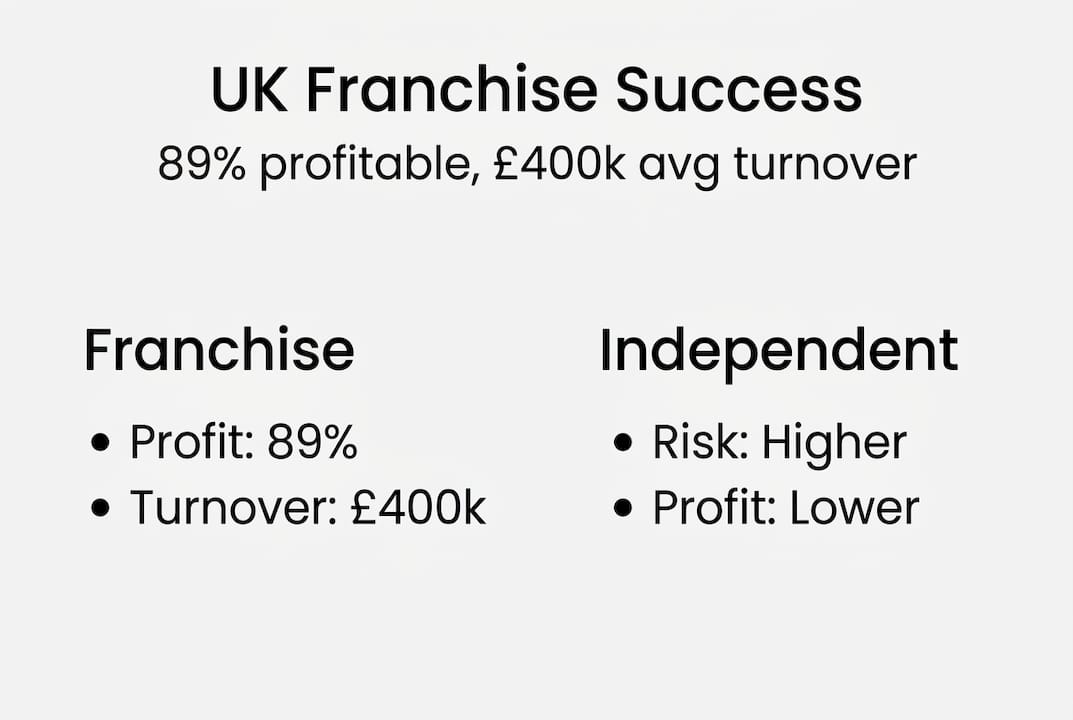
The numbers speak clearly. 89% of franchised units in the UK are profitable, with 60% of units operating five or more years being highly or quite profitable. That is not a lucky streak. It reflects the power of replicating a system that already works.
The key benefits of franchising go well beyond survival rates. Here is what sets franchising apart from going it alone:
- Proven business model: You are not testing an untried concept. The franchisor has already worked out the kinks.
- Brand recognition: Customers already trust the name, which shortens your path to revenue.
- Training and support: Most franchisors provide structured onboarding, ongoing training, and operational guidance.
- Purchasing power: As part of a network, you often benefit from group buying arrangements that reduce your costs.
- Peer network: Fellow franchisees are a built-in community of people who have faced the same challenges you will.
“Franchising offers a rare combination of entrepreneurial independence and the safety net of a proven system, making it one of the most accessible routes into business ownership.”
When you compare franchise vs startup in the UK, the structural advantages of franchising become even more apparent. You are not reinventing the wheel. You are driving a vehicle that has already been road-tested.
How franchises perform versus independent businesses
Let us look at the hard numbers, because this is where the case for franchising becomes genuinely compelling.
The UK franchise sector is a significant economic force. The sector contributes £19.1 billion to the economy, with 1,009 active systems and 50,421 units operating across the country. The average turnover per unit sits at £400,000. That is a meaningful benchmark when you are assessing what your investment could realistically generate.

| Metric | UK franchise sector | Typical independent startup |
|---|---|---|
| Profitability rate | 89% of units | Significantly lower |
| 5-year survival | 60% highly profitable | Majority fail within 5 years |
| Average unit turnover | £400,000 | Varies widely, often lower |
| Sector economic contribution | £19.1 billion | Fragmented |
These figures are not marketing spin. They come from structured national survey data and reflect the genuine performance of franchised businesses across the UK.
Key insight: The average £400,000 turnover per unit is particularly striking. Many prospective franchisees underestimate what a well-run franchise can generate once the model is established and the local customer base is built.
If you want to research franchise opportunities with a clear picture of what the sector delivers, starting with this data gives you a realistic foundation. The franchise vs startup comparison is not even close when you factor in support, brand equity, and survival rates together.
Expert perspectives: resilience and growth after the pandemic
The pandemic tested every business model imaginable. Franchising emerged from that period with its reputation for resilience firmly intact. Post-pandemic growth data and consistently low failure rates confirm that franchised businesses are structurally better equipped to weather economic disruption than most independent ventures.
Why? Because franchisors have a vested interest in keeping their network healthy. When one unit struggles, the franchisor steps in with support, guidance, and resources. That safety net simply does not exist for independent business owners.
“Empirical benchmarks show resilience through post-pandemic growth and low failures. For those wanting immediate traction, franchise resales offer a strategic route without the full risks of a brand-new startup.”
This brings us to an option that many first-time franchisees overlook: the resale. Buying an existing franchise unit means you are acquiring an established customer base, trained staff, and a track record of trading. You skip the painful early months of building awareness from zero.
Pro Tip: If you are concerned about the time it takes to reach profitability, explore franchise resale options before committing to a new unit. A resale can dramatically reduce your ramp-up period and give you immediate cash flow.
Of course, resales come with their own due diligence requirements. You need to understand why the previous owner is selling, review the unit’s financial history, and assess whether the territory still has growth potential. But for many investors, the trade-off is well worth it. Browsing top UK franchise opportunities that include resale listings gives you a broader picture of what is available right now.
Tailoring your franchise choice to budget and lifestyle
Not every franchise suits every investor. A management franchise requiring a £150,000 investment and a full-time commitment is a very different proposition from a home-based service franchise you can run around existing responsibilities. Getting this match right is arguably the most important decision you will make.
Start by being honest about three things: how much capital you can invest, how many hours per week you can realistically commit, and what kind of work genuinely motivates you. A franchise that ticks the financial boxes but leaves you dreading Monday mornings is not a good investment.
Here is a practical checklist to guide your thinking:
- Investment level: Consider not just the initial franchise fee but working capital, equipment, and premises costs.
- Time commitment: Some franchises demand full-time presence; others suit part-time or flexible working patterns.
- Lifestyle fit: Do you want to work from home, on the road, or from a retail unit? Each model has very different day-to-day realities.
- Growth ambitions: Are you happy running a single unit, or do you want to build a multi-unit operation over time?
- Sector interest: Passion for the industry you operate in makes a genuine difference to long-term performance.
BFA membership provides ethical standards, accreditation, and reassurance when you are evaluating opportunities. Always check whether a franchisor holds BFA accreditation as part of your shortlisting process.
Pro Tip: Use the franchise industries directory to filter opportunities by sector before you start comparing investment levels. Narrowing by industry first saves considerable time and keeps your research focused.
If you are ready to commit fully, exploring full-time franchise options gives you a curated view of opportunities that match that level of commitment. And if you are still working out what you can afford, a clear guide to pricing a franchise will help you build a realistic budget before you approach any franchisor.
The decision process: steps to evaluate and select the right franchise
Once you know what you are looking for, the evaluation process becomes far more manageable. Here is a structured approach that covers the essentials without overwhelming you.
- Define your criteria: Investment range, preferred sector, lifestyle requirements, and growth goals. Write these down before you start browsing.
- Research the market: Use directories and sector reports to identify franchises that match your criteria. Start with researching franchise opportunities to understand what information you should be gathering.
- Shortlist BFA-accredited franchisors: BFA accreditation signals that a franchisor meets recognised ethical and operational standards. It is a meaningful filter.
- Request the franchise disclosure document: This document outlines fees, obligations, territory rights, and support structures. Read it carefully and have a solicitor review it.
- Speak to existing franchisees: This is the step most people skip, and it is the most valuable. Ask about real earnings, franchisor responsiveness, and what they wish they had known before signing.
- Conduct financial due diligence: Review audited accounts, understand the fee structure, and model your projected returns conservatively.
- Visit the franchisor: A face-to-face meeting tells you a great deal about culture, communication style, and whether this is a relationship you want to be in for the next five to ten years.
| Evaluation stage | What to look for | Red flags |
|---|---|---|
| Initial research | Sector fit, investment range | Vague financial projections |
| BFA check | Accreditation status | No BFA membership |
| Disclosure document | Clear fee structure | Hidden costs or restrictions |
| Franchisee conversations | Honest earnings data | Reluctance to connect you with franchisees |
| Financial due diligence | Audited accounts | Unverifiable income claims |
Browsing latest franchise opportunities alongside franchise opportunities by region lets you cross-reference what is available nationally with what makes sense for your local market.
Where to find trusted franchise opportunities
You now have a clear framework for evaluating franchises, understanding the sector data, and matching opportunities to your personal goals. The logical next step is to put that framework into practice with access to a reliable, well-organised source of opportunities. The ultimate guide to franchising on Franchise Local covers everything from first principles through to advanced investment considerations, making it an ideal starting point for anyone at any stage of their research. When you are ready to browse specific listings, the UK franchise directory lets you filter by investment level, industry, region, and operational model, so you can move from research to shortlist quickly and confidently.
Frequently asked questions
Do franchises in the UK really have lower failure rates than independent startups?
Yes. National survey data consistently shows UK franchises experience significantly lower failure rates than independent startups, making them a structurally safer route into business ownership.
How profitable are UK franchises over time?
89% of UK franchise units are profitable, and after five years in operation, 60% are rated highly or quite profitable, reflecting the long-term strength of the model.
What is the average turnover for a UK franchise?
Current sector data shows the average turnover per unit is £400,000, giving prospective franchisees a useful benchmark when modelling their potential returns.
What benefits does BFA membership bring for franchisees?
BFA membership signals that a franchisor meets recognised ethical standards and has undergone accreditation, providing meaningful reassurance during your evaluation process.
How do I match franchise options to my lifestyle and budget?
Begin by clarifying your investment capacity and weekly time commitment, then use accredited directories and BFA-verified listings to filter opportunities that genuinely align with your goals and working preferences.