

TL;DR:
- Advertising is crucial for brand visibility and revenue growth in UK franchising.
- Franchisors typically manage national campaigns, while franchisees handle local marketing efforts.
- Active local advertising and measurement are key to franchise success and growth.
Franchise ownership in the UK is far more resilient than most people expect. Only a tiny fraction of UK franchises fail each year, and advertising boosts revenue by 33% for those who get it right. Yet many aspiring franchisees treat advertising as an afterthought, assuming the franchisor handles everything. This guide cuts through that misconception. Whether you are evaluating your first franchise opportunity or preparing to sign an agreement, understanding how advertising works, who pays for it, and how to maximise its impact could be the single most important thing you do before investing.
Key Takeaways
| Point | Details |
|---|---|
| Advertising boosts franchise growth | UK franchises achieve up to 33% more revenue with consistent advertising efforts. |
| Shared advertising responsibilities | Both franchisors and franchisees typically fund and execute advertising for maximum impact. |
| Strategic approach is essential | Choosing the right advertising channels and measuring results is key to standing out and succeeding. |
| Mindset shapes outcomes | Proactive, brand-focused advertising gives franchises a lasting competitive edge. |
Why advertising matters in UK franchising
In the franchise world, advertising is not simply about running a few social media posts or printing leaflets. It is the engine that keeps your brand visible, your customer pipeline full, and your revenue growing. For UK franchisees, this matters enormously because you are not just running a local business. You are representing a brand that customers already recognise, and that recognition is built and maintained through consistent, well-funded advertising.
The numbers back this up. Franchises contribute over £17 billion to the UK economy each year, and a significant portion of that success is tied to the strength of franchise advertising. When customers see the same logo, the same message, and the same tone across every touchpoint, trust builds quickly. That trust converts to sales faster than almost any other business factor.
Yet a common myth persists: that the franchisor handles all advertising and the franchisee simply benefits. This is rarely the full picture. Most franchise systems require franchisees to contribute to a shared advertising fund and to run their own local campaigns on top of that. Understanding franchise marketing explained from the outset helps you budget accurately and avoid nasty surprises.
Here is what strong franchise advertising actually delivers:
- Consistent brand recognition across all locations and customer touchpoints
- Higher customer trust, which shortens the sales cycle considerably
- Increased footfall to physical locations or traffic to digital platforms
- Revenue uplift averaging 33% compared to businesses with weak advertising
- Competitive advantage in local markets where independent rivals lack brand power
“Brand visibility is not a luxury in franchising. It is the foundation on which every sale is built.”
For anyone exploring essential franchise marketing strategies, the starting point is always understanding why advertising is non-negotiable in this business model, not optional.
How advertising responsibilities are structured in franchises
One of the most confusing aspects of joining a franchise is working out exactly who is responsible for what when it comes to advertising. The answer varies between franchise systems, but there is a common structure most UK franchises follow.
Centralised brand campaigns are typically managed by the franchisor. These cover national television, radio, large-scale digital campaigns, and PR activity. They are funded through a pooled advertising fund, to which every franchisee contributes a percentage of their turnover, usually between 1% and 4%.
Local advertising, however, is generally the franchisee’s responsibility. This includes community sponsorships, local social media management, leaflet drops, and regional promotions. This is where many new franchisees underestimate the workload and the budget required.
| Responsibility | Franchisor | Franchisee |
|---|---|---|
| National TV and radio campaigns | Yes | No |
| Brand guidelines and creative assets | Yes | No |
| Pooled advertising fund management | Yes | No |
| Local social media activity | Guidance only | Yes |
| Community events and sponsorships | No | Yes |
| Local leafleting and print | No | Yes |
| Google Business profile management | Shared | Primarily franchisee |
Understanding this split before you sign is critical. A good franchise marketing strategy guide will help you map out your expected local spend alongside your pooled fund contributions.
Here are the steps most franchisees follow when setting up their advertising structure:
- Review the franchise disclosure document for advertising fund obligations
- Request a breakdown of how the pooled fund has been spent historically
- Identify your local advertising budget based on territory size and competition
- Agree on co-operative advertising opportunities with your franchisor
- Build a 12-month local advertising calendar before launch
Pro Tip: Ask your franchisor for a detailed report on how the national advertising fund was allocated in the previous year. Franchisors who are transparent about this are far more likely to be strong marketing partners throughout your agreement.
Key advertising strategies that drive franchise growth
Not all advertising channels deliver equal results for UK franchises. The most successful franchisees use a blend of digital, print, and community-based approaches, tailored to their specific territory and customer base.

Digital advertising is now the dominant channel for most UK franchise sectors. Paid search campaigns on Google, targeted social media adverts on Facebook and Instagram, and email marketing to local databases all deliver measurable results at relatively low cost. The key is brand consistency in advertising, which increases customer trust and return on investment regardless of the channel used.
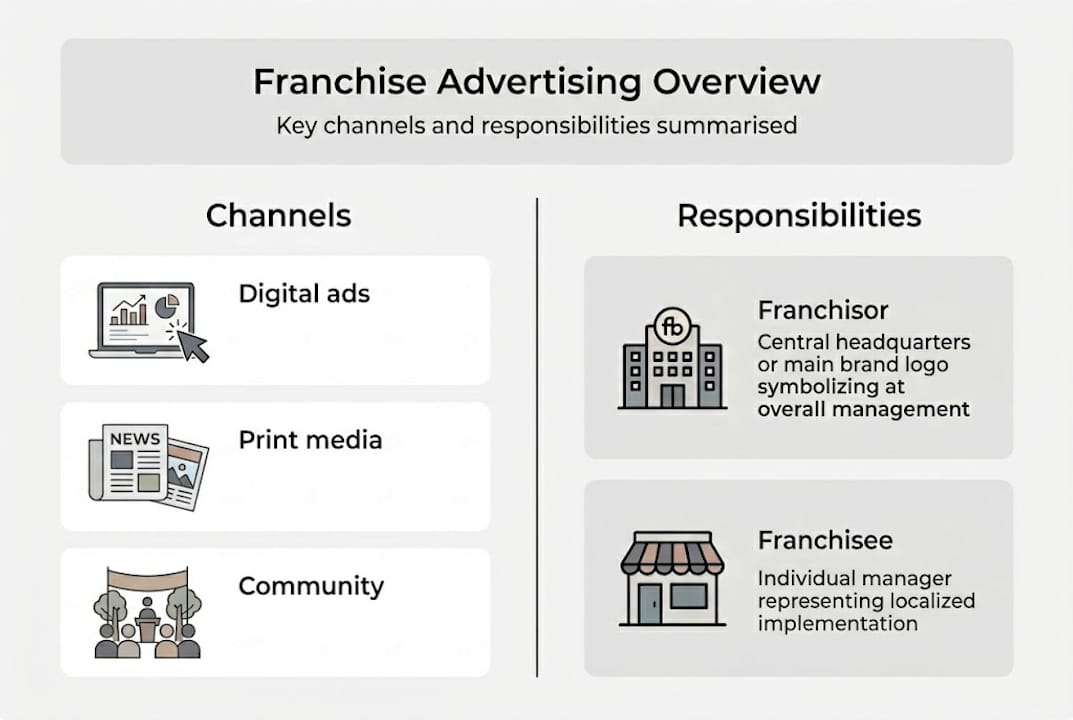
Print still plays a role in certain sectors, particularly food, care services, and home improvement franchises. Local newspaper adverts, door-to-door leaflets, and community magazine placements can generate strong leads in areas where digital penetration is lower among the target demographic.
Community engagement is often underestimated. Sponsoring a local sports team, attending business networking events, or partnering with a local charity builds the kind of goodwill that no paid advert can replicate. This is especially powerful for service-based franchises where personal trust is a deciding factor.
| Advertising channel | Average cost (monthly) | Typical reach | Estimated ROI |
|---|---|---|---|
| Google paid search | £300 to £800 | Local to regional | High |
| Social media adverts | £150 to £500 | Highly targeted | Medium to high |
| Local print and leaflets | £100 to £400 | Neighbourhood level | Medium |
| Community sponsorships | £50 to £300 | Hyper-local | High (long-term) |
| Email marketing | £50 to £200 | Existing database | Very high |
Pitfalls to avoid include inconsistent messaging across channels, neglecting your Google Business profile, and failing to track where your leads are actually coming from. Explore franchise marketing strategies and lead generation strategies to build a channel mix that suits your sector.
Pro Tip: Your strongest local advertising asset is often a satisfied customer. Build a system for collecting and displaying reviews from day one. Word-of-mouth, amplified digitally, consistently outperforms paid channels in franchise territories.
Measuring the impact: What advertising delivers for your franchise
Spending money on advertising without tracking results is like driving with your eyes closed. The most successful UK franchisees treat measurement as seriously as the campaigns themselves.
Key performance indicators (KPIs) to monitor include:
- Cost per lead: How much you spend to generate each new enquiry
- Conversion rate: The percentage of leads that become paying customers
- Customer acquisition cost: Total advertising spend divided by new customers gained
- Footfall or website traffic: Direct measure of visibility in your territory
- Revenue per campaign: Comparing sales before, during, and after specific campaigns
Franchises with strong advertising see an average revenue increase of 33%, but that figure only becomes real for you when you track it properly. Use your point-of-sale system, Google Analytics, and your CRM (customer relationship management) tool together to build a clear picture.
“The franchisees who grow fastest are not necessarily the ones who spend the most. They are the ones who know exactly what each pound of advertising is returning.”
Consider this scenario. A UK cleaning franchise owner in Manchester allocated £400 per month to local Google adverts and £100 to social media promotion. After six months of consistent tracking, she identified that Google search delivered 80% of her new bookings at a cost per lead of £12. She reallocated her social budget to increase Google spend, and her monthly revenue grew by 28% within three months. That is the power of measurement.
For those considering listing your franchise or scaling an existing one, building a measurement framework from the start is what separates growing franchises from stagnating ones.
Why the right advertising mindset sets great franchises apart
Here is something most franchise guides will not tell you. The biggest advertising mistake new franchisees make is not choosing the wrong channel. It is adopting a passive mindset. They assume that because they are part of a recognised brand, customers will simply appear. They wait for the franchisor’s national campaigns to do the heavy lifting, and then wonder why their territory is underperforming.
The franchisees who genuinely thrive take complete ownership of their local marketing. They do not wait to be told what to do. They study their territory, test different messages, build local relationships, and treat every advertising pound as an investment with an expected return.
Brand consistency matters enormously, but consistency does not mean passivity. You can stay within brand guidelines while still being creative, proactive, and deeply embedded in your local community. The franchisor provides the framework. You provide the energy and local knowledge that makes it come alive.
Challenge the assumption that the franchisor handles everything. Read your agreement carefully, understand your obligations, and then go beyond them. Explore ideas like creating franchise offers that attract customers at a local level while reinforcing the national brand. The franchisees who do this consistently are the ones who build genuinely valuable businesses.
Start building your successful franchise
Advertising is not a cost to minimise. It is the investment that determines how quickly your franchise grows and how strongly your brand resonates in your territory. Throughout your journey, here are resources to accelerate your franchise success. The ultimate guide to franchising gives you a solid foundation for understanding the full franchise model, from investment to operation. If you need specialist support, browse our franchise service providers directory to find marketing experts who understand the franchise sector. And when you are ready to explore opportunities by sector, our franchise industries listings let you filter by the type of business that suits your goals and lifestyle.
Frequently asked questions
Who pays for advertising in a UK franchise system?
Typically, both franchisors and franchisees contribute, with national campaigns funded centrally and local promotions paid by franchisees from their own budget.
How does advertising benefit a franchise compared to an independent business?
Franchise advertising leverages established brand recognition and can increase average revenue by 33% compared to independent businesses that must build awareness from scratch.
What are the most effective advertising channels for UK franchises?
Digital marketing, local community outreach, and national brand campaigns are consistently the strongest performing channels for UK franchise growth.
Can advertising obligations be negotiated in franchise agreements?
Some terms may be flexible, but most established franchisors maintain fixed pooled fund contributions to protect brand consistency across the entire network.