

Franchising carries a reputation for being the safer route into business ownership, and the numbers do support that view. Franchise failure rates sit below 1% annually, compared to roughly 50% for non-franchised start-ups within three years. But that safety net is not automatic. It is built, clause by clause, through careful legal scrutiny before you sign anything. This article explains how the UK’s franchising legal landscape works, what your agreement actually contains, and why professional legal advice is the single most important step you can take before committing your money and your future.
Key Takeaways
| Point | Details |
|---|---|
| No franchise-specific law | UK franchises rely on broad contract and competition law, making tailored legal advice essential. |
| Contract terms dictate success | Reviewing franchise agreements with a solicitor can prevent costly mistakes and loss of rights. |
| Pitfalls are preventable | Most franchise failures from legal missteps can be avoided through early due diligence and specialist review. |
| Strong advice boosts profits | Legal diligence supports the UK sector’s 93% profitability — much higher than independent start-ups. |
Understanding the UK franchising legal landscape
Most prospective franchisees assume there must be a dedicated law governing franchising in the United Kingdom. There is not. UK franchising relies on general contract law, competition law, and intellectual property law rather than any franchise-specific legislation. That means the protections you receive depend almost entirely on what is written in your agreement and how well you understand it before signing.
This is a critical distinction. In the United States, for example, the Federal Trade Commission requires franchisors to provide a detailed Franchise Disclosure Document before any money changes hands. In the UK, no mandatory disclosure is required by law. Franchisors are not legally obliged to hand over financial performance data, litigation history, or operational details unless they choose to do so.
Self-regulation fills part of the gap. The British Franchise Association (BFA) operates a voluntary Code of Ethics that member franchisors are expected to follow, including providing prospective franchisees with accurate and complete information. However, BFA membership is not compulsory, and many franchisors operate outside it entirely. That means the quality of information you receive before signing can vary enormously from one opportunity to the next.
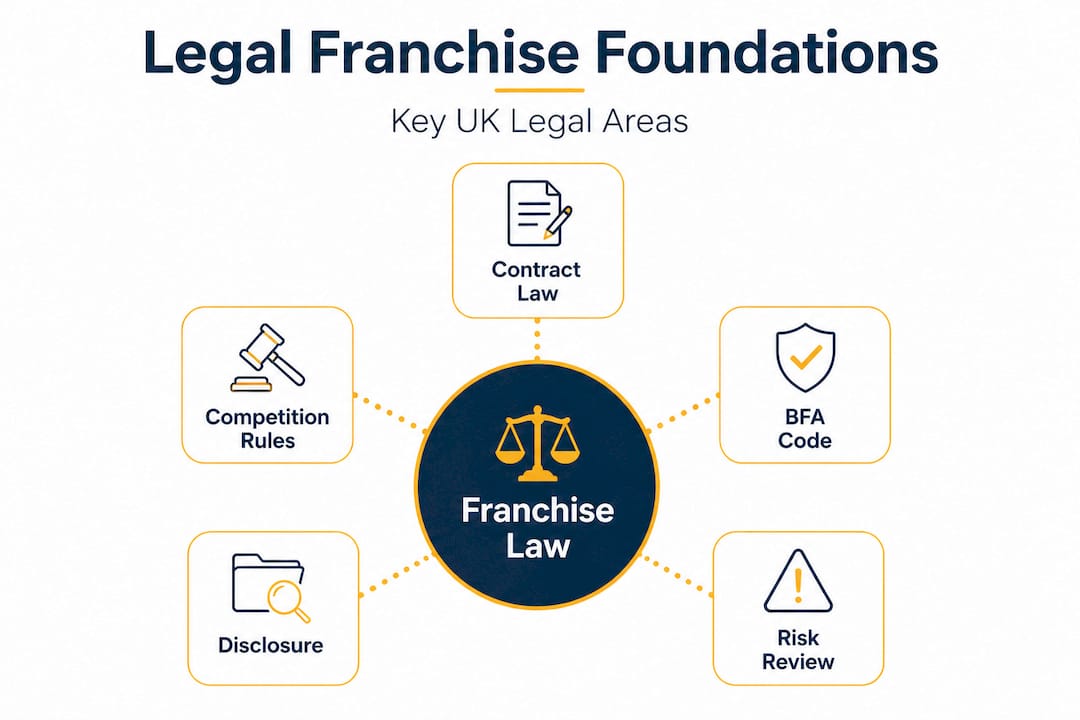
Understanding key franchise legal considerations from the outset helps you ask the right questions and spot the right red flags. Here is a quick overview of the legal areas that govern your franchise relationship:
| Legal area | What it covers |
|---|---|
| Contract law | The binding terms of your franchise agreement |
| Competition law | Territory rights, exclusivity, and pricing restrictions |
| Intellectual property law | Use of the franchisor’s brand, trademarks, and systems |
| Employment law | Staff obligations, TUPE transfers, and contractor status |
| Property law | Lease obligations, landlord relationships, and dilapidations |
The absence of franchise-specific legislation does not make franchising riskier than other forms of business. It does mean, however, that the legal requirements for franchising rest almost entirely on what your solicitor identifies and negotiates for you. Without that expertise, you are reading a complex legal document without a map.
Franchise agreements: Clauses that make or break your business
The franchise agreement is the foundation of your entire business relationship. It dictates what you can do, what you must do, what it costs, and what happens if things go wrong. Key mechanics to review include the term and renewal conditions, fees and royalties, territory exclusivity, IP rights, support and training obligations, supply chain requirements, personal guarantees, post-termination restrictions, and dispute resolution procedures. That is a substantial list, and each item carries real financial consequences.
Here is a comparison of standard versus risky clause wording to illustrate how much the language matters:
| Clause type | Standard wording | Risky wording |
|---|---|---|
| Territory | Exclusive territory clearly defined by postcode | “Reasonable area” at franchisor’s discretion |
| Fees | Fixed royalty percentage with a written cap | Variable fees “as determined by the franchisor” |
| Support | Minimum training hours and ongoing support specified | “Support as reasonably required” with no definition |
| Termination | Clear grounds and notice period for both parties | Franchisor can terminate “for any material breach” undefined |
| Post-term | Non-compete limited to 12 months and local area | Non-compete for 3 years across the entire UK |
The difference between those two columns can mean the difference between a thriving business and one that collapses under unexpected costs or loses its territory without warning. Reading franchise agreement essentials before you meet a solicitor gives you a working vocabulary, but a qualified franchise lawyer will spot the subtleties that a general reading misses.
Here is a practical checklist of what to examine before signing:
- Term and renewal: How long is the initial term? What are the conditions for renewal, and who decides?
- Fees and royalties: Are management service fees fixed or variable? Are marketing levies included?
- Territory: Is exclusivity guaranteed in writing, or does the franchisor retain the right to open competing outlets?
- IP and branding: What happens to your investment in the brand if the franchisor rebrands or sells?
- Supply chain: Are you locked into a single supplier? What happens if that supplier fails or raises prices significantly?
- Personal guarantees: Are you personally liable for business debts beyond your initial investment?
- Post-termination restrictions: How long and how broadly are you restricted from operating in the same sector after leaving?
- Dispute resolution: Is mediation or arbitration required before litigation? Who bears the costs?
Understanding the franchise agreement’s role in your day-to-day operations is just as important as understanding its legal implications. A good solicitor will help you see both dimensions.
Pro Tip: Ask for written clarification on every clause you do not fully understand. Ambiguity in a franchise agreement almost never works in the franchisee’s favour. If a franchisor refuses to clarify, that tells you something important.
Getting legal reviews before signing a franchise agreement is not just due diligence. It is the mechanism through which you turn a potentially one-sided document into a workable business arrangement.
Common legal pitfalls and how advice can prevent them
Knowing what the clauses say is one thing. Knowing where franchisees typically get caught out is another. Overly broad non-competes may be unenforceable if they are unreasonable in scope or duration, but you will not know that without legal advice. Personal guarantees can expose your home and personal savings to business debts. Vague support clauses can leave you without the training or operational help you were promised.

Here are the most common legal pitfalls, grouped by category:
Contract pitfalls:
- Vague or undefined territory boundaries that the franchisor can interpret narrowly
- Renewal clauses that allow the franchisor to impose entirely new terms at renewal
- Fee structures that increase without a clear mechanism for franchisee consent
Financial pitfalls:
- Personal guarantees that extend to the full value of the franchise agreement
- Marketing fund contributions with no transparency or accountability on how funds are spent
- Supply chain lock-ins that prevent you from sourcing competitively priced alternatives
Operational pitfalls:
- Support obligations described in vague language that is difficult to enforce
- Training commitments that are front-loaded at launch but disappear after the first year
- Obligations to refurbish or upgrade premises at your own cost on the franchisor’s schedule
Post-termination pitfalls:
- Non-compete clauses that prevent you from working in your chosen sector for years after exit
- Restrictions on selling your franchise that limit your exit options and reduce resale value
- Obligations to return or destroy proprietary materials that you have invested in building
Understanding territory rights in franchising is particularly important because territory disputes are among the most common sources of franchisee dissatisfaction in the UK. A solicitor can push for clear, map-defined exclusivity and ensure the agreement reflects what you were verbally promised.
“Franchisees who skip legal review often discover problems only when they are already locked into a five-year agreement with limited exit options. By then, the cost of fixing the problem far exceeds what legal advice would have cost at the outset.”
Pro Tip: Before signing, ask your solicitor specifically about the scope of any non-compete clause and the full extent of any personal guarantee. Both are negotiable in many cases, and both carry serious long-term consequences if left unchallenged.
Knowing how to avoid common franchisee pitfalls is far easier before you sign than after. And handling disputes in franchising once they arise is costly, stressful, and often avoidable with proper upfront advice.
Due diligence and disclosure: What you must know before committing
Prevention is always better than remedy. The due diligence stage is where legal advice pays for itself most clearly, because it is the point at which you can still walk away.
Although UK law does not require franchisors to provide a disclosure document, the BFA/QFA Code of Ethics does require member franchisors to give prospective franchisees full and accurate information before any commitment is made. If your franchisor is not a BFA member, you have no such assurance. Your solicitor becomes your primary safeguard.
Here is a step-by-step due diligence process to follow before committing:
- Verify the franchisor’s trading history: How long have they been franchising? How many units have opened and closed?
- Request audited financial accounts: Ask for at least three years of accounts to assess financial stability.
- Check litigation history: Has the franchisor been involved in legal disputes with franchisees? Your solicitor can conduct searches.
- Speak to existing franchisees: Ask for a full list of current and former franchisees. Contact them independently, not through the franchisor.
- Examine the operations manual: This document governs your day-to-day activities. It should be detailed, practical, and up to date.
- Assess IP ownership: Confirm that the franchisor actually owns the trademarks and systems you are licensing.
- Review the financial projections: Are they based on real unit performance data, or are they aspirational estimates?
| Due diligence item | Legal source or responsibility |
|---|---|
| Franchisor’s financial accounts | Franchisor obligation under BFA Code |
| Litigation history | Solicitor search and franchisor disclosure |
| Trademark and IP ownership | Companies House and IP Office searches |
| Territory exclusivity confirmation | Written into the franchise agreement |
| Existing franchisee references | Independent contact by prospective franchisee |
| Operations manual review | Franchisor disclosure before signing |
Thorough franchise due diligence is not about distrust. It is about making a properly informed decision. If a franchisor becomes evasive or resistant when you ask for documentation, that is a significant warning sign. Your solicitor will know exactly what to request and how to interpret what comes back.
When researching franchise opportunities, combining your own market research with professional legal scrutiny gives you the clearest possible picture of what you are buying into.
The business impact of good legal advice
The numbers behind UK franchising are genuinely impressive. 93% of franchisees report trading profitably, and the sector contributes £19.1 billion to the UK economy across more than 50,000 franchise units. Those figures are not accidental. They reflect a model where structure, brand strength, and legal rigour combine to reduce the risks that sink independent start-ups.
Low failure rates validate the argument that legal diligence is a core component of franchise success, not an optional extra. Here is how outcomes typically differ based on the level of legal preparation:
| Scenario | With legal advice | Without legal advice |
|---|---|---|
| Contract negotiation | Unfair clauses identified and amended | Signed as presented |
| Territory disputes | Exclusivity confirmed in writing | Boundary disputes arise later |
| Personal guarantee | Scope limited or removed | Full personal liability retained |
| Post-termination | Non-compete narrowed to reasonable terms | Broad restriction limits future options |
| Support obligations | Specific commitments written in | Vague wording leads to non-delivery |
| Exit options | Resale rights and process clearly defined | Exit blocked or heavily penalised |
Understanding how franchising works at a structural level helps you appreciate why legal review is so integral. The franchise model succeeds because it is built on clearly defined relationships. When those definitions are fuzzy, the model breaks down. Legal advice is what keeps the definitions sharp.
Why smart franchisees treat legal fees as an investment
Here is the uncomfortable truth that the industry rarely states plainly: the franchisees who skip legal advice are not saving money. They are deferring costs into a future where those costs arrive with interest, stress, and far fewer options.
We have seen prospective franchisees balk at a legal fee of £1,500 to £3,000 for a full agreement review, only to find themselves locked into a territory dispute or a personal guarantee claim worth tens of thousands of pounds two years later. The maths is not complicated. What feels like a cost at the start is actually the cheapest insurance policy you will ever buy.
There is also a negotiating dimension that rarely gets discussed. A good franchise solicitor does not just read your agreement. They push back. They write to the franchisor’s legal team with specific amendment requests. In many cases, franchisors will agree to changes because they want the deal to proceed and because the requests are reasonable. Franchisees who go in without legal support never even know those negotiations were possible.
Understanding your franchisee responsibilities from day one is only possible when you have had those responsibilities properly explained and, where necessary, negotiated. A franchise agreement is not a take-it-or-leave-it document in most cases. It is a starting point.
Pro Tip: Frame your legal fees as risk insurance rather than a transaction cost. A £2,000 legal review on a £50,000 franchise investment represents 4% of your total outlay. No other single action will protect that investment more effectively.
The most experienced franchisees we speak to consistently say the same thing: they wish they had spent more time on legal review before signing, not less. That perspective is hard-won and worth heeding before you commit.
Find the right franchise support for your journey
Taking the right legal steps is only part of the picture. Finding the right franchise opportunity in the first place requires access to trusted information, vetted listings, and experienced advisers who understand the UK market. The UK franchise guide at Franchise Local provides a comprehensive starting point for anyone exploring their options, with listings filtered by investment level, industry, and lifestyle preference. Before you engage a solicitor, it pays to have a clear shortlist of opportunities that genuinely match your goals. Once you do, you can also connect with qualified franchise service providers including legal advisers, financial consultants, and business coaches who specialise in franchising. The right support network makes the entire process faster, safer, and significantly less stressful.
Frequently asked questions
Is legal advice required to buy a franchise in the UK?
Legal advice is not legally required, but it is strongly recommended because UK franchising lacks specific legislation and relies on general contract, competition, and IP laws, leaving franchisees without statutory protections.
What risks arise without a specialised franchise solicitor?
Without legal review, it is common to miss serious risks such as unenforceable non-competes, personal guarantees that expose personal assets, and vague support clauses that the franchisor can interpret in their own favour.
How does legal advice impact franchisee success rates?
Informed legal advice is closely linked to the franchise sector’s 93% franchisee profitability and low failure rates, as it reduces the contract and compliance risks that derail independent businesses.
What should I ask my solicitor to check in a franchise agreement?
Ask your solicitor to review fees, territory rights, IP, support obligations, supply chain terms, personal guarantees, post-termination restrictions, and the dispute resolution process in full.