

UK banks will lend to franchisees, but approval hinges on your chosen brand’s track record and your own financial standing, not just a good idea. Start with a bank that has a dedicated franchise team, ask your franchisor whether they sit on a lender’s approved panel, and treat government-backed schemes as sensible top-up finance rather than a last resort.
Three trust signals worth knowing before you pick up the phone:
- The British Business Bank runs several schemes designed for businesses that don’t fit standard mainstream lending.
- Start Up Loans offer unsecured personal finance with government backing for anyone trading less than five years.
- British Franchise Association membership signals a franchisor has met independent standards on disclosure and support.
Key takeaways
| Question | Answer |
|---|---|
| Will UK banks finance franchisees? | Yes, but approval depends on brand track record and personal financial standing |
| Which banks have franchise teams? | NatWest, Barclays, Lloyds, HSBC, Metro Bank |
| Typical bank funding share | a significant portion for established brands; a smaller portion for unproven concepts, requiring a larger personal contribution. |
| Start Up Loan terms | £500–£25,000, fixed 7.5% interest, 1–5 year repayment |
| Barclays franchise offer | unsecured loans up to a six-figure sum, secured loans up to multi-million amounts, and funding up to around 70% of approved costs for selected brands. |
| Key working capital buffer | Around six months of personal living costs |
How UK banks assess franchisee financing applications
Banks don’t lend to a franchise concept. They lend to you, backed by evidence that the brand behind you actually works.
Personal credit history comes first. Lenders check your existing debt, run affordability tests against your income, and want a clean track record before they even look at your business plan. That part isn’t franchise-specific, it’s the same underwriting any small business borrower faces.
The franchise layer adds extra scrutiny. Underwriters look at the franchisor’s own trading history, how existing franchisees are performing, and what the franchise agreement actually commits you to, including territory exclusivity and the level of training and ongoing support on offer. A brand with ten profitable units nearby is a far easier sell than a concept franchising its first site.
Banks often view established franchise models as lower risk because lenders can review performance from existing franchisees, but this does not guarantee approval. Lenders still require personal creditworthiness and a realistic plan from you, whatever the brand’s own reputation.
Expect to be asked for:
- A personal guarantee, and often security against property or other assets for larger loans.
- Three-year profit and cash-flow forecasts with sensitivity scenarios, commonly modelled at 70%, 85% and 110% of projected sales.
- Evidence from comparable existing franchise units, not just your own projections.
Unproven brands typically mean a bigger personal contribution and tighter security requirements. Well-established, BFA-member franchisors with audited network figures usually get you a smoother conversation.
Which UK banks and lenders commonly finance franchisees?
Most high-street banks maintain dedicated franchise teams, and that matters more than it sounds. A generalist business banker asking “what’s a franchise agreement?” wastes your time; a specialist already knows the brand or asks the right three questions.

NatWest, Barclays, Lloyds and HSBC all run franchise-specific lending desks, and Metro Bank has built a growing reputation in the space too. Barclays is explicit about its offer: dedicated franchising sector support with unsecured borrowing up to £100,000, secured lending up to £10 million, and funding of up to 70% of approved costs for brands it recognises.
That figure of 70% isn’t universal. Loan-to-investment ratios shift according to how proven the brand is: established franchises can typically secure 50 to 70% of total investment from a bank, while newer or unproven concepts often see that fall to 30 to 50%, pushing more of the burden onto your own capital.
What you’ll typically find on offer:
- Unsecured term loans for smaller franchise packages, often under £100,000.
- Secured term loans against property or business assets for larger sites.
- Capital repayment holidays in the early months while the business finds its feet.
- Asset finance running alongside the main loan for vehicles, equipment or fit-out.
If a mainstream bank says no, specialist franchise finance brokers, community development finance institutions, and government-backed guarantee schemes are worth pursuing before you give up on the brand entirely.
Types of finance available to franchisees and what each covers
A single loan rarely covers everything. Most successful applicants build a funding stack rather than hunting for one product that does it all.
Term loans (secured or unsecured) usually cover the franchise fee and working capital, with secured versions unlocking larger sums against property or savings. Asset finance and hire purchase suit vehicles, kitchen equipment or shopfitting, keeping cash in the business while spreading the cost of physical assets over their useful life.
For the funding gap between your deposit and the bank loan, Start Up Loans fill a specific niche.
Start Up Loans at a glance: unsecured personal loans of £500 to £25,000, fixed interest at 7.5% a year, repayment terms of one to five years, plus free mentoring thrown in.
Larger applicants who don’t fit standard lending criteria have other doors to try:
- The Growth Guarantee Scheme, aimed at bigger loans where security is thin.
- CDFIs and the Bank Referral Scheme listed by the British Business Bank for businesses mainstream lenders decline.
- Personal savings or family equity, often used to plug the gap between bank finance and total investment.
Combining a Start Up Loan with a bank facility is common practice, not a sign your application is weak.
Documentation and numbers banks will expect from you
Turning up prepared cuts weeks off your decision time. Work through this in order.
- Personal financial statement covering assets, liabilities and monthly outgoings.
- Proof of deposit source, showing where your contribution is genuinely coming from.
- Credit report pulled recently, so you can address any surprises before a lender finds them.
- CV or personal statement demonstrating relevant management or sector experience.
- Signed franchise agreement, or the draft version if terms aren’t finalised.
- Franchisor performance data: audited accounts or network-wide unit economics.
- Three-year profit and loss forecast with cash-flow projections and sensitivity scenarios at 70%, 85% and 110% of projected sales.
- Capital expenditure schedule, covering fit-out, equipment and vehicles.
- Working capital calculation, including VAT assumptions and a contingency line.
On the numbers: expect to fund somewhere between 30% and 50% of total costs yourself for a newer brand, though established franchises can push bank funding up towards 70% of approved costs. Build in a working capital buffer equivalent to roughly six months of personal living costs, because that gap is exactly where many applications fall down. The British Franchise Association notes that applicants routinely underestimate total capital needs by leaving out working capital, VAT and professional fees, and lenders reject a fair number of applications purely for lacking that headroom. Building a proper franchise business plan from the outset avoids that trap entirely.
Steps to improve your approval odds and typical timing
Sequence matters here almost as much as the numbers themselves.
- Build your plan and forecasts first, including the sensitivity scenarios lenders expect to see.
- Ask your franchisor for their lender panel, since brands with pre-approved bank relationships move faster through underwriting.
- Speak to a franchise finance broker before you approach any bank directly. Specialist brokers already understand franchise models and can steer you towards the lender most likely to say yes, saving you from a scattergun approach.
- Approach two or three banks in parallel, rather than waiting on one decision before trying another.
Specialist franchise teams inside banks often turn decisions around faster than general business lending channels, sometimes within a couple of weeks once your documents are complete. Start Up Loan applications typically take a few weeks from submission to funds landing, partly because of the mentoring conversation built into the process.
Pro Tip: Negotiate the personal guarantee before you sign anything. Ask for a capped guarantee rather than an unlimited one, and request that security be released in stages as the business hits agreed performance milestones.
Offering stronger security or a bigger deposit generally buys you a better rate, and it’s always worth asking, even when the first offer looks reasonable.
Where to find lenders, brokers and the right franchise opportunity
Getting the finance sorted only matters if you’re backing the right brand. Franchiselocal’s industry directory lets you filter opportunities by sector and investment level, so you can match your funding capacity to realistic options rather than falling for the first listing you see.
Before signing anything, verify the franchisor properly:
- Confirm British Franchise Association membership, which requires a level of disclosure and support most unaffiliated brands never provide.
- Ask for network-wide performance figures, not just projections from head office.
- Check whether the brand appears on a major bank’s pre-approved lender list, since that alone speeds up your application.
Franchiselocal’s guide to franchise funding options walks through how bank loans, Start Up Loans and asset finance fit together for a first-time buyer.
Ready to match your budget to the right franchise?
Financing only makes sense once you know what you’re financing. Franchiselocal’s trending franchise opportunities page shows which brands are attracting serious buyer interest right now, filtered by investment level and industry, so you can build your lending case around a concept banks will actually recognise. If finance-adjacent sectors interest you, the loans franchises directory is worth a browse too.
Frequently asked questions
Do I need a personal guarantee for franchisee financing with UK banks?
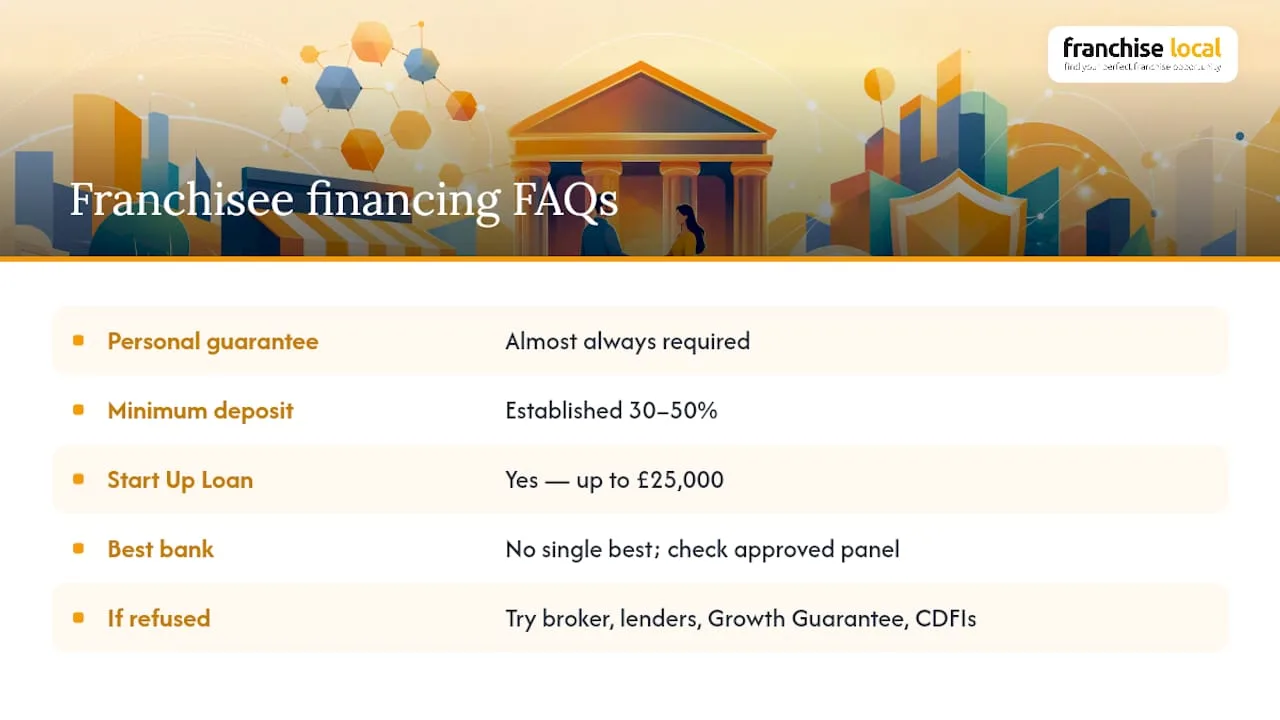
Almost always, yes. First-time buyers should expect to sign a personal guarantee, though you can negotiate a capped guarantee and ask for security to be released as the business hits agreed milestones.
What’s the minimum deposit for franchise bank financing in the UK?
It varies by brand maturity. Established franchises may only need 30 to 50% of total investment from you, while newer concepts often require a larger personal contribution because banks fund a smaller share of the total cost.
Can I combine a Start Up Loan with a bank loan for my franchise?
Yes, this is common practice. A Start Up Loan of up to £25,000 often covers the gap between your deposit and what a bank is willing to lend, and it comes with free mentoring support.
Which UK bank is best for franchise loans?
There’s no single best answer. NatWest, Barclays, Lloyds, HSBC and Metro Bank all run franchise-specific teams, and the right one depends on whether your chosen brand already sits on that bank’s approved panel.
What happens if a bank says no to my franchise loan application?
Try a specialist franchise finance broker, a different high-street lender, or schemes such as the Growth Guarantee Scheme and CDFIs listed by the British Business Bank for businesses that don’t fit mainstream criteria.