

After the 2026 revaluation, most high street franchise units qualify for lower RHL multipliers, but you must check your Valuation Office Agency entry now. Sign in to your business rates valuation account, estimate your bill with the correct multiplier, and confirm whether Supporting Small Business Relief protects you from a sharp increase.
What changed in 2026 and why it matters for franchises
The Valuation Office Agency updated rateable values across England and Wales from 1 April 2026, based on rental evidence from 1 April 2024. For franchise operators running shops, cafés or gyms, this revaluation lands alongside a permanent change to how retail, hospitality and leisure premises are taxed.
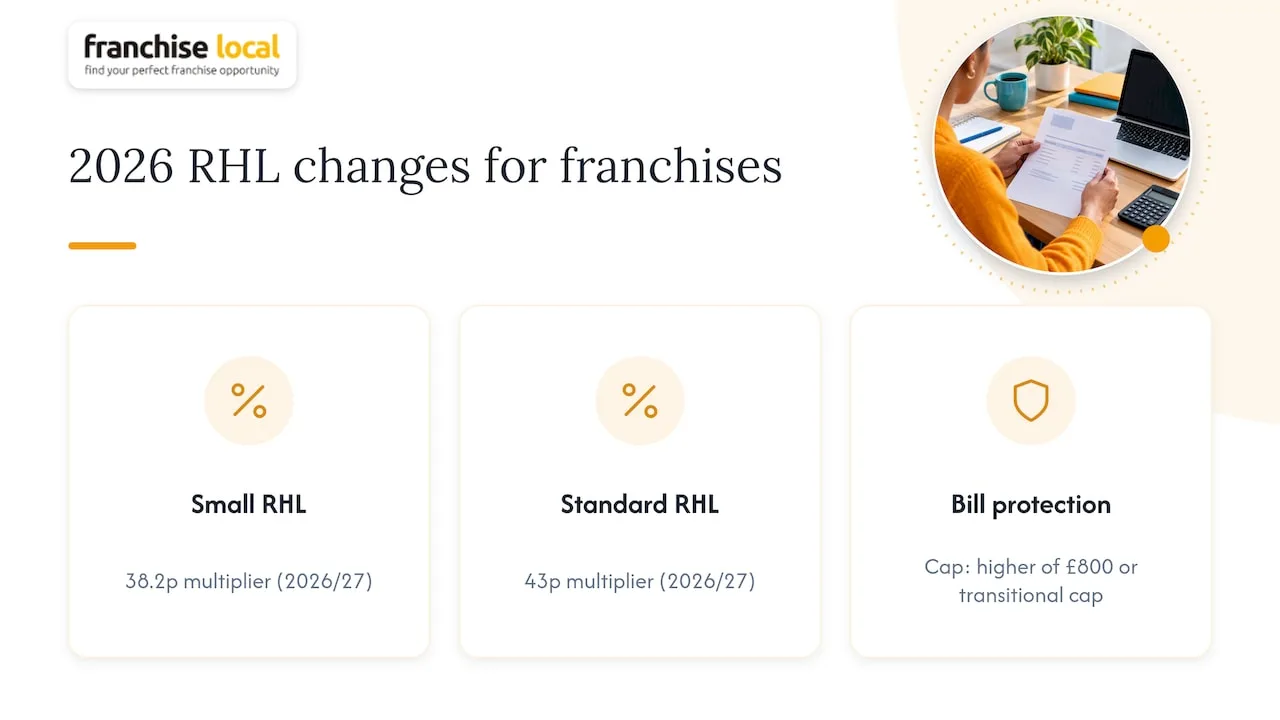
For 2026/27, the small business RHL multiplier is 38.2p and the standard RHL multiplier is 43p, replacing the temporary RHL relief scheme that ran in cash-capped form for several years. These lower rates apply specifically to qualifying retail, hospitality and leisure premises, which cover a large share of franchised units on the high street.
The funding logic behind this is straightforward: a higher multiplier on very large properties subsidises the lower RHL rates for smaller occupiers, shifting some of the burden up the property scale rather than removing it. For franchisees running a single unit or a small cluster of sites, this generally works in your favour.
Businesses losing existing reliefs face a separate protection. The 2026 Supporting Small Business Relief scheme caps bill increases at the higher of £800 per year or the relevant transitional relief cap, applied for up to three years from 2026/27. If your franchise site previously benefited from small business relief that is now reduced, this cushions the transition rather than leaving you exposed to the full increase in one go.
How business rates are calculated: a practical breakdown
Every business rates bill starts with the same formula. Your rateable value, an estimate of the annual rent your property could achieve, is multiplied by the relevant multiplier to produce the gross bill, and reliefs are then deducted.
GOV.UK confirms the formula as rateable value multiplied by the multiplier equals gross bill, with reliefs and discounts applied afterwards and transitional caps limiting how fast a bill can rise or fall between revaluations. The Valuation Office Agency sets rateable value using a fixed valuation date, currently 1 April 2024 for bills from April 2026, based on comparable rental evidence for similar property types.
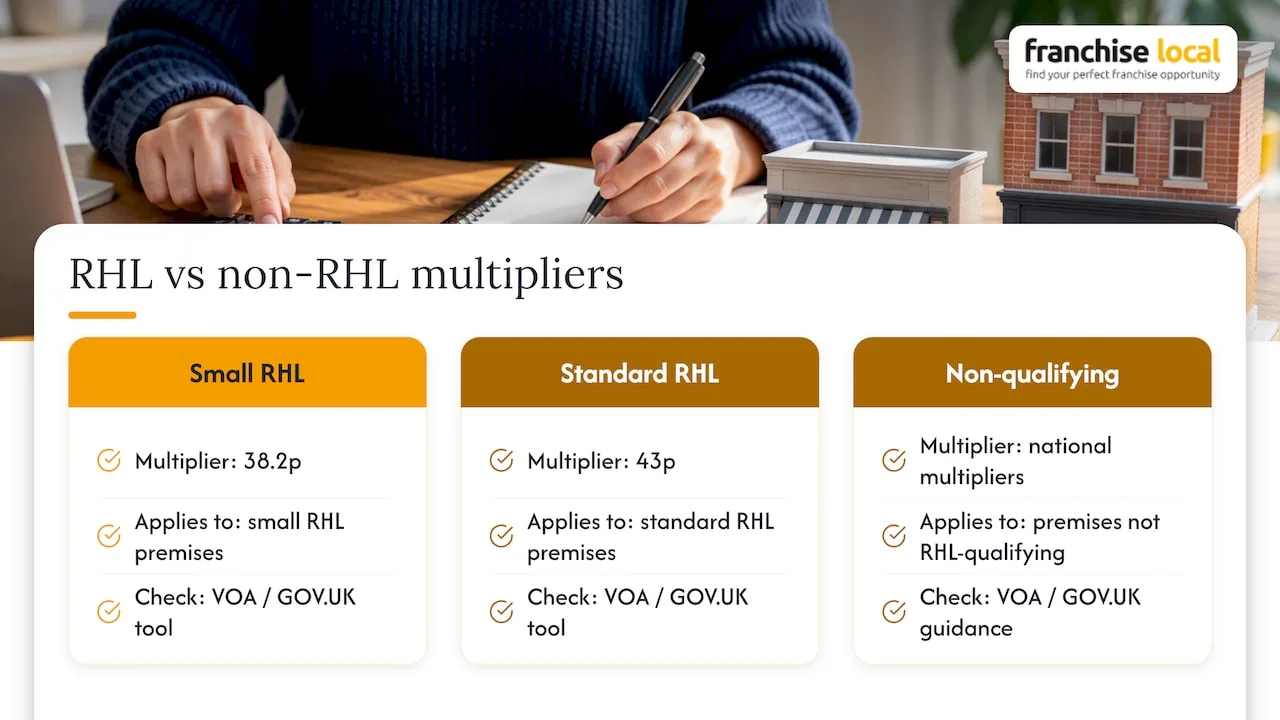
Choosing the right multiplier matters. Small RHL premises use 38.2p, standard RHL premises use 43p, and non-qualifying premises use the national small business or standard multipliers instead. You can find your rateable value and the applicable multiplier using the VOA’s “find a business rates valuation” tool, then cross-check the figure against GOV.UK’s guidance before budgeting for the year ahead.
Reliefs, eligibility and how they apply to franchised businesses
Franchise owners often run leaner margins than the parent brand suggests, so reliefs are worth understanding property by property rather than assuming national rules apply evenly.
- Small Business Rate Relief thresholds vary by rateable value, and taking on a second property no longer ends eligibility immediately: the grace period has been extended to three years, a material benefit if you are expanding to a second or third franchise unit.
- RHL qualification typically covers shops, cafés, restaurants, pubs and gyms, but excludes warehouses, distribution units and many back-office or head-office functions that franchisees also lease.
- Transitional relief and SSBR work together: statutory caps by rateable value band limit annual increases through 2028/29, and SSBR tops up protection for anyone losing relief outright.
- Devolved differences matter if you operate across borders: Wales has set its own retail multiplier with a 15% hospitality relief up to a £110,000 cap, while Scotland retains the Small Business Bonus Scheme for cumulative rateable values up to £35,000, so a franchise portfolio spanning England, Wales and Scotland needs separate calculations for each nation.
Local authorities also apply some discretion in how reliefs are administered, so two franchise sites with identical rateable values in different council areas can end up with different net bills.
Checking and challenging your property’s valuation
Franchise premises frequently carry valuation errors inherited from a previous occupier, a mistaken floor area, or a fit-out that no longer exists. Correcting these before your first bill lands can prevent months of overpayment.
- Sign in to your business rates valuation account on GOV.UK and locate your property record.
- Review the factual details held by the VOA, including floor area, property type and any fixtures.
- Start a “check” to correct any factual errors before pursuing a formal valuation dispute.
- Gather evidence: comparable rents, photographs, floor plans, lease terms and previous bills.
- Submit a challenge within four months of the check decision if the rateable value still looks wrong, including a proposed new figure supported by evidence.
Pro Tip: Challenges submitted without a proposed rateable value are less likely to succeed, so agree your evidence and target figure before you submit.
Appointing a rating agent makes sense once the numbers involved justify the fee, particularly for multi-site franchisees where a single valuation error might repeat across several properties. Expect the check stage to take a matter of months rather than weeks, so start the process as soon as you take on premises rather than waiting for the first bill.
Practical budgeting: estimate your bill and plan for changes
A worked example makes the formula concrete. Say a franchise unit has an illustrative rateable value of £35,000 and qualifies for the standard RHL multiplier of 43p. The gross bill before relief would be £35,000 multiplied by 0.43, giving £15,050 for the year.
If the site also qualifies for a relief that reduces the bill by, say, £3,000 as an illustrative figure, the net annual bill falls to £12,050, or roughly £1,004 a month before any transitional cap adjustments. These are illustrative inputs only, useful for modelling rather than quoting to a landlord or franchisor.
When building your own model, work through a short checklist:
- Confirm whether transitional caps or Supporting Small Business Relief apply to your specific rateable value band.
- Build base, optimistic and cautious scenarios rather than a single fixed number.
- Re-run your estimate before signing a lease renewal, taking over an existing franchise site, or opening a new one.
The 2026 revaluation replaced temporary cash caps with permanent lower RHL multipliers, which gives franchise investors a more stable basis for long-term cost forecasting than the previous system offered.
Impact of business rates on franchise profitability and cash flow management
Business rates sit alongside rent as one of the largest fixed costs a franchise site carries, and unlike royalties or marketing levies, they are payable regardless of turnover. A quiet month does not reduce the bill.
This fixed nature makes rates a particular pressure point for franchisees in their first year, when revenue is still building towards the levels the franchisor’s projections assumed. Modelling your rates liability alongside royalty payments, rent and stock costs before you sign gives a realistic picture of the break-even point, rather than one based on turnover alone.
Cash flow planning benefits from treating rates as a monthly outgoing rather than a single annual demand, since most councils allow payment over ten or twelve instalments. Building that monthly figure into your budget from day one, alongside the transitional caps and reliefs covered earlier in this guide, avoids the scramble that catches out franchisees who only look at the annual total. Reviewing our franchise business checklist before committing to a site helps you weigh rates against the wider cost base.
Differences in business rates liability between franchise owners and independent businesses
The rules themselves do not distinguish between a franchisee and an independent trader: rateable value and multiplier apply to the property, not the business model occupying it. Where the practical difference emerges is in negotiation and information.
Franchisors often hold data across their existing network on typical rates liabilities for comparable units, which can give a franchisee useful benchmarks that an independent trader opening a first site would not have access to. Some franchise agreements also specify who handles rates administration, particularly where the franchisor retains the head lease and sublets to the franchisee, shifting both the paperwork and, in some structures, the direct liability.
Independent operators negotiate rates matters entirely on their own, while franchisees can sometimes draw on the franchisor’s experience of previous rate reviews or revaluations at sister sites. That said, the underlying appeal and relief processes are identical for both, and no relief scheme treats franchised premises differently from independently owned ones purely because of the business structure.
Common exemptions and reliefs specific to franchises or chain businesses
No relief scheme is written exclusively for franchises, but several apply in ways that matter to how franchised sites are typically structured. Small Business Rate Relief and the RHL multipliers apply per property, so a franchisee running several small units across different locations may find each site individually eligible, even though the brand as a whole operates dozens of outlets nationally.
This property-by-property approach is worth understanding clearly: a franchisor’s national scale does not affect an individual franchisee’s eligibility for small business reliefs, because rates liability sits with the occupier of each specific property, not the brand. The extended three-year grace period for a second property is particularly relevant here, since many franchisees expand from one unit to two within their first few years of trading.
Chain-wide exemptions do not exist as a separate category. What does exist is empty property relief, available if a unit sits vacant between franchisee changeovers, and the check and challenge process outlined earlier, which applies identically whether the occupier is a sole trader, a franchisee or a national retailer. Understanding these mechanics property by property, rather than assuming brand-wide treatment, is the more useful mental model for any multi-site franchise owner.
How business rates affect site selection and franchise expansion planning
Rateable value varies enormously between locations even within the same town, and factoring this into site selection before signing a lease protects your margin from day one. A property with a high rateable value in a prime pitch might carry a rates bill that erodes much of the footfall advantage it offers.
Checking a prospective site’s rateable value using the VOA’s valuation tool before committing to a lease is a straightforward step that many first-time franchisees skip, focusing instead on rent and footfall alone. Comparing rates liability across two or three shortlisted locations, alongside rent and local competition, gives a fuller picture of which site will actually be more profitable.
For franchisees planning multi-site expansion, the extended SBRR grace period changes the calculation on timing. Opening a second site no longer means losing small business relief on the first property immediately, which softens the cash flow impact of scaling up. Reviewing sector-wide trends in our franchise industry trends guide alongside your own site-specific rates modelling helps identify which franchise models and locations are better positioned for the multiplier structure now in place.
Practical advice on negotiating business rates liabilities when taking over a franchise location
Taking over an existing franchise unit, rather than opening on a fresh site, brings its own set of rates questions worth raising before you sign anything. Ask the outgoing franchisee or the franchisor for the current rates bill, the rateable value on record, and whether any check or challenge is already in progress.
Request copies of the last two years of rates bills as part of due diligence, since these reveal whether the site has benefited from small business relief, RHL treatment or transitional protection, and whether that protection will continue once you take over as the new ratepayer. A change of occupier can sometimes trigger a fresh review of eligibility, so confirm this with the local authority directly rather than assuming continuity.
If the property’s factual details appear inaccurate, such as an overstated floor area from a previous fit-out, raise a check with the Valuation Office Agency before completion rather than after, since correcting the record can lower the rateable value you inherit. Negotiating a modest reduction in the purchase price or transfer fee to reflect an unresolved rates dispute is also a reasonable position to take if the figures look questionable. Our franchise business checklist covers the wider due diligence steps worth running alongside this.
How Franchiselocal supports franchise planning and discovery
Understanding business rates is one part of choosing the right franchise. A directory lets you filter opportunities by investment level, industry and location, making it easier to compare franchise models against the property costs you have just worked through.
Narrowing your search by industry helps you spot which franchise types typically occupy RHL-qualifying premises, such as retail and hospitality formats, versus those operating from industrial or back-office space that falls outside RHL treatment. Browse trending franchise opportunities or explore listings by industry to pair your rates planning with a shortlist of franchise brands that fit your budget and site strategy.
FAQ
What size is exempt from business rates?
Very low rateable values can qualify for full relief under Small Business Rate Relief rather than a blanket size exemption, though the precise thresholds depend on your rateable value band. Check your specific property’s rateable value against current GOV.UK guidance to confirm your position, since eligibility is set per property rather than by floor area alone.
What are the changes to small business rates relief for the 2026/27 financial year?
The main change is the extension of the grace period for businesses taking on a second property, now three years instead of one. Alongside this, the permanent RHL multipliers and the Supporting Small Business Relief scheme, which caps increases at the higher of £800 a year or transitional relief levels, both took effect from 2026/27.
Does a small business have to pay business rates?
Most small businesses occupying commercial premises are liable for business rates, though many qualify for relief that reduces or removes the bill entirely depending on rateable value. Confirming your rateable value and checking eligibility for Small Business Rate Relief through your local council is the quickest way to establish your actual liability.
How can I calculate my business rates for 2026?
Multiply your property’s rateable value by the relevant multiplier, using 38.2p for small RHL premises or 43p for standard RHL premises, then deduct any reliefs you qualify for. GOV.UK’s business rates estimator walks through each step and lets you check the figures against your specific property.