

Brexit did not create a new franchise law, and it did not end franchising in the UK. What it did was separate the UK from the EU’s legal and trade framework. That affects four areas: competition rules for franchise agreements, trade mark and design protection, the cost and paperwork of moving goods across the border, and data protection. If you are buying a UK-only franchise, most of it will touch you indirectly. If you are a franchisor selling in both markets, it touches you directly.
This guide sets out each change in plain terms, says who it matters to, and gives you a short list of checks before you sign or expand. You can also browse UK franchises for sale on Franchise Local, filtered by investment level, industry, lifestyle and location, once you know what to look for.
The short version: what changed and what stayed the same
The UK left the EU on 31 January 2020, and the transition period ended on 31 December 2020. From 1 January 2021 the UK became a third country, meaning a country outside the EU’s single market and customs union.
What changed
- Purely domestic UK franchise systems are now judged under UK competition law, not EU competition law.
- EU trade marks and registered Community designs stopped covering the UK. The UK created its own equivalent rights.
- Goods moving between Great Britain and the EU became subject to customs declarations and VAT treatment like trade with any other non-EU country.
- The UK GDPR replaced the EU GDPR as the data protection regime in the UK, read together with the Data Protection Act 2018.
What stayed the same
- There is still no dedicated franchise statute in the UK. General law applies: contract law, consumer law, competition law, employment law and intellectual property law.
- The industry still self-regulates through the British Franchise Association (BFA) and its code of ethical conduct.
- A franchise agreement is still a private contract, and the common law approach of “buyer beware” still applies.
That last point is why preparation matters. Our guide to franchise regulation in the UK explains how the framework works for buyers and franchisors, and what the UK franchise associations do shows where the self-regulatory standards come from.
Competition law: the biggest legal change for franchise agreements
Franchise agreements contain restrictions: territories, non-compete clauses, supply obligations, pricing guidance. Competition law decides which of those are acceptable. Before Brexit, the EU’s Vertical Block Exemption Regulation (VBER) gave franchisors a “safe harbour”, a set of conditions under which an agreement is automatically treated as compliant.
After Brexit the UK kept the old EU rules in domestic law for a time. That arrangement ended when the EU rules expired on 31 May 2022. The UK then introduced its own Vertical Agreements Block Exemption Order (VABEO), which came into force on 1 June 2022 and runs until 1 June 2028. The EU introduced a revised VBER of its own.
For most franchisors the UK order brought practical improvements. The BFA reported that:
- post-termination non-compete clauses now cover vehicle-based franchises;
- in-term non-competes can run beyond five years where the franchisor owns the vehicle;
- “know-how” is defined more simply, as a package of practical information that is not generally known but is significant and useful;
- franchisors can exchange information with franchisees even where the franchisor also competes with them.
Where the UK and EU rules now differ
Both regimes use a 30% market share threshold for the safe harbour. The differences are in the detail. For example, the UK treats wide retail parity clauses (clauses that stop a seller offering better prices elsewhere) as hardcore restrictions, which can remove the exemption for the whole agreement. The EU rule is narrower and targets those imposed by online platforms. The two regimes also expire on different dates: 2028 in the UK and 2034 in the EU.
What this means for you
- Buying a UK-only franchise: UK competition law governs your agreement. A properly drafted agreement should sit within the UK block exemption. If your agreement was signed before June 2022, it may be worth asking the franchisor whether it has been updated.
- Franchisor selling in the UK and the EU: assess each regime separately. Check market share, hardcore restrictions, resale price maintenance, and the length and scope of non-competes in each territory. One agreement template will not automatically satisfy both.
A franchise lawyer should review this. Our article on why legal advice is vital before buying a UK franchise explains what a review covers.
Trade marks and designs: two registers, not one
A franchise sells a brand. Protecting that brand is the franchisor’s job, and Brexit split the protection in two.
Until the end of 2020, an EU trade mark covered the UK. From 1 January 2021 it no longer did. To avoid a gap, the UK Intellectual Property Office (IPO) created a comparable UK trade mark for every registered EU trade mark. These kept their original filing dates and priority dates, and the owner paid no fee and made no application. Pending EU applications could be re-filed as UK applications within nine months, keeping the earlier date. Registered Community designs were replaced in the same way by UK registered designs.
The replacement UK rights are independent of the EU rights. They can be challenged, assigned, licensed and renewed separately. UK trade marks last ten years and can be renewed for further ten-year periods.
What this means in practice
- Franchisors: if you want protection in both markets, you need protection in both registers: one application to the UK IPO and one to the EU IPO, or an international filing designating both. Fees and processes are separate. Decide what protection you need before entering a market, not after.
- Franchisees: check that the brand you are buying is registered in the UK, in the franchisor’s name or the name of the company that licenses it to you. The right to use the brand is the core of what you pay for. Copyright also protects the manuals, training videos and software you receive, but only registered marks give exclusive rights over the name and logo.
- Cross-border brands: if a franchisor’s brand was originally registered only as an EU trade mark and later cloned, ask for confirmation that the UK right is in place and who owns it.
The IP clause in your agreement should say who owns what, what you may use and what happens to branding when the agreement ends. Franchise agreements and their role for UK entrepreneurs walks through the clauses buyers see most often.
Supply chains: customs, tariffs and paperwork
This is the area where franchise owners felt Brexit most directly, especially in food, hospitality, retail and any business that imports stock, ingredients or equipment.
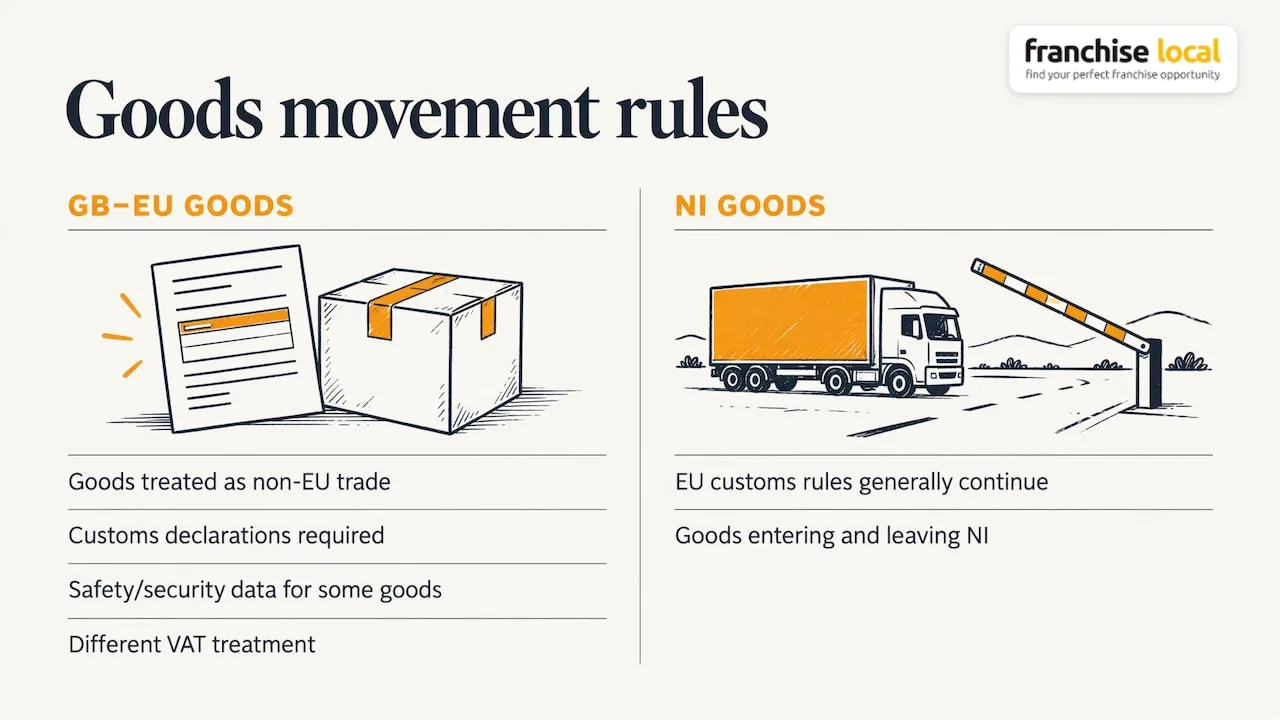
Since 1 January 2021, goods moving between Great Britain and the EU are treated like goods moving to or from any non-EU country. That means customs declarations, safety and security data for some goods, and different VAT treatment. Northern Ireland follows a different arrangement, because EU customs rules generally continue to apply to goods entering and leaving it.
The EU-UK Trade and Cooperation Agreement, in provisional force from 1 May 2021, provides for zero tariffs and zero quotas on goods that meet the rules of origin. The catch is the rules of origin. To benefit, a product must originate in the UK or EU as defined by the agreement, and the importer must be able to show it, usually through a statement on origin from the exporter. A product that is simply shipped through the UK or EU, with little made there, may not qualify and can attract tariffs.
Questions to ask a franchisor about supply
- Where do the products, ingredients or equipment come from? Are they sourced in the UK, or imported?
- If imported, who is the importer of record, and who pays duties, customs agent fees and import VAT: the franchisor, a central supplier or you?
- Are you required to buy from approved suppliers, and how are price changes passed on to you?
- Has the franchisor changed its supply chain since 2021, for instance by moving to UK producers?
Tariff and supply costs show up in your margins, so they belong in your business plan alongside royalties and marketing fees. The Franchise Planning Toolkit is a place to start building those numbers.
Some franchises responded to higher import costs by sourcing more from UK farms and producers. That can reduce exposure to border costs, although it may change the product range. A franchisee in a supply-heavy sector should expect the franchisor to explain how it handles this.
Data protection: UK GDPR now applies
Franchises collect customer data every day: bookings, loyalty schemes, email lists, payments. Since Brexit, the UK GDPR applies in the UK in place of the EU GDPR, alongside the Data Protection Act 2018. The rules are very similar in content, but they are now UK law, enforced by the Information Commissioner’s Office (ICO).
Two points matter for franchising:
- The UK GDPR directly regulates processors as well as controllers. In many franchises the franchisee and franchisor both handle the same customer data, so who is controller, who is processor and who is a joint controller needs to be set out clearly.
- If a franchise serves customers in the EU or runs across the UK-EU border, the EU GDPR may apply as well as the UK regime. A franchisor expanding abroad needs to consider both, plus local privacy rules, and may need data processing agreements between the parties.
Our guide on making your franchise ICO ready lists the five core documents a UK franchise should have in place.
Costs and tax: what Brexit did and did not change for franchisees
Brexit did not change the basic tax position of a UK franchisee, which is worth saying because many buyers worry about it. These points are the ones to plan for.
- VAT registration: UK VAT registration becomes compulsory when your taxable turnover passes £90,000 in a rolling 12 months. Royalties charged by a VAT-registered franchisor include 20% VAT. If you are not VAT-registered, you cannot recover it, so it is a real cost. Weigh voluntary registration against whether your own customers can reclaim VAT.
- Overseas franchisors: if you receive services such as IP licences, software or management services from a franchisor based outside the UK, you may need to account for VAT yourself under the reverse charge. Ask your accountant how it applies.
- Initial franchise fee: for a sole trader or partnership, HMRC guidance treats an initial franchise fee as capital expenditure, even if paid in instalments, whereas annual fees are generally allowable revenue expenses. Companies are treated differently under the intangible assets rules.
- Employment costs: employer National Insurance, workplace pension contributions and employers’ liability insurance apply as they would to any UK business. Check the current rates on GOV.UK when you build your forecast.
An accountant who knows franchising can model these before you commit.
If you are a franchisor planning to expand across the UK-EU border
Brexit made cross-border expansion a deliberate legal project rather than a simple extension of the UK network. Before you offer franchises in the EU, work through this list:
- Brand protection: file for an EU trade mark and, where relevant, EU designs. UK registrations no longer cover the EU.
- Competition compliance: test the agreement against both the UK order and the EU regulation, as the two differ.
- Local franchise rules: several EU countries have pre-contract disclosure or registration rules for franchisors. The UK does not. Take advice from counsel in each target country.
- Agreement terms: cover territory, term and renewal, fees, brand standards, IP, reporting, termination, governing law and dispute resolution, with local input.
- Disclosure: UK law has no strict duty of pre-contract disclosure, but BFA members must disclose. Using a uniform disclosure document as good practice makes international deals easier to build.
- Supply and customs: decide who is the importer, who pays duties, and whether products meet rules of origin.
- Data: map where customer data flows and which privacy regime applies.
- Heads of terms: keep them non-binding on the main commercial points. Adding binding terms such as exclusivity, confidentiality, choice of law or deposits raises the risk that they become binding without a full agreement.
What this means if you are buying a UK franchise
Most buyers will operate entirely within the UK, so Brexit rarely changes the day-to-day. It still shapes what you should ask. A short checklist:
- Is the brand’s trade mark registered in the UK, and in whose name?
- Does the franchise agreement reflect the current UK competition rules, including non-compete and pricing clauses?
- Where does the stock come from, and how exposed are you to import costs?
- Are the data protection roles between you and the franchisor clearly set out?
- Is the franchisor a BFA member, and does it give you full written disclosure before you sign?
- Have a solicitor with franchise experience and an accountant reviewed the figures and the agreement?
To see how the terms fit together, read our explanation of franchise legal requirements in the UK and the difference between a franchise licence and a franchise. For the wider picture, the Ultimate Guide to Franchising covers the buying process from first search to signing.
Where the market stands
Brexit changed the terms of cross-border trade, but UK franchising continued to operate on the same foundation: proven business models, a contract between two parties and self-regulation by the industry. Businesses that depend on imports have had to adapt, and franchisors with EU plans have had to build separate legal structures. Businesses that operate domestically, with UK-sourced supply and clear agreements, are in the simplest position. For current market direction, see UK franchising trends for 2026.
Find a franchise that fits your plan
Franchise Local is a UK franchise directory. You can filter opportunities by industry, investment level, lifestyle and location, then send an enquiry to the franchisors you want to know more about. Searching and enquiring are free for buyers. If you work with business-to-business or finance models, where supply chain exposure to the border is often lower, our lists of business to business franchises and financial business franchises are good places to begin. Franchisors and brokers who want to reach buyers can find out about listing on Franchise Local and read about the role of listings in franchising.
FAQ
Is there a specific franchise law in the UK after Brexit?
No. The UK has no legislation aimed specifically at franchising, before or after Brexit. General law applies, including contract, competition, consumer, data protection and intellectual property law, and the industry self-regulates through the British Franchise Association and its code. That is why a careful reading of the franchise agreement matters.
Do EU trade marks still protect a franchise brand in the UK?
No. Since 1 January 2021 an EU trade mark no longer covers the UK. The UK IPO created comparable UK trade marks for existing EU registrations, keeping their original dates. A franchisor that wants protection in both markets now needs both a UK and an EU registration.
Does Brexit affect a franchise that only operates in the UK?
Mainly through costs and compliance, not through the franchise model. Domestic agreements fall under UK competition law, data is governed by the UK GDPR, and any imported stock may face customs steps and costs. Ask the franchisor how supply and pricing have been handled.
Which competition rules apply to a UK franchise agreement today?
For a purely UK system, the UK Competition Act 1998 and the Vertical Agreements Block Exemption Order apply. The order has been in force since 1 June 2022 and runs until 1 June 2028. If the franchise also operates in the EU, EU competition rules may apply to that part of the network.
Do I need legal advice before buying a franchise?
Yes. Because the law leaves the detail to the contract, a solicitor experienced in franchising should review your agreement before you sign. An accountant should check the financial projections and VAT position as well.