

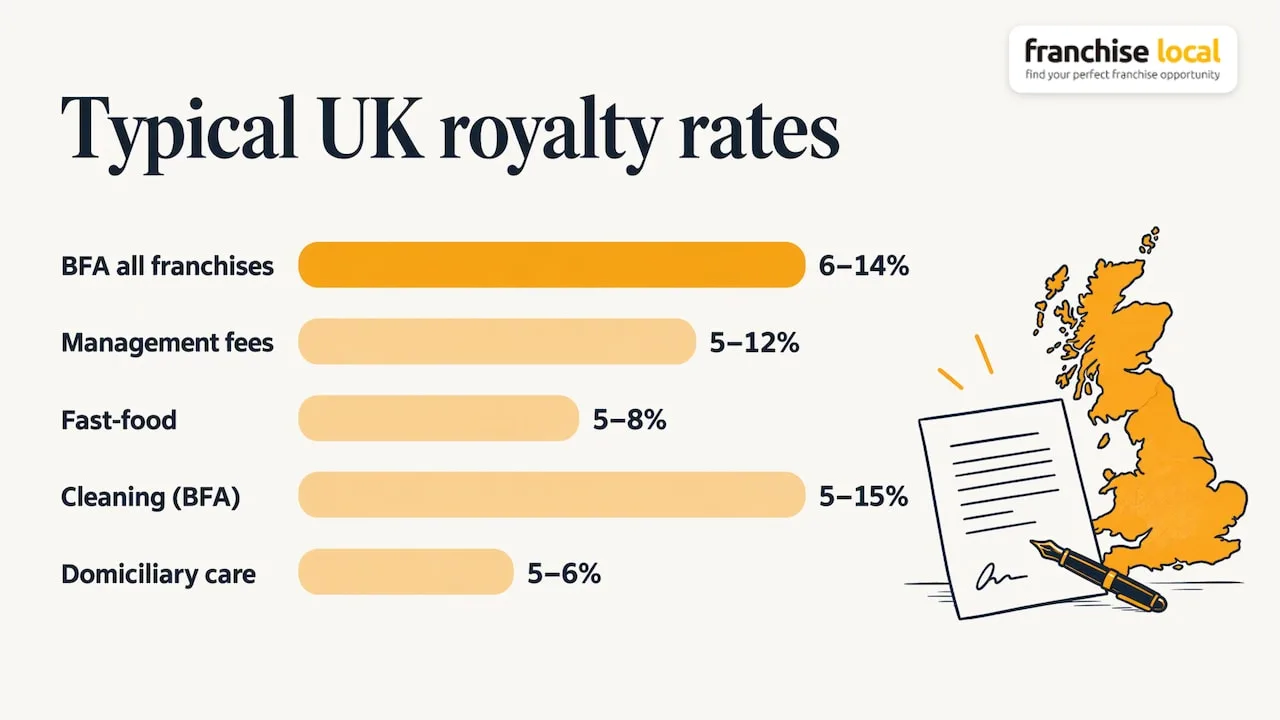
Most UK franchise royalties sit between 5% and 10% of gross sales, and the British Franchise Association (BFA) puts the typical range at 6% to 14% of gross revenue. The percentage is only part of the picture. Marketing levies, technology fees and VAT sit on top, and together they decide what a franchise really costs you each month. This guide shows the ranges by sector, how the fee is calculated, what to check in the agreement and how to compare brands on total cost rather than headline rate.
What a royalty is, and what it is not
A royalty is the ongoing payment you make to the franchisor for as long as your agreement runs. It is usually weekly or monthly. It pays for continued access to the brand, the operating system, training, software and support.
It is separate from the initial franchise fee. The initial fee is a one-off payment when you join, which gives you the right to trade under the brand and use its systems. The royalty is the running cost. The BFA notes that agreements typically last between 5 and 20 years, so a royalty is a long commitment, not a short-term charge.
In the UK you will also see the same charge called a management service fee (MSF). It is the same idea under a different name. For the entry cost side, see our guide to the franchise fee explained, and for the full picture of what owners pay, read what franchisees pay to own a brand.
Typical UK franchise royalty rates
There is no legal standard rate in the UK. Published figures differ by source and by sector, which is why it helps to see them side by side.
| Sector or source | Typical royalty or MSF |
|---|---|
| BFA, all UK franchises | 6% to 14% of gross revenue |
| UK franchise management fees, across sectors | 5% to 12% of turnover, with most networks between 8% and 10% |
| Fast-food franchising | 5% to 8% of gross sales |
| Cleaning franchises (BFA, 2026 guide) | Commonly 5% to 15% of turnover |
| Domiciliary care franchises | 5% to 6% of turnover, plus about 2% marketing levy |
| Business services and professional franchises | Often at the lower to middle part of the range, depending on support |
Two things explain the spread. The first is how much the franchisor does for you. A brand that supplies leads, central booking, software and field support will usually charge more than one that provides a system and an occasional visit. The second is your margin. A sector with thin margins cannot carry a high percentage, which is why food and care franchises tend to sit lower than some service models.
Treat any single average with caution. A rate of 6% on a high-margin business can be easier to carry than 4% on a low-margin one. Our guide to franchise royalty fees and how much they should be goes deeper on that comparison.
How royalties are calculated
The most common method is a fixed percentage of gross sales. If your agreement says 6% and you sell £100,000 in a month, you owe £6,000 plus VAT, so £7,200 once 20% VAT is added where the franchisor charges it.
Other structures appear in UK agreements:
- Fixed percentage. The same rate for the whole term. It is the simplest to forecast.
- Increasing percentage. A lower rate while you are building the business, rising later.
- Decreasing or tiered percentage. The rate falls as sales grow. For example, 5% on the first £10,000 of weekly turnover, 4% on the next £10,000 and 3% above that. On £25,000 in a week, that is £500 plus £400 plus £150, or £1,050, an effective rate of 4.2%.
- Fixed fee. A set weekly or monthly sum regardless of sales. It rewards growth but is harder to carry in a slow month.
- Minimum or percentage. You pay the higher of a minimum sum or the percentage. The minimum protects the franchisor when sales are low.
Payment frequency follows the sector. Weekly payments are common in food, hospitality and retail. Monthly is more usual in professional services. Quarterly appears in some business-to-business models.
Some systems do not show a royalty at all. They earn through a mark-up on products you must buy, a technology platform fee or a central marketing levy. If a brand advertises no royalty, ask what replaces it and add that cost to your forecast.
The percentage is not the whole cost
The royalty is one line in a list of recurring charges. The others usually include:
- A marketing contribution, commonly 1% to 3% of turnover, pooled for national or regional promotion.
- A technology or software fee, often a fixed monthly sum.
- Other network charges such as insurance, training days or conference costs.
- VAT on all of the above where the franchisor is VAT registered.
Here is how that adds up on £100,000 of monthly sales:
| Charge | Monthly cost |
|---|---|
| 6% royalty | £6,000 |
| 2% marketing contribution | £2,000 |
| Technology fee | £750 |
| Other network charges | £250 |
| Total | £9,000, or 9% of turnover |
A headline 6% became 9%, before VAT. A UK legal review service warns that a 6% royalty combined with marketing, service fees and other charges can reach 10% to 15% of turnover. On a tight-margin business, that is the difference between a comfortable living and a struggle.
The BFA makes the same point in its 2026 cleaning franchise guide: total cost of ownership matters more than the entry price, and a cheap franchise can become the most expensive when software, marketing and system costs are charged separately.
A worked example: care franchise
UK domiciliary care franchises typically charge an upfront fee of around £20,000 to £35,000 plus VAT, then 5% to 6% of turnover in royalties and about 2% in marketing levies for the whole term. On £500,000 of annual turnover that is roughly £30,000 in royalty and £10,000 in levy, about £40,000 a year.
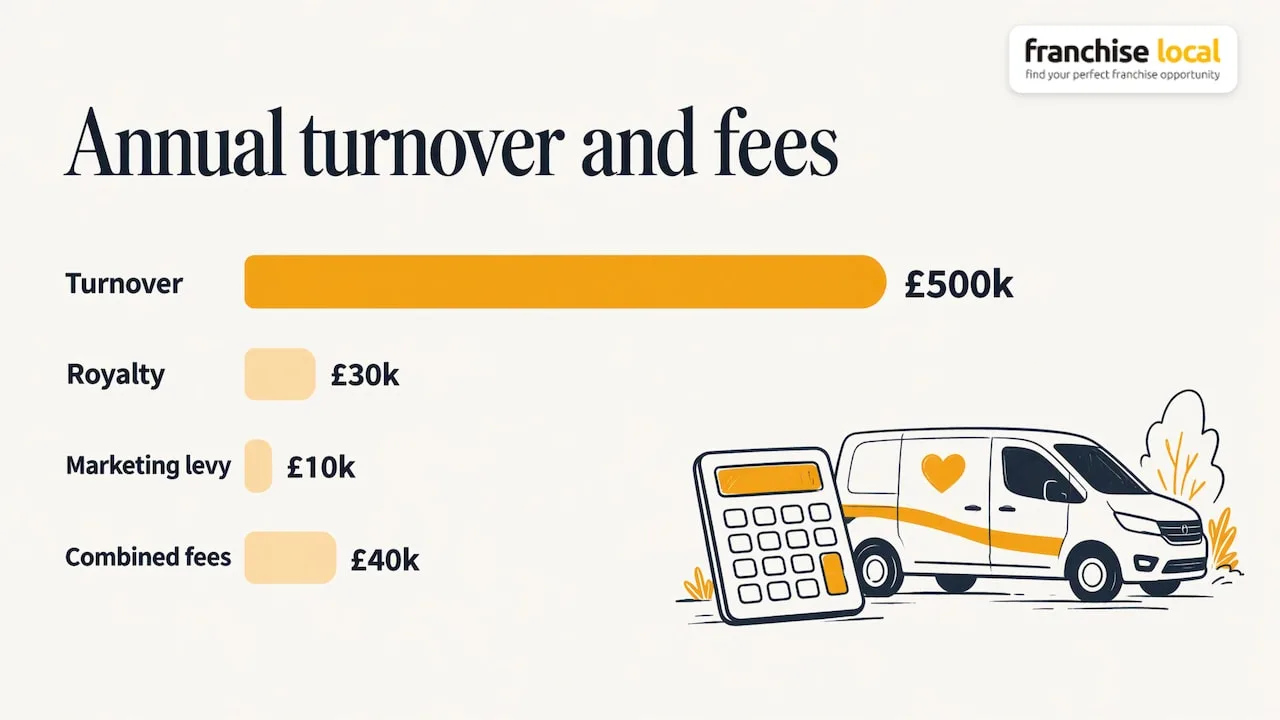
Sector net margins of 8% to 12% mean the fee is charged on the whole turnover while your profit is only a slice of it. That is why a royalty must be tested against your own margin, not judged by its percentage. Our franchise unit economics guide walks through the four numbers that decide whether a unit makes money.
Tax and VAT on royalties
HMRC treats the two kinds of payment differently. Its Business Income Manual says the initial franchise fee is usually capital, as are the related legal fees, so it is not deductible against trading profit. Part of the initial fee can sometimes be treated as revenue where it clearly covers something like staff training, depending on the facts. The ongoing annual fees you pay are generally allowable expenses when working out your taxable profit.
VAT matters for cash flow. Where the franchisor is VAT registered, royalties and marketing contributions normally carry VAT at 20%. If your own turnover is below the VAT registration threshold, which is £90,000, you cannot reclaim it. A franchisee with £70,000 of turnover and a 10% royalty pays £7,000, and roughly £1,400 a year of that is VAT you cannot recover. Build this into your forecast from the start, and ask your accountant to confirm your position.
What to check in the agreement
The UK has no franchise statute and no legal requirement for formal disclosure documents, so the agreement is the whole relationship. The sector relies on self-regulation, including the BFA’s Code of Ethics. That makes the agreement the place where royalty disputes are won or lost, and most disputes are about what the percentage applies to rather than the percentage itself.
Check these points before you sign:
- The definition of gross sales. Does it include or exclude VAT, refunds, vouchers, discounts, tips and sales through delivery platforms? A narrower base lowers your bill.
- What the initial fee includes. Are training, equipment, stock and premises fit-out covered, or payable on top?
- Payment timing. Weekly, monthly or quarterly, and the due date after the period ends.
- Reporting and audit rights. How often you report, which till or software you must use, and who pays for an audit.
- Late payment. Grace periods, default interest and whether non-payment lets the franchisor terminate.
- The marketing fund. Whether the franchisor must account for how it is spent. Reading the annual fund statement is the simplest way to judge its value.
- Changes. How far the franchisor can change the fee, the product range or the approved supplier during the term.
- Minimums. Whether a minimum payment applies when sales are low, such as in the first months.
Have a solicitor experienced in franchising review the agreement before you commit. They can tell you how each clause applies to your situation.
Can you negotiate royalty terms?
Franchisors often describe the agreement as a standard template, because every franchisee in a network is meant to operate in the same way. Terms that protect brand consistency rarely move. Some commercial points do, and franchisees have sought changes to territory, performance targets, marketing contributions and sometimes the royalty itself.
Practical areas to raise include:
- Extended payment terms on the initial fee.
- Additional training or support after opening.
- A right of first refusal if a nearby territory comes up for sale.
- A reduced or stepped royalty while the business is starting up.
Go in with a forecast. A franchisor will respond better to a clear case built on your projected turnover and margin than to a general request for a lower rate. Decide which two or three terms matter most to you before the conversation starts.
How to judge whether a rate is fair
No royalty percentage is fair or unfair on its own. What matters is the value you get for what you give up. On one side are the brand, the systems, the support and your territory. On the other are your independence, your freedom over pricing and suppliers, and your flexibility to leave.
A higher royalty with strong demand, good margins and proven systems can outperform a lower royalty on weak economics. Use this method to compare brands:
- List every recurring charge, not only the royalty, and express each as a percentage of turnover.
- Add them up, then add VAT where you cannot recover it.
- Subtract the total from the brand’s typical gross margin, then your own running costs.
- Link the royalty and levy lines in your cash flow forecast directly to forecast turnover, so the numbers update when your sales assumptions change.
- Run the forecast again at 70% of expected sales to see how the fees behave in a slow first year.
Our guide on how to evaluate franchise costs gives you a fuller framework, and the average franchise fee and the real cost shows how a roughly £14,000 average fee compares with an average total investment of around £45,000. For a wider read on what each fee type means in practice, see royalties in franchising: the UK guide.
Compare brands on fees in one place
Franchise Local is a UK directory where you can filter franchise opportunities by industry, investment level, lifestyle and location. Searching is free for buyers. Browse the trending franchise opportunities to see which sectors are drawing interest, then shortlist the brands that fit your budget and compare their fee structures using the checks above. If you are new to the model, the ultimate guide to franchising covers the basics from the first search to signing.
FAQ
What is a normal royalty rate for a UK franchise?
The BFA gives a typical range of 6% to 14% of gross revenue. Many networks settle between 8% and 10%, and some sectors such as fast food sit lower, at around 5% to 8%. Always add marketing levies and technology fees to get the true recurring cost.
Is the royalty charged on profit or on sales?
In most UK franchises it is a percentage of gross sales or turnover, not profit. You owe it even in a month when you make little or no profit. This is why checking the royalty against your forecast margin matters before you sign.
Do I pay VAT on franchise royalties?
Where the franchisor is VAT registered, royalties and marketing contributions normally carry VAT at 20%. If you are VAT registered you can usually reclaim it. If your turnover is below the £90,000 registration threshold, it is an extra cost, so include it in your forecast.
Are royalty payments tax deductible?
Generally yes. HMRC treats ongoing franchise fees as allowable expenses when working out taxable trading profit. The initial franchise fee is usually capital and is not deducted in the same way. Confirm your own position with an accountant.
Can a franchisor change my royalty during the agreement?
Only if the agreement allows it. This is why you should check how far the franchisor can change fees, products or suppliers before you sign, and ask a franchise solicitor to review the wording.