

A franchise competitor analysis is a structured comparison of the franchise you are considering against three groups: other franchises you could buy, independent businesses offering the same service in your area, and other outlets inside the same network. Done well, it tells you whether a brand is worth the investment, whether your territory is viable and what you must do better than the business down the road. This guide sets out a five-step method you can complete before you sign anything.
Why competitor analysis matters when you buy a franchise
Most competitor analysis advice is written for people launching their own brand. A franchise buyer has a different job. The brand, the product and the operating system already exist, so your question is not “how do we stand out?” but “is this the right system, in the right place, at the right price?”
The UK market is large enough that the choice is real. The British Franchise Association’s 2024 survey reported 1,009 UK franchise systems and 50,421 franchised units, contributing £19.1 billion to the economy, with 89% of units profitable. Those are sector-wide figures. They show a substantial, varied market, but they do not prove that any single brand or territory will work for you. That is what your own analysis is for.
A good analysis answers four practical questions:
- How does this franchise compare with the alternatives on cost, support and terms?
- Who will compete with me for customers in my catchment?
- How close are other outlets from the same brand?
- What would I need to do to win business locally?
Step 1: Identify your three types of competitor
Before you collect any data, decide who counts. A franchise buyer faces rivals at three levels, and each needs a different kind of research.
| Competitor type | Who they are | What you learn from them |
|---|---|---|
| Rival franchises | Other franchise brands you could buy instead | Fees, royalties, support, territory terms, track record |
| Local competitors | Independents and chains serving the same customers near your territory | Pricing, reputation, service gaps, local demand |
| Same-brand outlets | Neighbouring franchisees of the same network | Territory overlap, cannibalisation risk, real-world performance |
Within the local group, it helps to separate direct and indirect rivals. Direct competitors offer similar products or services to similar target groups, while indirect competitors meet the same need in a different way or compete for the same time and money. For a home-visit service franchise, a direct rival is another local operator. An indirect rival might be a customer doing the job themselves, or an app.
If your franchise is location-based, draw a radius around your proposed territory. The same IONOS guidance notes that offline businesses can use a radius to narrow down the list. Pick a sensible distance for how far your customers will travel or how far you will drive, then list everyone inside it.
One point of view worth testing: HeadRed argues that a franchise’s real digital rivals are often local businesses ranking just above or below it in high-intent searches, rather than national brands. Check this for your own sector by searching as a customer would and seeing who appears.
Step 2: Build a competitor file
A spreadsheet beats a pile of bookmarks. Create one row per competitor and keep the same columns for every one, so the comparison is fair.
A workable file follows the structure of a standard competitor analysis template, which records:
- Company profile, trading history, size and location.
- Products or services, features and quality.
- Prices, extra costs, discounts and pricing strategy.
- Target customers and marketing channels.
For franchise buyers, add columns the template does not cover: initial fee, ongoing fees, territory size, contract length, training and support, and the number of franchisees who have left in recent years.
Where to find the information
Start with what is public. Business Wales recommends searching Google, then reading competitor websites and social media, and following up with on-the-ground research. That includes secret shopping, phoning for a quote, trying their online ordering, asking for price lists or brochures and observing how they operate.
The guidance is written for Wales, but the method applies anywhere in the UK. Treat it as a minimum:
- Read every competitor’s website, service pages and pricing.
- Check their social media for how often they post and how customers respond.
- Request a quote or brochure as an ordinary customer would.
- Visit in person if they have premises, and note footfall, staffing and presentation.
- Record the date next to every figure, so you know how old it is.
Step 3: Compare rival franchise offers
The first layer of your analysis is franchise against franchise. If you have not yet narrowed your shortlist, our guide to how to compare franchise models covers the structural differences. Our industry directory also lets you list brands in one sector side by side before you start the detailed work.
Once you have two to four brands, compare them on the same terms:
| Criterion | What to record | Why it matters |
|---|---|---|
| Initial investment | Franchise fee plus equipment, vehicle, stock, training and launch costs | Shows the real cash you need on day one |
| Ongoing fees | Royalty, marketing contribution, technology or software fees | Determines margin once you are trading |
| Territory | Size, exclusivity, what the franchisor may do inside it | Protects your customer base |
| Support | Training length, field support, helpdesk, marketing help | Affects how fast you reach break-even |
| Contract | Length, renewal terms, resale and exit conditions | Decides your options if things change |
| Evidence | Franchisee turnover, what existing owners report | Tests the franchisor’s claims |
Figures supplied by a franchisor are a starting point, not proof. UK government-backed guidance on assessing a franchise opportunity tells prospective franchisees to assess competition locally and nationally, verify the franchisor’s claims with evidence and visit franchisees in different locations and at different levels of success. Do not rely only on the contacts the franchisor offers you. Our list of questions to ask UK franchisees gives you a script for those calls.
Read the contract as well as the brochure. How territory, fees and renewal are written can change which franchise is the better buy, so work through our guide to evaluating franchise agreements before you rank your options.
Step 4: Analyse the local competition
A strong brand can still struggle in a crowded or poorly matched area. The second layer of your analysis looks at who you will actually fight for customers.
Find local rivals the way customers do
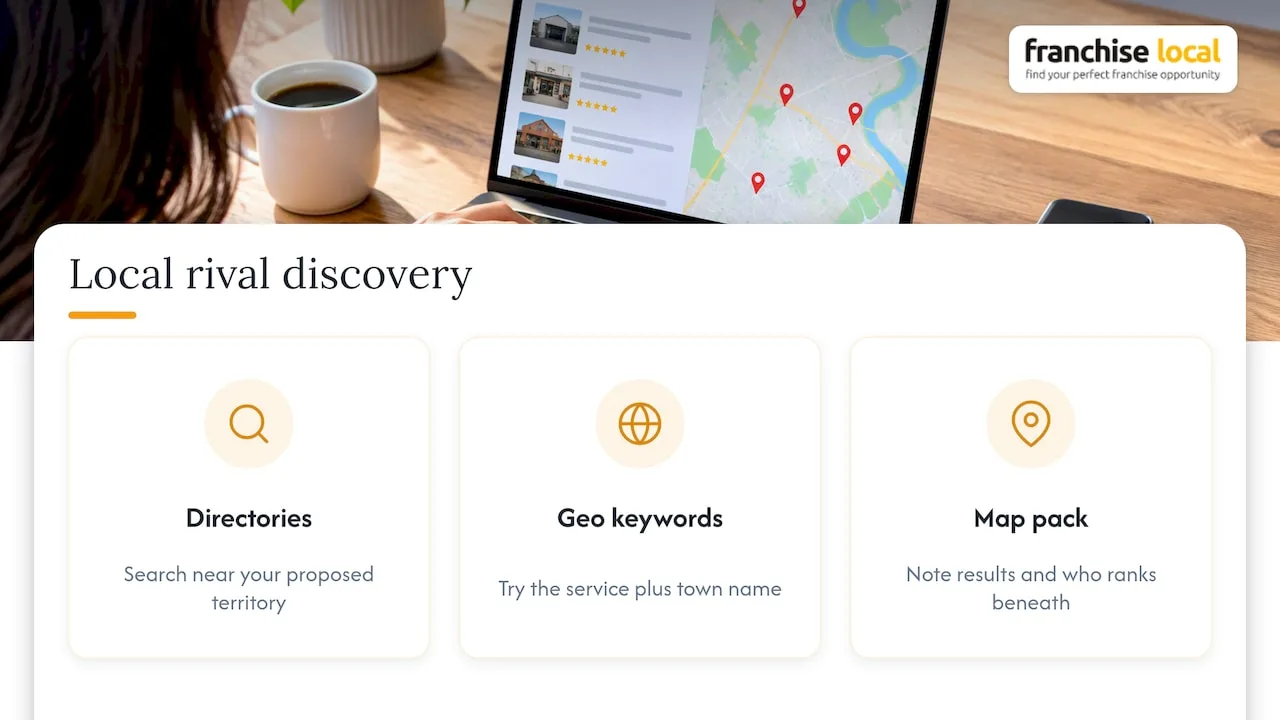
LocalIQ lists three practical methods: searching business directories, running geo-targeted keyword searches and checking the local map pack. Try each from a device near your proposed territory, using the words a customer would type, such as the service plus the town name. Note who appears in the map results and who ranks beneath them.
Audit how they present themselves
For each local rival, record:
- Reviews: how many, the average rating, and how quickly and politely the owner replies.
- Online listing: whether the Google Business Profile is complete, which categories and secondary services it uses, and how recent the photos are.
- Pricing: published prices, minimum charges, call-out fees and offers.
- Service gaps: recurring complaints in reviews, such as slow response, unclear quotes or limited hours.
- Marketing: leaflets, local sponsorship, social media activity and paid search adverts.
HeadRed also suggests auditing how rivals manage their Google Business Profile categories and customer feedback. That is useful because those habits show you which competitors are actively working for local customers and which have simply left a listing in place.
Turn complaints into your plan
The most valuable column in your file is the one that records what customers dislike. If five local competitors have reviews complaining about missed appointments, reliability is a gap you can fill. If every rival is cheaper and customers do not complain about quality, you may be entering a price war. Either way, you now know what the franchise needs to deliver before you pay for it.
If local search is part of how you will win work, our 30/90/180 local SEO plan for franchises explains how to build reviews and visibility after launch.
Step 5: Check proximity and cannibalisation inside the network
The competitor many buyers forget is another franchisee of the same brand. If outlets are too close, they share the same customers and everyone earns less. This is called cannibalisation.
Location specialists at CACI describe using competitor research alongside catchment and customer-demand data to assess proposed franchise sites. Their approach considers proximity to existing sites and the risk of cannibalisation, and looks for coverage gaps and promising catchments. You do not need professional software to apply the logic:
- Ask the franchisor for a map of current and planned territories near yours.
- Check the territory clause: is it exclusive, and can the franchisor sell into it through other channels?
- Ask neighbouring franchisees how often they take work from, or lose it to, adjacent areas.
- Compare the population and customer profile of your territory with the brand’s best-performing ones.
The point is to confirm that your territory contains enough of the right customers to support the fees you will pay, after competitors take their share.
Find franchises to compare in one place
A competitor analysis is quicker when your shortlist is already organised. Franchise Local lets you filter UK franchise opportunities by industry, investment level, lifestyle and location, so you can place similar brands next to each other and start your comparison file with real options. Browse trending franchise opportunities to see which brands buyers are currently looking at, then request details directly from the franchisors that fit.
Turn your findings into a decision
Data does not decide anything until you score it. Give each franchise a mark from 1 to 5 against the criteria that matter most to you, and weight them. A simple version looks like this:
| Criterion | Weight | Franchise A | Franchise B |
|---|---|---|---|
| Total investment against your budget | 25% | ||
| Territory protection | 20% | ||
| Local competition level | 20% | ||
| Franchisee satisfaction | 20% | ||
| Support and training | 15% |
Fill it in after your research, not before. If one brand scores well overall but badly on territory protection, ask the franchisor to address that specific point in writing. If two score similarly, the franchisee conversations usually separate them.
Test your numbers too. Local competitor pricing tells you what customers will pay. Subtract the franchisor’s ongoing fees and your running costs and check that the remainder supports the income you need. Our cash flow visualiser helps you see how those figures behave month by month.
Finally, treat your analysis as one part of formal checking. The franchise due diligence checklist shows where competitor work sits alongside legal, financial and franchisee checks, and why due diligence matters in the UK. Before you commit money, have a solicitor experienced in franchising review the agreement and an accountant check your forecasts.
Mistakes that weaken a franchise competitor analysis
- Comparing only the brochures. Marketing material is written to sell. Check claims with franchisees and independent sources. Our ten franchise myths shows which claims buyers most often need to verify.
- Ignoring indirect competitors. If customers can solve the problem another way, they are competing for the same budget.
- Using national data for a local decision. Market size across the UK says little about demand in your postcode area.
- Copying rivals. Your aim is to find where you can do better locally, not to imitate everyone nearby.
- Using out-of-date facts. Prices, reviews and rankings change. Always note the date you collected each one.
How often to update your analysis
Before you buy, complete the analysis in a few weeks and repeat the key local checks, such as prices, reviews and new openings, just before you sign. Competitors can change between your first visit and your contract date.
After launch, review the file on a regular rhythm. A quarterly check of prices, reviews and search results is a reasonable habit for most local service businesses, and you should revisit it whenever a new competitor opens or a neighbouring territory changes. This is a practical suggestion rather than a rule. Adjust it to how quickly your sector moves.
Keep a mix of sources. Search results and review sites show current local activity. Your franchisor’s network team can show how other territories are performing. Word of mouth also remains important: the British Franchise Association’s 2018 survey found that while recruitment channels were shifting toward social media and sector websites, word of mouth remained a consistent recruitment method. Talking to people in the network will often tell you more than a desktop search.
Frequently asked questions
What is a franchise competitor analysis?
It is a structured comparison of a franchise opportunity against its rivals. That covers other franchise brands, local businesses in your territory and neighbouring outlets in the same network. The aim is to judge whether the brand, the terms and the location give you a realistic chance of earning a return.
How do I find my local competitors?
Search as a customer would, using the service and your town, and note who appears in the map results and the listings below. Add business directories, social media and a visit or call to each rival. Then draw a radius around your territory and keep only those inside it.
What should I compare between two franchises?
Compare the total initial investment, royalties and other ongoing fees, territory size and protection, training and support, contract length and renewal terms. Then test the franchisor’s claims by speaking to existing franchisees, including some you have chosen yourself rather than ones the franchisor recommends.
Can competitor analysis tell me if a franchise will be profitable?
No. It shows you the market you would enter and how the franchise compares with alternatives, but it cannot guarantee results. Combine it with franchisee references, a realistic cash flow forecast and professional legal and financial advice before you commit.
Sources
- The results are out: 2024 National Franchise Survey, British Franchise Association
- Checking out the competition, Business Wales
- How to successfully identify competitors for your business, LocalIQ
- How to conduct a competition analysis, IONOS UK
- Local competitor analysis for franchises, HeadRed
- Competitor analysis template, Simply Business
- Assess a franchise opportunity, nibusinessinfo.co.uk
- Identifying franchise sites, CACI
- 2018 Franchise landscape, British Franchise Association