

Good franchise location research means testing the territory or site on your own evidence before you sign. Check who lives there, who already competes there, how people move through the area, what the premises will really cost, and whether the franchisor’s map matches the ground. This guide sets out each check in order, with the UK figures and official sources to use.
The same method covers what readers call franchise location analysis and franchise territory research. A van-based home service needs a territory. A shop, café or gym needs a site. The questions overlap, and where they differ, we say so.
Why location research matters in the UK
The UK franchise sector is large and mostly healthy. The 2024 British Franchise Survey counted 1,009 franchise systems and 50,421 units, with average annual turnover of £400,000 per unit and 89% of units reported as profitable. Those are national averages. Your result depends on one postcode area, one catchment and one set of neighbours.
The British Franchise Association (BFA) describes territory choice as one of the most important decisions a franchisee makes, and one that is often oversimplified. Most people stop at population and household counts. Those matter, but they are only the start.
If you are still deciding which brand to buy, begin with our step-by-step guide to choosing a franchise in the UK. Come back here once you have a shortlist.
Step 1: Decide what the location has to do for you
A location is only “right” against a plan. The BFA’s advice is that the choice should match your intended role. An owner-operator who wants a steady, hands-on business needs something different from someone who plans to recruit and manage a large team from day one.
Write down a short wishlist before you look at any map:
- Your role: hands-on from day one, or managing staff within a year.
- Your travel limit: the longest daily journey you will accept, for you or your team.
- Your budget ceiling: initial fee, set-up costs and running costs, not just the franchise fee.
- Your working pattern: full-time, part-time or home-based.
- Your must-haves: parking, visibility, proximity to home, school-run hours.
This wishlist stops you drifting towards whichever area a franchisor happens to have available. It also gives you a score sheet for comparing two or three candidate areas side by side.
Step 2: Read the franchisor’s territory map critically
Most franchisors supply a territory map, usually built on high-level demographics and postcode boundaries. It is a sensible starting point. Practitioners advise against relying on it alone, because population makeup and competition can shift after the map was drawn.
Ask the franchisor these questions, and get the answers in writing:
- How was the territory defined: by postcode, household count, business count or drive time?
- When was the underlying data last updated?
- How many existing franchisees border this territory, and how do they perform?
- Are customers from outside your boundary allowed to buy from you, and can neighbours sell into yours?
- Can the boundaries change, and what is the process if you raise a concern?
- What happens to the territory if you reach the agreed performance level, or fail to?
The Elite Franchise Magazine piece on territories makes the same point from a franchisee’s side: the best decisions combine the information you are given with your own findings and local knowledge.
Step 3: Test demand with demographics
Start with the numbers, but be specific about which numbers. The ones that matter depend on the model.
| Franchise type | Demographics that matter most |
|---|---|
| Home services (cleaning, repairs, care) | Home ownership, age profile, household income, housing type |
| Children’s activities and education | Number of under-12s, school density, family income |
| Food and drink | Daytime and evening population, workers, students, spending levels |
| Business services | Count of small and medium-sized businesses, sectors, growth |
| Fitness and wellbeing | Age mix, income, working-age residents within a short drive |
Use free official sources to check the franchisor’s claims. The Office for National Statistics publishes local population and housing data from the census, and local councils publish economic profiles for their areas. Compare what you find with the claims in the franchisor’s presentation. If the two disagree, ask why before you go further.
For how demand translates into profit, read our guide to franchise unit economics and the key franchise profitability factors.
Step 4: Map the competition
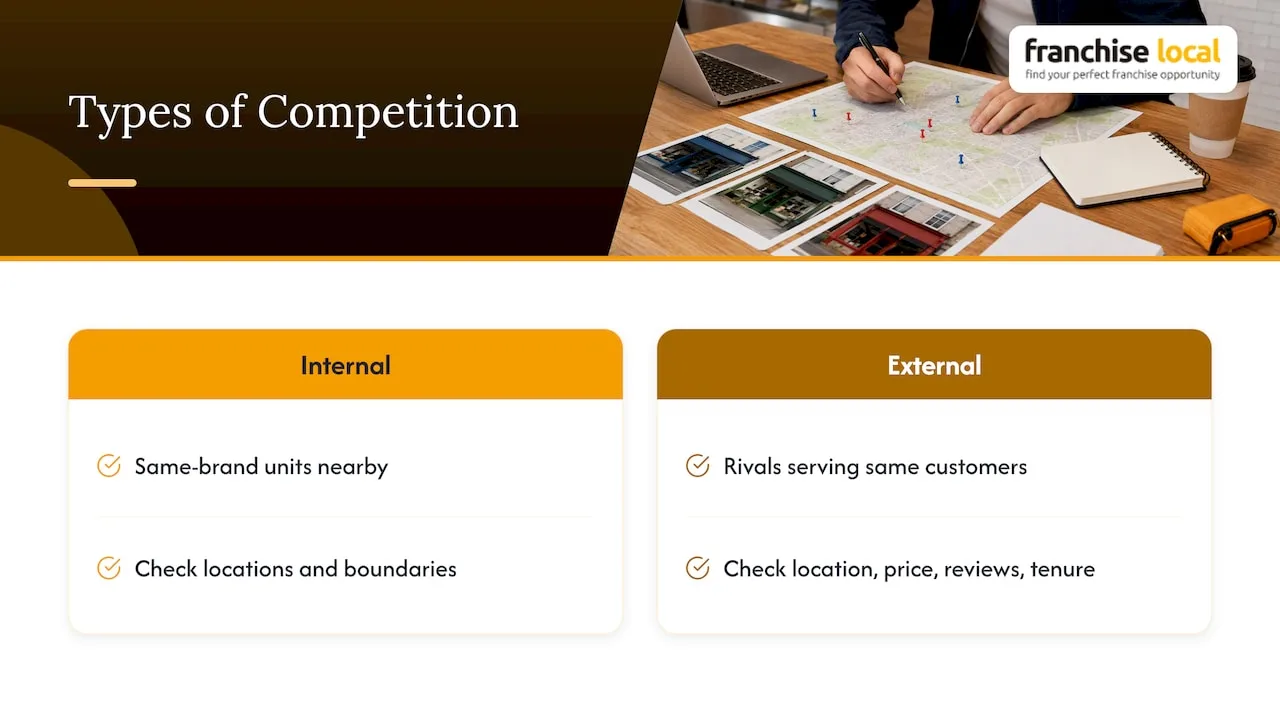
Competitor mapping comes in two parts, and territory research needs both.
Internal competition. These are other units of the same brand nearby. Ask for their locations and how close their boundaries run to yours.
External competition. These are rival businesses serving the same customers. Search Google Maps for the service in your target area, then list each competitor with its location, price points, reviews and how long it has traded.
A crowded area is not automatically a bad one. It can show proven demand. What matters is whether the existing providers are strong, and whether the franchise offers something they do not. A gap on the map can also be a warning: ask why nobody is there.
The BFA has covered how data-driven location tools are helping franchisors identify white space by combining demographic fit, competitor mapping and footfall. If your franchisor offers a tool like this, ask to see how it scored your area, then check the inputs yourself.
Step 5: Check footfall, access and the health of the area
For shops, cafés, gyms and anything that relies on passing trade, visit in person. Go more than once.
- Visit on a weekday morning, a lunchtime, a weekday evening and a Saturday.
- Count people passing the unit in 15-minute blocks, and note how many are your type of customer.
- Check where people park, which bus and rail links serve the area, and which side of the street is busiest.
- Look at neighbouring units: who else draws customers to this spot?
- Talk to nearby traders about trading patterns and any planned changes.
The health of a high street is not fixed. Government guidance on the vitality of town centres points to changing consumer behaviour, including hybrid working, and suggests watching vacancy rates, pedestrian flows and the diversity of uses. The Office for National Statistics reports that retail employment fell more sharply in central high streets and shopping centres than in non-central high streets and retail parks between 2015 and 2024. A busy-looking centre can be weaker than it appears, and a quieter edge-of-town site can be stronger.
There is also a trap in cheap rent. Industry guidance says a cheaper, less visible location is often harder to turn around than a pricier one, even with a strong management team. Judge the unit on what it can earn, not only on what it costs.
Step 6: Work out the real cost of the premises
Rent is one line. Before you commit to a site, calculate the full occupancy cost.
Business rates
Business rates are the property’s rateable value, set by the Valuation Office Agency, multiplied by a government-set multiplier. Guidance for new businesses notes that Small Business Rate Relief gives 100% relief up to a rateable value of £12,000, tapering for values between £12,001 and £15,000.
The multipliers changed in April 2026. For 2026 to 2027, the small business retail, hospitality and leisure multiplier is 38.2p, and the small business multiplier is 43.2p, for rateable values under £51,000. Whether a unit counts as retail, hospitality or leisure can change the bill, so check the category with your local council before you sign. Our guide to avoiding a rates shock explains the 38.2p and 43p rates in more detail.
Condition and repairs
Ask the landlord for a full schedule of conditions. Without one, you risk inheriting repair liabilities from the previous tenant. Have a solicitor review the lease before you sign it, including break clauses, rent reviews and repair obligations.
Planning and use class
Since the 2020 Use Classes Order, many commercial uses, including shops, offices and restaurants, fall under Class E. That lets a business change between these uses without a planning application. Moves to residential use are subject to strict prior approval rules. The same guidance says standard planning decisions generally take 8 weeks and complex ones up to 13, so build that time into your opening plan. Always confirm the current use class and any restrictions with the local planning authority for the exact unit.
Step 7: Test the daily reality of a mobile territory
Home-based and mobile franchises have no shopfront, but the territory still has to work. A territory that looks compact on a map can prove inefficient because of local road networks, traffic patterns or poor access, and the extra travel time and fuel erode your margin.
Try this before you commit:
- Pick ten addresses spread across the territory, matching the customers you expect.
- Drive between them at the times you would be working, including rush hour.
- Record the time and mileage for each leg.
- Estimate how many jobs you could complete in a day, then work out revenue per day.
- Repeat for a second candidate territory and compare.
Rural areas can offer less competition but longer journeys. Dense urban areas can offer more customers per hour but congestion and parking costs. Neither is better in general. The test shows which fits your model.
Step 8: Talk to people who already work there
Nothing replaces speaking to existing franchisees. The questions below give you facts rather than sales talk:
- How long did it take to reach break-even, and what did you expect?
- Did the territory match the description you were given?
- What do you wish you had checked before you signed?
- How does the franchisor respond when you raise a problem?
- Would you buy again?
Speak to franchisees you pick yourself, not only those the franchisor introduces. Include someone from a neighbouring territory if you can. The BFA notes that its franchisor members undergo auditing before joining, which is a useful signal, but it does not replace your own checks on a specific territory.
Our guide on how to research franchise opportunities in the UK lists more questions for the validation stage.
A simple scorecard for comparing areas
Score each candidate territory from 1 to 5 on every row, then weight the rows that matter most to your plan.
| Check | What to look at | Score (1 to 5) |
|---|---|---|
| Demand | Demographics that fit the model | |
| Competition | Internal and external, strength and gaps | |
| Access | Footfall, parking, transport, road network | |
| Area health | Vacancy, footfall trends, planned changes | |
| Cost | Rent, rates, repairs, fit-out | |
| Operations | Travel time, staffing pool | |
| Franchisee feedback | Neighbours’ and existing owners’ views | |
| Personal fit | Your role, commute, lifestyle |
Our six location checks for UK franchise site selection by postcode goes deeper on the postcode-level checks. Pair the scorecard with a franchise business plan, so the location figures feed straight into your forecasts.
Find franchises by region and budget
If you want to start from the area rather than the brand, use Franchiselocal’s filters. You can browse franchises by UK region, narrow by industry on the industries page, or compare full-time franchise opportunities against your wishlist. For fresh options, see new franchises and trending franchise opportunities. Each listing lets you send an enquiry to the franchisor, so you can ask the territory questions above before you go further.
Red flags in a territory offer
- The franchisor will not share how the territory was defined or when the data was updated.
- Pressure to sign quickly because “another buyer is interested”.
- No written boundary, or boundaries the franchisor can change freely.
- Existing franchisees in similar areas who are unwilling to talk, or who all tell the same story.
- Projections that assume the best-performing unit in the network.
- A site recommended mainly because the rent is low.
One red flag is a reason to ask more questions. Several together are a reason to walk away.
FAQ
What is a franchise location?
It is the place where your franchise operates. For a shop, café or gym, it is a specific unit. For a mobile or home-based franchise, it is a defined territory, usually set by postcodes, which gives you the right to operate there under the franchisor’s brand.
How do I analyse a franchise territory?
Check five things: demographic fit, internal and external competitors, footfall or travel patterns, the cost of premises or operating time, and feedback from existing franchisees. Verify the franchisor’s territory map with your own data rather than relying on it. Score each area against your wishlist so you can compare candidates fairly.
Should I trust the territory map the franchisor gives me?
Use it as a starting point. These maps are usually based on high-level demographics, and the area may have changed since it was drawn. Ask how it was built and when it was last updated, then confirm it with a visit and your own research.
Does a cheaper rent mean a better franchise site?
Not necessarily. A cheaper, less visible site is often harder to make work than a better-positioned one. Compare total occupancy costs, including business rates and repair obligations, against the sales the site can realistically support.
Do I need planning permission for a franchise unit?
Often not, if the unit already has a suitable use. Many shop, office and restaurant uses fall under Class E, which allows changes between them without a planning application. Check the unit’s current use class with the local planning authority before you sign a lease.
Sources
- 2024 National Franchise Survey results, British Franchise Association
- Finding the perfect franchise territory, British Franchise Association
- Getting territorial, Elite Franchise Magazine
- Hot Locations location intelligence tool, British Franchise Association
- Ensuring the vitality of town centres, GOV.UK
- High streets and retail areas in Great Britain, Office for National Statistics
- Location, location, location, British Franchise Association
- Business Start Up and Development Toolkit, Bristol City Council
- Changes to business rates multipliers from 2026, Bristol City Council
- Set up new consumer and retail premises, business.gov.uk
- BFA responds to Government debate on franchising, British Franchise Association