

Franchise risk assessment is the structured process of evaluating financial, legal, and operational factors before committing capital to a franchise investment. For aspiring UK franchise owners, knowing how to assess franchise risk is not optional. It is the difference between a profitable business and a costly mistake. The British Franchise Association (BFA) Code of Ethics, established in 1977, remains the UK’s primary benchmark for ethical franchising and is routinely referenced by courts in disputes. That standard exists for a reason: franchise agreements are complex, long-term commitments that demand rigorous scrutiny before you sign anything.
How to assess franchise risk: the financial factors that matter most
Financial due diligence is the foundation of any credible franchise risk analysis. You need to understand every cost layer before projecting a single pound of profit.
The average UK franchise start-up cost sits between £50,000 and £60,000, according to BFA data as of 2024. That figure varies significantly by sector and business model, so treat it as a baseline, not a ceiling.
The costs you must examine include:
- Upfront franchise fee: The initial licence payment to use the brand and system.
- Ongoing royalties: Typically a percentage of turnover, paid monthly or quarterly.
- Marketing levies: Contributions to a central marketing fund, often non-negotiable.
- Mandatory supplier costs: Some franchisors require you to buy stock or equipment from approved suppliers at fixed prices.
- Lease and premises commitments: Commercial leases can run 5–10 years and carry personal guarantee clauses.
- Staffing costs: Recruitment, training, and payroll obligations that franchisors rarely include in headline projections.
Franchise financial projections presented by franchisors are guidelines, not guarantees. Their assumptions and calculation methods must be questioned and verified independently.
Pro Tip: Have an independent accountant review the franchisor’s figures against your personal funding plan before you proceed. An accountant will spot unrealistic break-even timelines that a franchisor’s own projections routinely obscure.
Cash flow stability deserves equal attention. A franchise can show paper profitability while running out of working capital in its first year. Ask for monthly cash flow projections, not just annual profit and loss summaries, and stress-test them against a slower-than-expected ramp-up period.
How do you investigate franchisor stability and track record?
A franchisor’s history tells you more about future risk than any glossy brochure. The length of operation, network size, and exit data are the three metrics that matter most.

Start by confirming BFA membership. BFA members commit to the Code of Ethics and submit to independent scrutiny. Non-members are not automatically disqualified, but the absence of membership removes a layer of accountability that protects you.
Request the franchisor’s five-year exit data as a non-negotiable part of your research. Investigating historical exit data and the underlying reasons for closures is a standard due diligence step recommended by franchise legal specialists. High exit rates, especially those attributed to “mutual agreement” or “personal reasons,” often mask financial failure or network dissatisfaction.
Follow these steps to build a clear picture of franchisor stability:
- Verify the franchisor’s trading history. Confirm how long the business has operated as a franchise, not just as a standalone business. A brand that franchised two years ago carries more risk than one with a 15-year network.
- Check Companies House records. Review filed accounts, director changes, and any county court judgements against the franchisor or its parent company.
- Search for legal disputes. Public court records and industry forums can surface complaints or litigation that franchisors will not volunteer.
- Ask for a full franchisee contact list. A confident franchisor provides this without hesitation. Reluctance to share it is a warning sign.
- Review the franchisor’s support infrastructure. Ask how many field support staff exist per franchisee. A ratio of one support manager to 30 or more franchisees signals stretched resources.
Franchisors who restrict contact with existing franchisees signal possible high failure rates or operational issues within the network. Treat any restriction on franchisee communication as a serious red flag, not a minor inconvenience.
Pro Tip: Search the franchisor’s brand name alongside terms like “complaint,” “dispute,” and “failed” on UK business forums and Companies House before your first formal meeting. You will learn more in 20 minutes than in an hour of sales presentations.
What legal factors must be reviewed to evaluate franchise risks?
Legal due diligence is where most aspiring franchise owners underinvest their time and money. The franchise agreement is a long-form legal document that governs every aspect of your relationship with the franchisor for years. Vague or one-sided clauses create liabilities that surface only after you have committed your capital.
A franchise agreement must clearly state territory boundaries, renewal rights, fees, and exit terms to control investment risk effectively. Ambiguity in any of these areas shifts risk entirely onto you.
The key clauses to scrutinise include:
- Territory rights: Is your trading area exclusive? Can the franchisor open a company-owned outlet or grant another franchisee within your territory?
- Renewal conditions: What are the terms for renewing at the end of your agreement? Can the franchisor change fees or conditions on renewal?
- Exit terms: What happens if you want to sell your franchise? Does the franchisor have a right of first refusal? What are the transfer fees?
- Non-compete provisions: How long and how wide is the non-compete clause after exit? A two-year, nationwide non-compete can effectively end your career in that sector.
- Franchisor control provisions: Can the franchisor alter the operating system, product range, or supplier requirements unilaterally? If so, your cost base can change without your consent.
One of the most overlooked risks in franchise contracts is the “entire agreement” clause. Verbal promises by franchisors are legally unenforceable without being written into the contract. If a franchisor tells you in a meeting that you will receive dedicated marketing support or a protected territory extension, that promise is worthless unless it appears in the signed agreement.
Legal due diligence must also extend to intellectual property rights, lease assignments, and exit terms. Intellectual property issues arise when a franchisor’s trademark is not properly registered or is subject to a third-party challenge. Lease obligations create risk when the franchisor holds the head lease and you operate as a sub-tenant, giving the franchisor significant leverage over your business continuity.
Always instruct a solicitor who specialises in franchise law, not a general commercial lawyer. The cost of specialist legal advice is a fraction of the cost of signing a contract you do not fully understand. For further guidance on protecting yourself legally, the Franchiselocal resource on legal advice before buying a franchise covers the key considerations in detail.
How do existing and former franchisees reveal real investment risk?
Franchisee conversations are the most underused tool in franchise risk assessment. No franchisor disclosure document tells you what it is actually like to run the business day to day.
Request a complete list of current franchisees from the franchisor. Then contact franchisees the franchisor did not suggest. Franchisors naturally steer prospective buyers towards their most successful or satisfied operators. Speaking to a random selection gives you a more accurate picture.
When speaking to current franchisees, ask:
- How long did it take to break even? Compare their answer to the franchisor’s projection.
- How responsive is the franchisor’s support team? Ask for a specific example of when they needed help and how quickly it arrived.
- What costs surprised you most in the first year? This question consistently surfaces expenses the franchisor’s projections omit.
- Would you invest again, knowing what you know now? The hesitation before the answer is often more revealing than the answer itself.
- What is your current monthly revenue versus the franchisor’s forecast? Franchisees who are performing well will share this readily.
Former franchisees provide a different and equally valuable perspective. They have no ongoing relationship with the franchisor to protect, so their accounts tend to be more candid. Trace former franchisees through LinkedIn, local business directories, or Companies House records. Ask them why they left and whether they would recommend the network to a friend.
Franchisors who limit franchisee contact are signalling that the network may not withstand scrutiny. A healthy franchise network welcomes prospective franchisees speaking to its operators because satisfied franchisees are its best sales tool.
How to bring your findings together and decide on risk level
Synthesising financial, legal, and franchisee data into a clear risk verdict requires a structured approach. Gut instinct has no place at this stage.
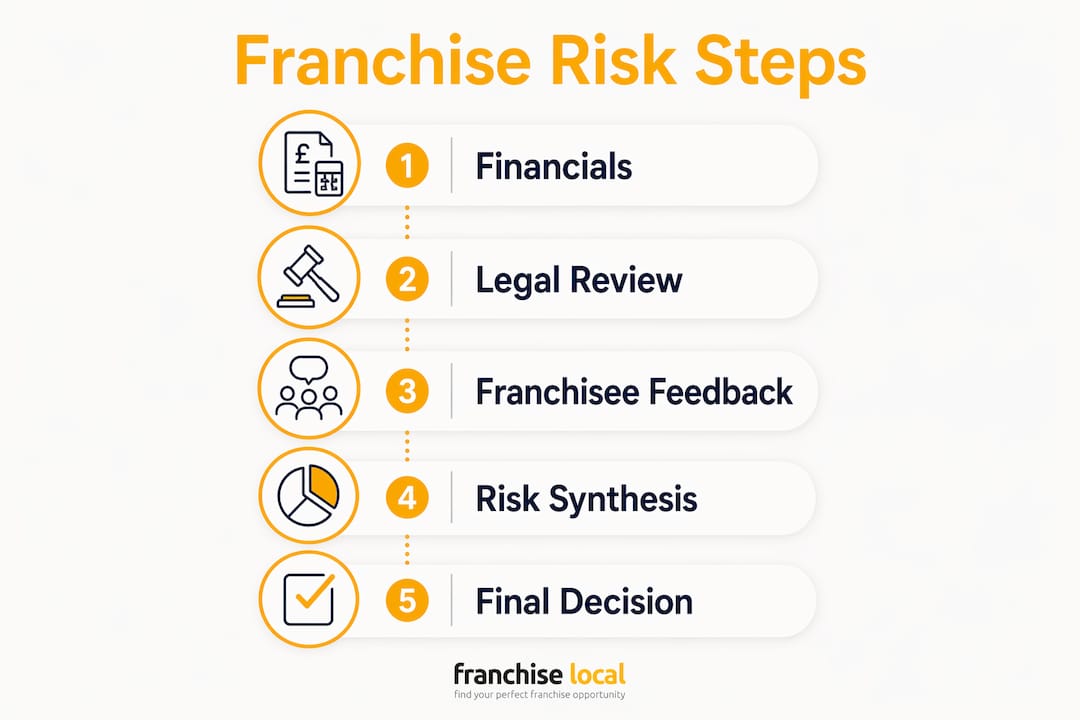
Use a simple assessment framework to score each area:
| Assessment area | Green: low risk | Amber: moderate risk | Red: high risk |
|---|---|---|---|
| Financial projections | Independently verified, conservative | Franchisor-only data, plausible | Unverifiable or overly optimistic |
| Franchisor stability | 10+ years, low exit rate, BFA member | 5–10 years, moderate exits | Under 5 years, high exits, no BFA |
| Legal contract | Clear territory, fair exit terms | Some ambiguity, negotiable | Vague clauses, non-negotiable |
| Franchisee feedback | Majority positive, on-target earnings | Mixed, some concerns | Negative majority, restricted access |
| Support infrastructure | Dedicated field support, regular contact | Reactive support, limited contact | No structured support |
Score each row honestly. A single red rating does not automatically disqualify a franchise, but two or more red ratings together represent a risk profile that most investors should decline.
Personal fit matters alongside the objective data. A franchise that scores amber across the board may still be the right choice if your skills, capital reserves, and risk tolerance align with the model. A franchise that scores green on paper but requires skills you do not have carries its own category of risk.
Common mixed-signal scenarios include a franchisor with strong financials but poor franchisee feedback. This pattern often indicates a profitable system that is poorly supported. It is worth negotiating enhanced support commitments into the contract before proceeding, and getting those commitments in writing.
Pro Tip: Before making a final decision, instruct both a franchise solicitor and an independent accountant to review your complete findings. Their combined assessment costs far less than unwinding a franchise investment that goes wrong. Franchiselocal’s franchise selection checklist provides a structured framework to support this final stage.
Franchiselocal: find and evaluate UK franchise opportunities
Franchiselocal connects aspiring UK franchise owners with vetted opportunities across dozens of industries, investment levels, and regions. The platform’s directory lets you filter by budget, sector, and location, so you can focus your due diligence on franchises that genuinely fit your profile. Whether you are looking at financial business franchises or browsing the full range of top UK franchise opportunities, Franchiselocal provides the listings, guidance articles, and industry context to support every stage of your assessment. Use the directory as your starting point, then apply the risk assessment framework in this guide to evaluate each opportunity with confidence.
FAQ
What is franchise risk assessment?
Franchise risk assessment is the process of evaluating a franchise opportunity across financial, legal, and operational dimensions before investing. It draws on due diligence methods including contract review, franchisor background checks, and franchisee interviews.
How much does the average UK franchise cost to start?
Average UK franchise start-up costs range from £50,000 to £60,000 according to BFA data, though costs vary significantly by sector and business model.
Are verbal promises from a franchisor legally binding?
No. Verbal franchisor promises are unenforceable due to the “entire agreement” clause present in most UK franchise contracts. Every commitment must appear in the signed agreement to carry legal weight.
What does it mean if a franchisor restricts franchisee contact?
It is a red flag. Restricting franchisee contact typically signals high failure rates, network dissatisfaction, or operational problems the franchisor does not want prospective buyers to discover.
Do I need a specialist solicitor to review a franchise agreement?
Yes. A solicitor who specialises in franchise law will identify risks in territory clauses, exit terms, and intellectual property provisions that a general commercial lawyer may overlook. The cost is modest relative to the size of the investment.