

Franchise territory selection is the process of defining clear, balanced geographic zones where a franchisee holds the right to operate, protected by demographic data, competitive analysis, and contractual terms. Get this decision right and you build a market position that compounds over years. Get it wrong and you face cannibalisation, legal disputes, and underperforming units. This guide explains how to select franchise territories using a structured workflow that combines franchise territory mapping, demographic scoring, and legal due diligence. Whether you are buying your first franchise or expanding an existing network, the principles here apply directly to the UK market in 2026.
How to select franchise territories: the core framework
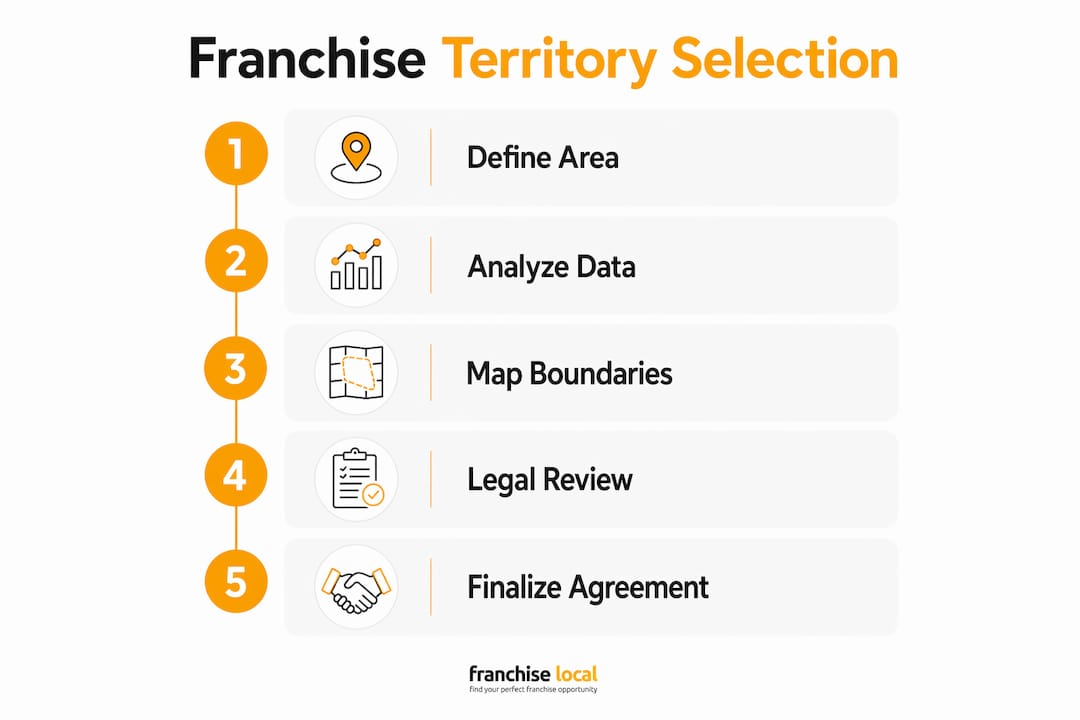
The industry term for this process is franchise territory analysis, a workflow that moves from raw demographic data through spatial mapping to legal review. The output is a scored, mapped, and legally defined zone that you can defend in negotiations and grow within over time.

Three decisions sit at the heart of every territory selection. First, you must define the geographic boundary. Second, you must assess whether the population and market within that boundary can support a profitable unit. Third, you must confirm that your contractual rights within that boundary are clear and enforceable.
The Franchise Disclosure Document (FDD) is the legal foundation. FDD Item 12 defines territory size and type, typically using population thresholds, household counts, zip code clusters, or drive-time zones. A common benchmark is 30,000 people within a defined trade area, though this varies significantly by sector. Understanding what Item 12 says before you sign anything is not optional. It shapes your rights for the entire term of the franchise agreement.
What demographic and market data should you analyse?
Demographic and market data determine whether a territory can generate the revenue your investment requires. The most reliable models score territories across nine critical factors: residential population, daytime population, median household income, population growth trends, traffic counts, competitor saturation, co-tenant pulling power, cannibalisation risk from adjacent franchisees, and proximity to target customer clusters.
A 9-factor scoring system benchmarked against the franchisor’s Item 19 unit-level performance data gives you a defensible, data-driven basis for every territory decision. Item 19 is the section of the FDD where franchisors disclose financial performance representations. Matching your territory scores to the demographic profiles of top-performing existing units tells you whether your chosen area is likely to replicate that success.
The table below summarises the key data types, their sources, and why each matters.
| Data type | Primary source | Why it matters |
|---|---|---|
| Residential population | UK Census, ONS | Sets baseline demand for most consumer franchises |
| Daytime population | Esri, Placer.ai | Critical for food, retail, and service franchises |
| Median household income | ACS, ONS | Indicates spending capacity and product fit |
| Population growth trends | ONS projections | Flags territories with rising or declining demand |
| Traffic counts | Local authority data | Drives footfall estimates for location-dependent units |
| Competitor saturation | Placer.ai, field research | Reveals addressable market share |
| Cannibalisation risk | Franchisor mapping data | Prevents revenue overlap with adjacent franchisees |
Pro Tip: Start by profiling the top 25–30% of the franchisor’s existing units. Build your scoring model from those demographic fingerprints, not from generic national averages.
Competitor density mapping is particularly powerful. The calculation is straightforward: multiply the number of households in a territory by average category spending, then apply a realistic penetration rate, and divide by the number of competing outlets. Competitor density mapping gives you a revenue ceiling for the territory before you commit a penny.
How do you map and define franchise territory boundaries?
Mapping methods vary widely in accuracy, and the method you choose directly affects how well your territory reflects real customer behaviour. The five main approaches are zip code bundles, municipal boundaries, radius circles, drive-time polygons (isochrones), and custom polygons.
Radius circles are the simplest method. Draw a circle of a fixed distance around a proposed location and everything inside becomes your territory. The problem is that a 3-mile radius in central Birmingham and a 3-mile radius in rural Shropshire represent entirely different customer populations and travel times. Radius methods ignore roads, rivers, motorways, and urban density.
Drive-time isochrones are far more accurate. They map the area reachable within a set travel time, typically 5, 10, and 15 minutes, following actual road networks. A 10-minute drive-time polygon in a dense urban area may cover only 2 square miles. The same polygon in a rural area may cover 20 square miles. That difference is exactly what you need to capture.
The comparison table below outlines the trade-offs between the most common mapping methods.
| Method | Accuracy | Complexity | Best suited for |
|---|---|---|---|
| Radius circles | Low | Very low | Quick initial scoping only |
| Zip code bundles | Medium | Low | Administrative simplicity |
| Municipal boundaries | Medium | Low | Regulatory alignment |
| Drive-time polygons | High | Medium | Consumer-facing franchises |
| Custom polygons | Very high | High | Complex urban or rural territories |
GIS tools such as Maptive and Population Explorer allow you to build, balance, and validate territories using real demographic data overlaid on accurate maps. Population Explorer specifically supports territory balancing, which means adjusting boundaries so that population or income metrics stay within a 10% variance across comparable territories. That 10% variance target reduces disputes between franchisees and supports long-term network health.
Pro Tip: Always run your drive-time polygons at peak travel times, not off-peak. A territory that looks accessible at 11am may be effectively cut off during the morning commute.
What legal and contractual terms govern territory rights?
Legal clarity in territory agreements is the difference between a protected market position and years of costly disputes. The types of franchise territories fall into three categories, each with distinct implications.
- Exclusive territories give the franchisee the sole right to operate within a defined area. No other franchisee or franchisor-owned unit can open there. This is the strongest protection available and the most valuable to negotiate.
- Protected territories offer partial protection. The franchisor typically agrees not to open competing units but may reserve rights for alternative channels such as online sales, ghost kitchens, or corporate accounts.
- Non-exclusive territories provide no geographic protection at all. Multiple franchisees may operate in the same area. These are common in service franchises where territory is less critical, but they carry real cannibalisation risk.
FDD Item 12 legal clarity governs potential operating disputes for decades. Vague language in Item 12 is not a minor drafting issue. It is a long-term liability. Before signing, confirm the following points are addressed explicitly in your agreement.
- The precise method used to define the territory boundary (drive-time, radius, zip codes, or custom polygon)
- Whether the franchisor retains rights to sell via online channels, ghost kitchens, or third-party delivery platforms within your territory
- Revenue-sharing arrangements if the franchisor operates alternative channels that serve your customers
- Your right of first refusal (ROFR) on adjacent territories if they become available
- The process for resolving boundary disputes, including whether an independent surveyor or mediator is specified
Securing a ROFR on adjacent territories is one of the most underused negotiating tools available to franchisees. It costs nothing at signing and gives you the option to expand before a competitor or another franchisee moves in next door.
What is the step-by-step franchise territory analysis workflow?
A professional franchise territory analysis workflow takes approximately 4 hours per territory to complete properly. That time covers data gathering, scoring, mapping, and stress-testing against Item 19 performance data. Rushing this process is the single most common mistake first-time franchisees make.
Follow these steps in order.
-
Define your candidate locations. Identify two or three potential sites or zones within the broader region you are considering. Use the franchisor’s preferred mapping tool or commission your own GIS analysis via Maptive or Population Explorer.
-
Gather demographic data. Pull residential population, daytime population, median household income, and growth trends from ONS, Esri, or Placer.ai for each candidate territory. Record everything in a standardised spreadsheet.
-
Score each territory across nine factors. Apply the 9-factor scoring model to each candidate. Weight the factors according to the franchisor’s sector. A food franchise weights traffic counts heavily. A B2B service franchise weights business density and median income more.
-
Map competitor locations. Plot every direct competitor within and adjacent to each territory. Calculate the total addressable market using the households-times-spending-times-penetration formula. Divide by competitor count to estimate your realistic revenue ceiling.
-
Cross-reference with Item 19 data. Compare your territory scores against the demographic profiles of the franchisor’s top-performing units. If your candidate territory scores significantly below those profiles, treat it as a red flag, not a minor concern.
-
Validate your scoring model. Holding out 20–30% of existing top-performing units from your calibration dataset and testing whether your model correctly predicts their performance is the most reliable way to confirm your framework works. This step significantly increases scoring model defensibility.
-
Review Item 12 with a franchise solicitor. Do not attempt to interpret FDD territory language without qualified legal advice. A franchise solicitor familiar with UK law will identify ambiguous clauses, missing protections, and negotiating opportunities that a general commercial lawyer may miss.
-
Negotiate and document final boundaries. Once you have agreed on a territory, insist that the boundary is documented with a map attached to the franchise agreement, not described only in words. A map eliminates ambiguity.
Pro Tip: Build a scenario model in your spreadsheet that shows revenue projections at 50%, 70%, and 90% of the market penetration rate. If the 50% scenario still covers your fixed costs, the territory has a viable floor.
How does your franchisee role affect territory selection?
The size and structure of the territory you need depends directly on how you plan to operate the business. Operational needs differ by franchisee role, and the British Franchise Association is clear that territory sizing must align with your business structure and capacity.
Consider these distinctions carefully before finalising your territory choice.
- Hands-on owner-operators typically benefit from smaller, tightly defined exclusive territories. You are personally delivering the service or managing the unit directly. A territory you can physically cover without overstretching is more valuable than a large territory you cannot serve well.
- Management-heavy franchisees who plan to employ staff and run multiple units need larger territories from the outset. Securing adjacent territories or a right of first refusal on expansion zones at the point of signing is critical for this model.
- Single-unit franchisees with growth ambitions should negotiate ROFR clauses even if they have no immediate plans to expand. Market conditions change. Locking in the option to grow costs nothing now and protects your future position.
Oversimplifying territory selection to population counts alone ignores these operational realities and risks a mismatched assignment. A territory with 50,000 residents may be ideal for a management-heavy cleaning franchise and completely wrong for a hands-on tutoring franchise that depends on personal relationships within a tight local community.
Network expansion strategy also matters here. Franchisors with aggressive growth plans may fill adjacent territories quickly. If you intend to scale, act early. The key franchise profitability factors that separate high-performing franchisees from average ones consistently include territory quality and the strategic foresight to secure expansion rights before they are needed.
Why data alone will not save a poorly structured territory
I have reviewed enough franchise territory decisions to know that the biggest mistakes rarely come from bad data. They come from good data applied without operational context.
The drive-time mapping versus radius debate is a perfect example. Most franchisors still use radius circles because they are easy to explain and quick to draw. But a 5-mile radius in Manchester city centre and a 5-mile radius in the Cotswolds are not comparable territories by any meaningful measure. Franchisees who accept radius-based definitions without questioning them are accepting a fiction dressed up as a boundary.
The ROFR clause is another area where I see franchisees leave value on the table. Solicitors sometimes advise against asking for it because it can slow negotiations. My view is the opposite. A ROFR on adjacent territories is one of the cheapest options you will ever buy. The franchisor pays nothing to grant it. You pay nothing to hold it. But the day a competitor moves into the territory next door, you will wish you had it.
Validated scoring models genuinely reduce conflict within franchise networks. When every franchisee can see that territories were balanced to within 10% of each other on population and income metrics, disputes about fairness drop sharply. That matters for morale, for retention, and for the long-term health of the network you are joining.
The most important thing I can tell you is this: treat territory selection as a legal and commercial negotiation, not just a geographic exercise. The map is the starting point. The contract is what protects you.
— Will
Find your next franchise opportunity with Franchiselocal
Selecting the right territory starts with selecting the right franchise. Franchiselocal lists hundreds of UK franchise opportunities across sectors, investment levels, and operating models, making it straightforward to match your territory ambitions to a proven business format. Browse business services franchises if you are considering a B2B model with flexible territory structures, or explore networking franchises for relationship-driven opportunities where local market knowledge gives you a genuine edge. Each listing includes investment details and sector information to help you begin your demographic and market research from an informed starting point. Start your search at Franchiselocal today.
FAQ
What is franchise territory selection?
Franchise territory selection is the process of identifying and defining a geographic zone where a franchisee holds the right to operate, supported by demographic data, competitive analysis, and contractual protections documented in FDD Item 12.
How long does a franchise territory analysis take?
A professional franchise territory analysis takes approximately 4 hours per territory, covering data gathering, demographic scoring across nine factors, mapping, and stress-testing against Item 19 unit-level performance data.
What is the difference between exclusive and protected territories?
An exclusive territory grants the franchisee sole operating rights within a defined area, while a protected territory prevents competing franchise units but may allow the franchisor to operate alternative channels such as online sales or ghost kitchens within the same zone.
Why are drive-time polygons better than radius circles?
Drive-time polygons map the area reachable within a set travel time using actual road networks, capturing real geographic barriers and urban density. Radius circles ignore these factors entirely, producing territory definitions that do not reflect how customers actually travel.
What is a right of first refusal in franchise territory agreements?
A right of first refusal (ROFR) gives a franchisee the option to acquire adjacent territories before they are offered to other parties. It costs nothing to negotiate at signing and protects long-term expansion plans within the franchise network.