

What franchise brand alignment means and why it matters
Franchise brand alignment is the consistent understanding, communication, and delivery of a brand’s core value proposition across every location, team, and customer touchpoint in a franchise network. It is not simply about matching logos or colour palettes. It means every franchisee, manager, and front-line team member operates from the same strategic foundation, making decisions that reinforce the same brand promise.
The distinction between brand alignment and brand consistency is worth holding clearly. Alignment is the internal, strategic foundation: shared purpose, shared values, shared understanding of what the brand stands for. Consistency is the external expression of that foundation, the visual identity, tone of voice, and service experience customers actually encounter. You cannot reliably achieve the latter without the former.
For UK franchise leaders, the stakes are direct. Brand inconsistency leads to customer confusion, diluted brand value, reduced marketing effectiveness, and operational inefficiencies that harm network growth and reputation. A single off-brand experience in one location does not just disappoint one customer. It chips away at the equity every franchisee in the network has invested in.

Four elements must remain constant across all locations: brand purpose, brand promise, tone of voice, and the core customer experience. Local execution, such as community partnerships, campaign timing, and regional content, can flex within clearly defined guardrails. That balance between fixed and flexible is the practical heart of franchise brand alignment.
Why achieving brand alignment across franchise locations is harder than it looks
Brand misalignment rarely happens because franchisees want to go rogue. It happens because the system around them is unclear, under-resourced, or both. Understanding where alignment breaks down is the first step to fixing it.
Common causes of franchise brand misalignment:
- Unclear non-negotiables. When franchisors have not explicitly defined what must stay fixed, franchisees fill the gap with their own judgement, and that judgement varies.
- Inconsistent brand literacy. Franchisees join networks with very different levels of marketing knowledge. Without structured onboarding, some will interpret the brand confidently and others will guess.
- Fragmented communication. Central guidance that arrives late, in long PDFs, or through inconsistent channels feels distant. Local pressures then take priority.
- Poor governance and unclear decision rights. When nobody knows who is allowed to approve a local campaign or adapt a template, every choice becomes a negotiation or a workaround.
- Over-policing or under-policing. Franchisors who audit everything create resentment and slow local teams down. Those who audit nothing allow standards to erode quietly.
- Leadership misalignment at the top. Senior teams often use similar vocabulary but differ deeply on what the brand actually means, and those differences filter down through the network.
- Insufficient training on the “why.” Franchisees who understand only the rules, not the rationale behind them, are far less likely to apply those rules correctly in novel situations.
Franchise brand consistency fractures when speed and clarity collide. If approvals take too long, people work around them. If brand standards feel rigid without explanation, local teams quietly ignore them. The result looks like wilful drift, but it is usually a systems failure.
Practical strategies to build and maintain franchise brand alignment
The most effective approach to franchise brand alignment combines clear structure with genuine enablement. Rules alone do not create consistency. Tools, training, and trust do.
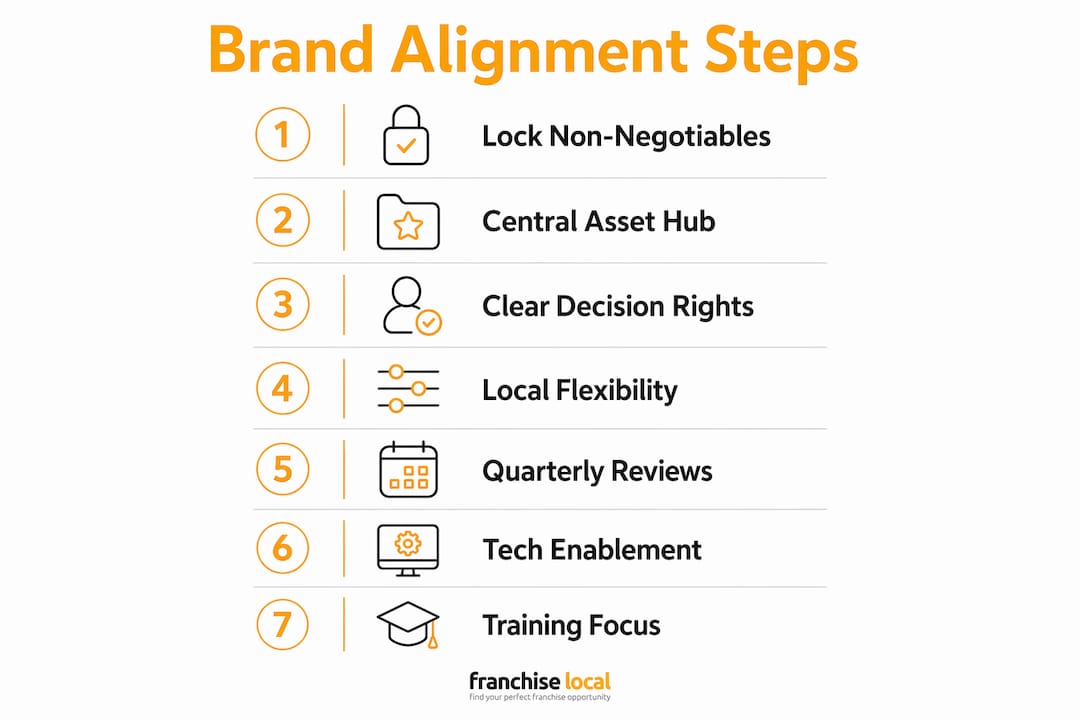
1. Lock your non-negotiables explicitly.
Define what must never vary: brand purpose, core visual identity, tone of voice, pricing rules, service steps, and customer experience standards. Put these in a short, visual “brand rules” document rather than a 60-page manual. Short brand rules documents combined with a single digital asset hub and lightweight quarterly reviews drive faster adoption and practical consistency across franchise networks.

2. Build a single digital asset hub.
Store all approved templates, copy blocks, social media assets, email snippets, and campaign materials in one accessible location. When franchisees can find the right asset in seconds, they use it. When they cannot, they create their own version.
3. Define decision rights clearly using a RACI model.
A RACI framework (Responsible, Accountable, Consulted, Informed) makes explicit who creates content, who approves it, who must be consulted, and who is simply kept informed. Explicit decision rights enable franchisees to act confidently and reduce delays or negotiations over brand decisions.
4. Allow structured local flexibility.
Protect the brand promise and flex the proof. Franchisees can adapt community partnerships, local campaign timing, regional content, and personal storytelling, provided core positioning, visuals, and service sequence remain intact. UK franchise systems that define fixed non-negotiables while allowing local execution flexibility create guardrails that allow speed without brand drift.
5. Run quarterly brand health reviews, not punitive audits.
Sample social media posts, local marketing materials, and customer-facing communications against a short checklist. Share examples of what “good” looks like. Consistency rises when franchisees see the standard clearly and have the assets to match it.
6. Use technology as an enabler.
Centralised CRM systems, cloud-based brand asset libraries, internal communication platforms, and e-learning tools all reduce the friction between brand standards and daily execution. When franchisees have the right tools, they naturally stay closer to the brand.
7. Train on the “why,” not just the “what.”
Franchisees who understand the rationale behind brand rules are more likely to maintain standards voluntarily, creating sustainable alignment across the network. Workshops, one-to-one coaching, and peer learning sessions build that understanding far more effectively than documentation alone.
Pro Tip: Use Marvia or a similar brand management platform to centralise your digital asset library, set template lock rules, and give franchisees controlled editing access. This removes the most common cause of visual inconsistency: franchisees improvising because approved assets are hard to find.
How leadership and franchisee engagement drive brand consistency
Leadership alignment is where brand strategy either takes root or quietly fails. Senior teams that use consistent language, make decisions that visibly reinforce brand values, and communicate transparently give franchisees a clear model to follow. When leadership behaviour contradicts the stated brand promise, no amount of documentation corrects it.
Alignment failures often stem from leadership teams using similar vocabulary but differing deeply on brand meaning, requiring audits of whether internal decisions actually support external positioning. A quarterly leadership audit, reviewing whether recent operational, hiring, and marketing decisions reinforce the brand promise, surfaces these gaps before they reach franchisees.
Franchisee engagement works best when it is structured around support rather than surveillance. Peer networks, franchisee councils, and recognition programmes for brand excellence create a culture where alignment feels like a shared achievement rather than a compliance requirement. Most brand misuse in franchises arises from a lack of training or confidence rather than deliberate sabotage. Effective coaching and peer support improve voluntary brand adoption far more reliably than enforcement.
Brand alignment is a cultural opportunity relying on trust, shared mission, visible leadership, and recognition systems, not just contract enforcement. Franchisees who feel genuinely supported and understood are the ones who protect brand standards most consistently.
UK franchise consultants consistently emphasise that empowering franchisees with practical tools and concise training, rather than lengthy manuals, produces the strongest results. A franchisee who can find the right template, understand why it matters, and get a quick answer when they are unsure is a franchisee who stays on brand. For a deeper look at how franchise marketing strategy connects to alignment, the Franchiselocal resource library covers the UK context in detail.
Psychometric diagnostic assessments for leadership alignment are increasingly used by UK franchise networks to identify where senior and regional leaders diverge on brand values before those differences cascade downward. Identifying the gap is always cheaper than repairing the damage it causes.
Legal and intellectual property protections for UK franchise brand alignment
Brand alignment has a legal dimension that franchise leaders cannot afford to treat as secondary. In the UK, the primary mechanism for protecting brand identity is trademark registration with the UK Intellectual Property Office (IPO). Trademarks are valid for renewable 10-year terms and are enforceable through franchise agreements with proportionate non-compete clauses.
Registering your trademark with the UK IPO protects your logo, name, and distinctive brand elements from misuse both inside and outside the franchise network. Without registration, enforcing brand standards against a franchisee who deviates, or against a third party who copies your identity, becomes significantly harder and more expensive.
Key legal protections to have in place:
- Trademark registration covering your brand name, logo, and any distinctive visual elements, filed with the UK IPO.
- Franchise agreement clauses that define the scope of permitted IP use, including what franchisees may and may not adapt, and under what conditions.
- Non-compete and post-term restrictions drafted to be proportionate under UK law, protecting brand equity after a franchisee relationship ends.
- Confidentiality agreements covering proprietary systems, operational know-how, and trade secrets shared during the franchise relationship.
- Copyright protections for original marketing materials, training content, and operational documentation.
Intellectual property rights are central to franchising, covering the brand, trademarks, logos, and proprietary systems licensed to franchisees. Franchise agreements must clearly define the scope of IP use and include robust protections against misuse or unauthorised replication. Effective IP management ensures brand consistency and legal protection across the franchise network.
Legal protection and cultural alignment work together, not in isolation. A franchise agreement that covers every scenario but sits inside a network with poor communication and low franchisee trust will still produce brand drift. Franchise quality and brand alignment depend on both: the legal framework sets the boundaries, and the culture determines whether franchisees choose to operate well within them. The legal strategy should be integrated with brand governance, training, and leadership visibility rather than treated as a standalone fix.
For franchise leaders exploring opportunities where strong brand alignment is already built into the model, Franchiselocal’s directory of UK franchise opportunities covers sectors from business services to financial franchises, each with established brand frameworks you can evaluate before committing.
How to measure whether your franchise brand alignment is actually working
Measuring alignment requires looking beyond surface-level consistency. A network where every location uses the correct logo but delivers wildly different service experiences is not aligned. It is merely visually uniform.
Practical signals worth tracking:
- Customer feedback variance across locations. If satisfaction scores differ sharply between sites, the brand promise is not landing consistently.
- Visual standards spot checks. Sample social media posts, local print materials, and signage quarterly against a short checklist. Track the variance, not just the worst offenders.
- Time-to-market for local brand activation. If franchisees take weeks to launch a campaign because they are waiting for approvals or building assets from scratch, governance is the bottleneck.
- Franchisee confidence surveys. Ask franchisees directly whether they feel equipped to represent the brand. Low confidence scores predict future inconsistency.
- Internal decision audits. Review whether recent operational, hiring, and marketing decisions at head office level reinforce the stated brand positioning.
The goal is not to audit everything. Leading franchise networks track a handful of meaningful signals and use the results to improve guidelines and target training, not to assign blame. Consistency rises when franchisees see what good looks like and have the assets to replicate it. That principle applies equally to how you report measurement results back to the network. Share the wins prominently. Address the gaps quietly and constructively.
Branding powers franchise growth most effectively when alignment is treated as an ongoing discipline rather than a one-time project. The networks that get this right review their brand health regularly, update their tools when guidelines change, and keep franchisees informed and equipped at every stage.