

Technology defines the role of franchises in modern commerce by determining how efficiently they operate, how effectively they market, and how consistently they deliver across every location. Digital marketing now accounts for 65% of new franchise leads, far outpacing offline methods at 23%. That single figure tells you where franchise growth is won or lost. For entrepreneurs evaluating franchise opportunities, understanding how technology shapes operations and marketing is no longer optional. It is the foundation of every sound investment decision.
What is the role of technology in franchises today?
Technology in franchising is defined as any digital system, software platform, or data-driven tool that helps a franchisor or franchisee run their business more efficiently, market more effectively, or maintain brand standards across multiple locations. The industry term for this integrated approach is “franchise technology infrastructure,” and it covers everything from point-of-sale systems to AI-driven scheduling tools.
The technology impact on franchises is measurable and direct. Franchises that adopt integrated digital systems reduce operational inconsistency, cut administrative costs, and generate more qualified leads than those relying on manual processes. The gap between tech-enabled and non-tech-enabled franchise units widens each year, making early adoption a competitive necessity rather than a preference.
Regulatory bodies such as the British Franchise Association (BFA) increasingly recognise technology compliance as part of franchise due diligence. Franchisees are expected to understand not just what technology a franchisor mandates, but why, and what the contractual implications are. That level of scrutiny protects both parties and sets the standard for responsible franchise growth in the UK.
How does technology improve operational efficiency in franchises?
Operational efficiency is where franchise technology delivers its clearest, most quantifiable returns. SaaS inventory and scheduling tools reduce human errors by up to 40%, and IoT sensors in food franchises cut operational costs by 20%. Those are not marginal gains. They represent the difference between a profitable unit and one that struggles to break even.

SaaS platforms and IoT sensors
Cloud-based SaaS applications handle inventory tracking, staff scheduling, compliance reporting, and customer data in one place. A franchisee running a food outlet, for example, can monitor stock levels in real time, receive automated reorder alerts, and log temperature compliance without manual checks. IoT sensors go further by tracking energy use, equipment performance, and foot traffic, feeding data directly into central dashboards that franchisors monitor across all units.
Technology automates repetitive tasks, freeing franchisees to focus on customer interaction and loyalty building. That shift in focus is significant. Time spent on manual stock counts or paper-based compliance logs is time not spent on service quality, which is the primary driver of repeat business.
AI tools for staffing and compliance
AI-enabled tools now handle demand forecasting, shift planning, and compliance alerts. A franchisor can set system-wide compliance rules, and the AI flags any unit that falls outside acceptable parameters before an audit occurs. Franchisors that embed AI within core systems achieve consistent operational compliance and efficiency gains that bolt-on tools cannot replicate.
| Technology type | Primary operational benefit | Example application |
|---|---|---|
| SaaS platforms | Error reduction, compliance tracking | Inventory and scheduling software |
| IoT sensors | Cost savings, real-time monitoring | Energy and temperature management |
| AI scheduling tools | Labour efficiency, demand forecasting | Shift planning and staffing alerts |
| Centralised dashboards | Brand consistency, performance visibility | Multi-unit reporting and KPI tracking |
Pro Tip: When evaluating any operational technology, measure its impact on three specific outcomes: labour hours saved per week, reduction in compliance incidents, and change in average transaction value. If a vendor cannot show you data on at least two of these, the tool is not ready for franchise deployment.
How does digital marketing technology drive franchise growth?
Digital marketing technology is the primary growth engine for franchise lead generation. 67% of franchise brands use digital advertising as their most effective traffic driver, with some franchise categories reporting 100% reliance on digital channels. The role of digital marketing in franchising has shifted from supplementary to central, and the data confirms it.
Local SEO, Google Ads pay-per-click (PPC), and social media advertising deliver the highest return on investment for multi-location franchise networks. Digital advertising channels like local SEO and PPC are prioritised by over 70% of top franchise brands. The reason is precision. Digital channels allow franchisors to set national brand parameters while franchisees target local audiences with location-specific messaging.
Balancing national brand control with local marketing
The most effective franchise marketing models combine franchisor-set brand standards with franchisee-led local adaptations based on local data. Shared CRM systems and centralised dashboards make this balance achievable. A franchisor controls brand assets, approved messaging, and campaign templates. The franchisee adjusts targeting, local offers, and community-specific content within those guardrails.
This framework protects brand integrity while giving individual units the flexibility to compete locally. Without it, franchisees either go off-brand or miss local opportunities entirely. Both outcomes damage the network. You can read more about UK franchise lead generation strategies that apply this principle in practice.
Top digital marketing channels for franchises
- Local SEO: Optimises each franchise location’s Google Business Profile and local search rankings, driving foot traffic and enquiries from nearby customers.
- PPC advertising: Google Ads and Bing Ads deliver immediate visibility for high-intent search queries, with costs controlled at both national and local level.
- Social media advertising: Facebook, Instagram, and LinkedIn campaigns allow precise demographic targeting, useful for both consumer and B2B franchise models.
- Email marketing: Automated sequences nurture leads from initial enquiry through to conversion, maintaining consistent brand communication.
- Content marketing: Blog posts, guides, and video content build organic search authority over time, reducing long-term cost per lead.
AI-powered tools now enhance each of these channels. For a deeper look at how AI is reshaping lead acquisition, the AI-driven SEO guide for 2026 covers the mechanics in detail.
Pro Tip: Use AI-powered local SEO tools to audit each franchise location’s Google Business Profile monthly. Inconsistent NAP data (name, address, phone number) across locations is the single most common cause of lost local search rankings in multi-unit franchise networks.
What challenges come with adopting technology in franchise systems?
Technology adoption in franchising carries real risks that entrepreneurs frequently underestimate. Franchisees often face technology lock-in with no cost limits on mandatory upgrades and no guarantee of data access after leaving the system. That is not a minor contractual detail. It is a structural risk that affects both the day-to-day cost of running the franchise and its resale value.
Franchise agreements commonly require franchisees to use franchisor-specified platforms, often proprietary systems with no open data export function. When a franchisee exits the network, they may lose access to years of customer data, transaction records, and operational history. Total dependency on proprietary platforms causes data lock-in that threatens both resale value and operational continuity after exit. This is a point that many prospective franchisees only discover after signing.
The AI marketing claims problem is equally significant. Vendors frequently label basic automation tools as “AI-powered” to justify premium pricing. AI should be measured by practical impact on labour hours, conversion rates, and administrative burden, not on the label alone. A scheduling tool that saves two hours per week per unit is valuable. A “machine learning” dashboard that produces reports no one acts on is not.
Financial uncertainty compounds these issues. Franchise agreements often lack limits on the cost or frequency of required technology updates. A franchisee who budgets £500 per month for technology fees may face a mandatory platform upgrade that doubles that cost within two years, with no contractual protection against it.
Pro Tip: Before signing any franchise agreement, ask three specific questions about technology: What platforms are mandatory? What are the current monthly costs and the contractual cap on increases? And what data can you export if you exit the network? If the franchisor cannot answer all three clearly, treat that as a red flag.
Best practices for integrating technology in franchise operations
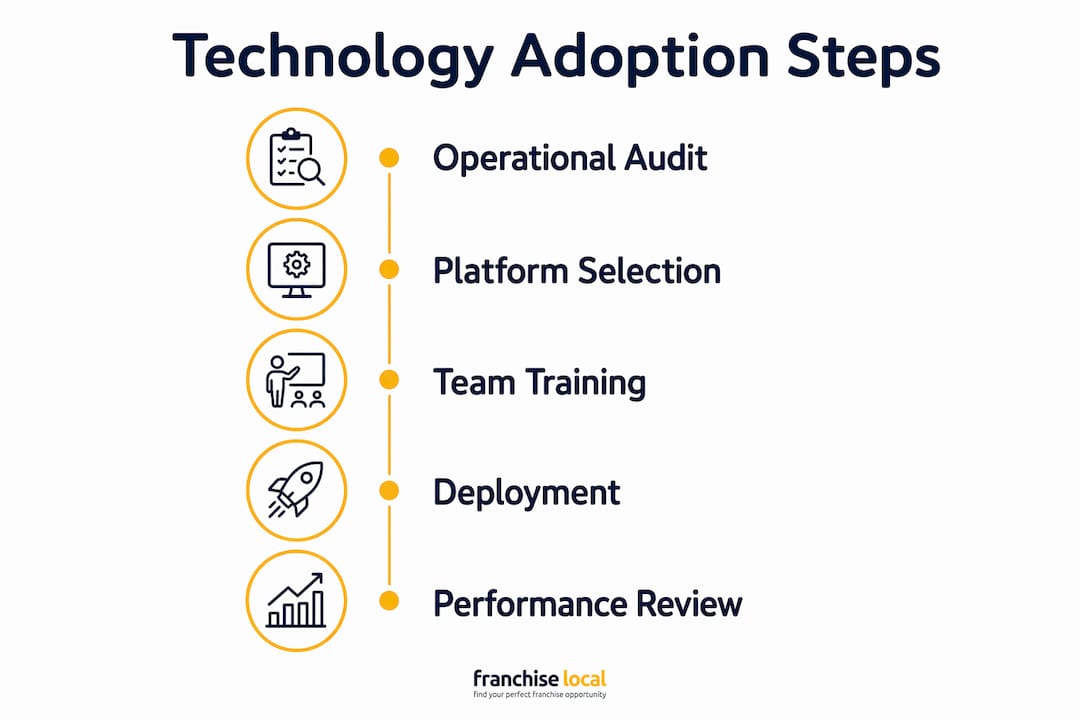
Successful technology integration follows a clear sequence. Franchisors that impose technology without franchisee input see lower adoption rates and higher support costs. Those that involve franchisees in selection and piloting achieve faster rollout and better outcomes across the network.
Steps for successful technology adoption
- Audit current operations first. Identify the three highest-cost or highest-error processes in your franchise unit before selecting any technology. Technology should solve a defined problem, not create a new one.
- Pilot with a small group. Test any new platform with two or three franchisees before network-wide rollout. Collect data on time saved, error rates, and franchisee satisfaction before committing.
- Set measurable success criteria. Define what success looks like before deployment. Operational technology should be assessed on labour savings, sales conversion, ticket size increases, and efficiency gains.
- Train thoroughly and repeatedly. One-off training sessions produce poor adoption. Build a training programme with refresher modules, video guides, and a dedicated support contact for franchisees.
- Review and iterate quarterly. Technology needs change as the business grows. Schedule quarterly reviews to assess whether current tools still meet operational and marketing needs.
The best franchise marketing models combine franchisor-set brand standards with franchisee-led local adaptations based on data. That principle applies equally to operational technology. Franchisors set the system. Franchisees adapt within it.
| Adoption step | Expected benefit | Timeline |
|---|---|---|
| Operational audit | Identifies priority areas for tech investment | Week 1–2 |
| Pilot programme | Validates tool effectiveness before full rollout | Month 1–3 |
| Network-wide training | Consistent adoption and reduced support costs | Month 3–4 |
| Quarterly review cycle | Continuous improvement and cost control | Ongoing |
Franchisors investing in AI-driven tools for scheduling and communication see stronger unit economics across the network. The key is embedding these tools within core systems rather than adding them as optional extras. Optional technology gets ignored. Mandatory, well-supported technology becomes part of the franchise’s competitive advantage. For practical guidance on applying these principles, the essential franchise marketing strategies resource from Franchiselocal covers the marketing side of this integration in detail.
How Franchiselocal helps you find tech-ready franchise opportunities
Franchiselocal is the UK’s leading digital directory for franchise opportunities, connecting entrepreneurs with franchise businesses across every industry, investment level, and location. When you are evaluating a franchise, technology infrastructure is one of the most important factors to assess alongside brand strength and financial performance. Franchiselocal provides the resources and listings you need to make that assessment with confidence. The ultimate guide to franchising covers everything from evaluating franchisor technology requirements to understanding your rights as a franchisee. You can also browse the full UK franchise directory to find opportunities that match your investment level and preferred industry.
FAQ
What is the role of technology in franchises?
Technology in franchises manages operations, marketing, and brand consistency across multiple locations. It covers SaaS platforms, AI scheduling tools, digital marketing systems, and centralised reporting dashboards.
How does digital marketing technology help franchise lead generation?
Digital marketing accounts for 65% of new franchise leads, with local SEO, PPC, and social media delivering the highest return on investment for multi-location networks.
What are the biggest technology risks for franchisees?
The two primary risks are technology lock-in, where franchisees are bound to mandatory platforms with no cost caps, and data loss on exit, where franchisees lose access to operational and customer data after leaving the network.
How should franchisors evaluate AI tools for their network?
AI tools should be measured by their impact on labour hours, conversion rates, and administrative burden. The “AI” label alone is not a reliable indicator of value.
What digital marketing channels work best for franchises?
Local SEO and PPC advertising are prioritised by over 70% of top franchise brands, with social media advertising and email marketing providing strong supporting returns for both consumer and B2B franchise models.