

The most realistic low cost franchise opportunities in the UK right now sit in cleaning, tutoring, leaflet distribution, property services, and travel — many with headline fees well under £10,000. The catch every buyer needs to understand: the franchise fee is rarely the full story. Total start-up costs routinely include equipment, a vehicle, local marketing, and working capital, with industry practitioners identifying a typical total investment range of £20,000–£75,000 for most franchisees. Very low-cost options are the exception and demand more owner effort and patience during ramp-up.
Here is a quick shortlist grouped by investment threshold:
Under £5,000 (headline fee):
- DOR-2-DOR — leaflet distribution franchise; low equipment needs, home-based, suits part-time operators
- Andy’s Oven Cleaning — mobile cleaning; van and equipment required, but franchise licence itself is low-cost
- Agency Express — property board installation; van-based, straightforward skill set, recurring client base
£5,000–£10,000 (headline fee):
- Maid2Clean — domestic cleaning management; home-based, no cleaning required by the owner, suits full-time operators building a team
- Kumon (UK) — children’s tutoring; study centre model, suits educators or parents with a suitable premises
- The Travel Franchise — home-based travel agency; suits people with sales confidence and a network to tap
Industry practitioners identify a total investment sweet spot of roughly £20,000–£75,000 for most franchisees, which means very low-cost options are genuinely an exception. For a deeper understanding of franchising structures and costs, see Franchise Opportunities | HellCrust Pizza. They can work well, but they typically demand more owner effort and more patience during the ramp-up phase.
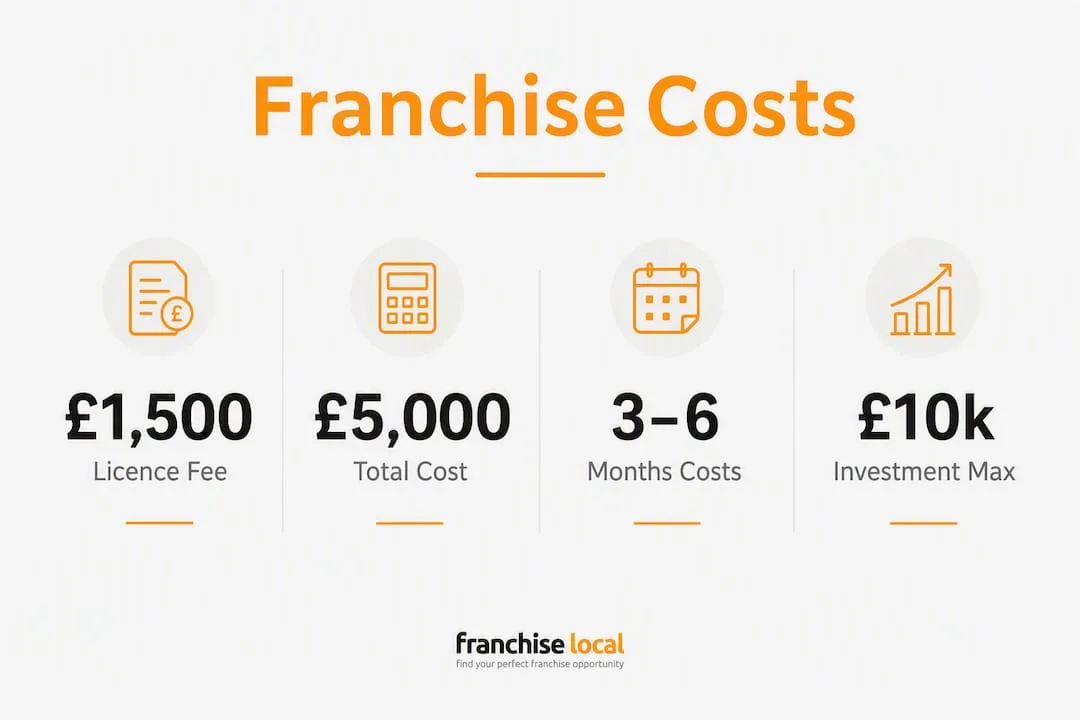
Pro Tip: Budget for at least 3–6 months of operating costs on top of your start-up spend. Underestimating working capital during the ramp-up phase is one of the most common reasons early franchise businesses struggle.
Home-based and mobile models suit part-time buyers or first-time owners testing the water. Management-style franchises like Maid2Clean suit full-time operators ready to build a small team from day one.

How do low cost UK franchises compare side by side?
The table below covers the key metrics that separate one affordable franchise option from another. Figures are indicative ranges drawn from published franchisor information and industry guidance; always request a full cost breakdown directly from the franchisor before committing.
| Franchise | Initial fee (approx.) | Est. total start-up cost | Business model | Ramp-up to break-even | Franchisor support | Ongoing fees |
|---|---|---|---|---|---|---|
| Maid2Clean | ~£3,000–£5,000 | £5,000–£10,000 | Home-based management | 3–9 months | Training, territory, marketing materials | Monthly management fee |
| Kumon (UK) | ~£1,000–£3,000 | £8,000–£15,000 | Study centre / premises | 6–18 months | Full curriculum, training, ongoing support | Monthly franchise fee |
| The Travel Franchise | ~£2,995–£9,995 | £5,000–£15,000 | Home-based | 3–12 months | Training, booking systems, marketing | Commission split / monthly fee |
| Agency Express | ~£5,000–£7,000 | £10,000–£18,000 | Mobile / van-based | 3–9 months | Training, territory, equipment guidance | Monthly management fee |
| DOR-2-DOR | ~£1,500–£3,000 | £3,000–£7,000 | Home-based / mobile | 1–6 months | Territory, training, print support | Ongoing licence fee |
| Andy’s Oven Cleaning | ~£5,000–£8,000 | £8,000–£15,000 | Mobile / van-based | 3–9 months | Training, equipment, marketing | Monthly royalty |
Notes on the figures above:
- “Initial fee” is the licence or franchise fee only. “Est. total start-up cost” adds equipment, vehicle costs where applicable, initial marketing, and a modest working capital buffer.
- Kumon’s premises requirement means total costs vary significantly depending on whether you rent a dedicated space or use an existing venue.
- The Travel Franchise offers tiered entry packages; the higher package typically includes more marketing support and a faster ramp-up.
- Agency Express and Andy’s Oven Cleaning both require a van, which is often the single largest cost item beyond the franchise fee itself.
The gap between headline fee and total cost is where most buyers get caught out. A £3,000 licence fee attached to a van-based model can translate into a significantly higher total commitment once the vehicle, equipment, and first three months of operating costs are included. For most successful franchisees, industry guidance suggests preparing for a total spend of £20,000–£75,000 — however, lower-cost options do exist in limited cases.
Why choose a low-cost franchise over starting from scratch?
The core advantage is the combination of a proven model and a lower capital barrier. You are not building brand recognition from zero, and you are not writing your own operations manual. For first-time business owners, that structure is genuinely valuable.
Home-based, mobile, and management franchise formats keep costs down by eliminating premises and fit-out expenses. Cleaning, tutoring, leaflet distribution, and B2B services are the sectors where these models cluster most densely in the UK.
The real advantages of entry-level franchise models:
- Lower capital barrier means you can start without external funding in many cases
- Established brand and operating system reduces early trial-and-error
- Defined territory gives you a geographic focus for marketing
- Franchisor training shortens the learning curve considerably
- Flexibility: most home-based and mobile models can be run part-time initially
The trade-offs are worth knowing before you sign anything. Smaller territories come with lower-cost franchises, which caps your revenue ceiling unless you buy additional areas later. Royalty rates can be proportionally higher on low-ticket franchises, which squeezes margins when turnover is modest. And the honest reality is that low-cost models succeed when the owner is heavily involved at launch — passive or management-only approaches rarely work at very low investment levels without prior operational scale.
Pro Tip: Before comparing franchise fees, calculate your total capital available and subtract 3–6 months of personal living costs. What remains is your real investment budget — and it is often smaller than buyers expect.
Who benefits most from cheap franchise opportunities? Part-time entrepreneurs who want a structured side income, first-time buyers who want to learn business ownership with a safety net, and cash-constrained buyers who plan to reinvest early profits to scale. The model suits people with strong self-discipline and a willingness to do the operational work themselves, at least in the early months.
How do you choose the right low-cost franchise for your situation?
Start with three questions before you look at any brand: How much capital do you genuinely have available (total, not just the headline fee)? How many hours per week can you commit? And what skills or sector experience do you bring?
Once you have honest answers to those, the shortlisting process becomes much more structured.
Step-by-step selection framework
- Set your real budget. Total capital available minus personal living costs for 3–6 months equals your maximum investment. Never commit your last pound to a franchise fee.
- Match the model to your lifestyle. Mobile and home-based models suit flexible schedules; study-centre models like Kumon require fixed weekly hours and a suitable venue.
- Assess your skills honestly. Cleaning management suits organisers; travel franchises suit confident communicators; property services suit people comfortable working independently outdoors.
- Check territory availability. Ask the franchisor for a territory map and confirm your target area is genuinely available and not already saturated.
- Verify total costs in writing. Request an itemised cost schedule covering the franchise fee, equipment, vehicle, initial marketing, technology, and recommended working capital.
- Check association membership. The Quality Franchise Association and the British Franchise Association (BFA) both encourage members to disclose costs clearly. Membership is a useful trust signal, not a guarantee.
- Speak to existing franchisees. Ask the franchisor for a reference list; any reluctance to provide one is a red flag.
- Get professional advice. Have a franchise solicitor review the agreement and an accountant assess the financial projections before you sign.
Questions to ask existing franchisees
| Question | What you are really checking |
|---|---|
| How long did it take you to cover your start-up costs? | Realistic ramp-up timeline |
| What were your actual costs versus what the franchisor quoted? | Hidden or underestimated expenses |
| How responsive is head office when you have a problem? | Quality of ongoing support |
| Has your territory produced the customer volume you expected? | Territory viability |
| Would you buy this franchise again knowing what you know now? | Overall satisfaction |
| What does a typical working week look like for you? | Lifestyle fit and workload |
Red flags to watch for
- No written list of existing franchisees willing to speak to you
- Vague or verbal-only cost disclosures with no itemised breakdown
- Earnings claims that sound guaranteed or unusually high without supporting data
- Pressure to sign quickly or before a “deadline”
- Franchise agreement that has not been independently reviewed by a solicitor
The BFA and QFA both publish guidance on what a responsible franchisor should disclose. If a franchisor cannot meet that standard, the low headline fee is not worth the risk.
What does a low-cost franchise really cost, and how do you fund it?
The headline franchise fee covers the licence and initial training — it is the entry ticket, not the full price of admission. The broader start-up capital requirement typically includes:
- Franchise fee: the licence itself, usually covering territory rights and initial training
- Equipment and tools: cleaning machines, oven cleaning kits, property boards, or tutoring materials depending on the sector
- Vehicle: van-based models (Agency Express, Andy’s Oven Cleaning) add £5,000–£15,000 or more depending on whether you buy new, used, or lease
- Initial local marketing: leaflets, local digital advertising, and launch promotions to secure your first customers
- Technology: website, booking software, or CRM tools where not included in the franchisor package
- Working capital: 3–6 months of operating costs to cover the period before revenue stabilises
On the tax side, HMRC generally treats the initial franchise fee as capital expenditure rather than a trading expense, while ongoing royalty payments are typically allowable business expenses. That distinction matters for cashflow modelling: you cannot offset the licence fee against your first year’s trading profits in the same way you can offset royalties. Speak to an accountant before you finalise your numbers.
Realistic ramp-up timelines
Home-based and mobile models tend to reach break-even fastest, often within 3–9 months when the owner is actively marketing from week one. Study-centre models like Kumon typically take longer, 6–18 months, because building a pupil base requires sustained local awareness. The ramp-up phase is where working capital earns its keep.
Financing options for low-cost UK franchises
- Personal savings: the most straightforward route for sub-£10,000 investments; no interest, no lender approval
- Bank loans: high-street banks with franchise lending desks (NatWest, HSBC, Lloyds) will consider franchise loans, though small investment tickets can be less attractive to lenders than larger ones
- Specialist franchise lenders: some lenders focus specifically on franchised businesses and understand the model better than generalist underwriters
- Government start-up schemes: the British Business Bank’s Start Up Loans programme offers government-backed personal loans for new businesses, typically up to £25,000
- Personal guarantee: for very low investment tickets, lenders may prefer to fund equipment rather than the licence fee, which changes your repayment structure and risk profile
Pro Tip: If a lender will not fund your franchise investment directly, ask whether they will fund the equipment or vehicle instead. Separating the asset finance from the licence fee often makes the overall package more fundable.
For most buyers entering at under £10,000, personal savings combined with a modest equipment loan is the most practical and lowest-risk route. Most franchisees, however, fall into the industry’s typical total investment ‘sweet spot’ of £20,000–£75,000, as practitioners advise.

These profiles cover the brands most commonly featured in the UK’s entry-level franchise market. Figures are based on published information and should be verified directly with each franchisor, as packages and pricing change.
Maid2Clean
A domestic cleaning management franchise where the owner recruits and manages cleaners rather than cleaning themselves. The headline franchise fee sits in the £3,000–£5,000 range, with estimated total start-up costs of £5,000–£10,000 including marketing and working capital. Home-based, with no van required. Suits full-time operators who are comfortable with recruitment, customer service, and local marketing. Franchisor support includes territory rights, training, and marketing materials. Ask next: What is the average number of active clients in a mature territory, and how long did franchisees take to reach that level?
Kumon (UK)
The world’s largest supplementary education provider, with study centres run by franchisees across the UK. The initial fee is modest, but total start-up costs rise to £8,000–£15,000 once premises, materials, and marketing are factored in. Suits former teachers, parents with educational backgrounds, or anyone with patience and a structured approach to working with children. Kumon provides full curriculum support, training, and ongoing guidance. Ask next: Is a dedicated premises required, or can a community hall or similar venue be used to keep costs down?
The Travel Franchise
A home-based travel agency model where franchisees sell holidays and earn commission. Entry packages range from approximately £2,995 to £9,995, with higher tiers including more marketing support and a faster path to profitability. Total start-up costs depend heavily on the package chosen and how much local marketing the franchisee invests in early. Suits confident communicators with an existing social network. Ask next: What is the realistic commission income in year one at each package level, based on actual franchisee data?
Agency Express
A mobile franchise installing and removing estate agent property boards. The franchise fee is typically in the £5,000–£7,000 range, but a van is essential, pushing total start-up costs to £10,000–£18,000 or more. Suits people comfortable working independently outdoors with a reliable vehicle. The recurring nature of property board work provides a relatively predictable workflow once established. Ask next: How many active estate agent clients does a typical franchisee hold in their first year, and what is the average revenue per client?
DOR-2-DOR
One of the UK’s best-known leaflet distribution franchises, with headline fees typically in the £1,500–£3,000 range. Total costs remain relatively low because no specialist vehicle or equipment is required beyond basic distribution tools. Home-based and genuinely part-time friendly. Suits people who want a flexible, low-overhead business with a clear local marketing proposition. Franchisor support includes territory mapping, print partnerships, and training. Ask next: What is the average number of distribution clients a franchisee holds after six months, and what does a typical monthly revenue look like?
Andy’s Oven Cleaning
A mobile oven cleaning franchise with a low headline fee but a van requirement that adds meaningfully to total costs. Start-up costs typically land in the £8,000–£15,000 range once the vehicle, cleaning equipment, and initial marketing are included. Suits people who prefer practical, hands-on work and want to build a loyal repeat-customer base. The oven cleaning sector benefits from consistent domestic demand. Ask next: What is the average number of repeat bookings per customer per year, and how quickly do franchisees fill their weekly schedule?
Franchiselocal
Franchiselocal is not a franchise itself but the UK’s leading franchise marketplace and directory. It lists hundreds of opportunities across investment bands, including a dedicated franchises under £5,000 category and broader filters for industry, lifestyle, and location. For buyers at the research stage, it is the practical starting point for building a shortlist, requesting information packs, and comparing options side by side. Ask next: Use the investment filter on Franchiselocal to pull a live list of current opportunities in your target sector and budget range.
What are the practical next steps before you commit?
The gap between “interested” and “ready to sign” should include at least six structured steps. Rushing any of them is where buyers make expensive mistakes.
- Set your investment ceiling. Calculate total available capital, subtract 3–6 months of personal living costs, and treat the remainder as your maximum. Never include money you cannot afford to lose.
- Build your shortlist using investment filters. Use Franchiselocal’s UK franchise search to filter by investment band, industry, and location. Aim for three to five candidates at this stage.
- Request a franchise information pack from each shortlisted franchisor. A credible franchisor will provide a written pack covering the business model, territory, costs, training, and support. Anything verbal-only at this stage is a warning sign.
- Ask for a written list of existing franchisees. Contact at least two or three independently. Use the questions in the table above as your framework.
- Arrange a franchise solicitor review. The franchise agreement is a legally binding document, often weighted in the franchisor’s favour. A solicitor with franchise experience will identify unusual clauses, non-compete restrictions, and exit terms before you sign.
- Have an accountant review the financial projections. Ask the franchisor for historic financial performance data from existing franchisees, not just projections. An accountant can assess whether the numbers are realistic and model the HMRC treatment of fees versus royalties.
- Check BFA or QFA membership. Neither guarantees success, but both require members to meet disclosure and conduct standards. Membership confirms the franchisor has passed a basic credibility threshold.
- Confirm territory rights in writing. Verbal assurances about exclusivity mean nothing once the agreement is signed. The territory definition, its boundaries, and any exclusivity conditions must appear in the written contract.
Due diligence checklist
- Full itemised cost schedule (fee, equipment, vehicle, marketing, working capital)
- Written territory map and exclusivity terms
- Training programme details (duration, location, content, ongoing support)
- Historic profit and loss data from at least two existing franchisees
- Exit terms and resale conditions
- Non-compete clauses (duration and geographic scope)
- Renewal terms and any fee increases at renewal
- Dispute resolution process
One reasonable thing to ask at the enquiry stage: whether the franchisor offers a starter package or phased payment option. Not all do, but some low-cost franchisors will split the initial fee across the first few months to ease cashflow. It is worth asking before assuming the full fee is due on day one.
This article provides general information about franchise investment in the UK and does not constitute legal, financial, or tax advice. Confirm current costs, legal obligations, and tax treatment with a qualified solicitor and accountant before making any investment decision.
Franchiselocal: your starting point for affordable UK franchise options
Franchiselocal gives you a direct route to the UK’s most complete franchise directory, filtered exactly to your budget. Instead of trawling individual franchisor websites, you can set an investment ceiling of under £5,000 or under £10,000, pick your preferred industry, and pull a live list of current opportunities in your area in seconds.
The platform’s investment filters cover every threshold discussed in this article, from entry-level options under £5,000 through to the industry sweet-spot range under £40,000. Each listing includes a direct enquiry form so you can request an information pack without leaving the page. Curated category pages cover B2B service franchises, business services, and networking franchises, making it straightforward to compare models across sectors.
Browse live low-cost listings now at Franchiselocal.co.uk and use the investment filter to build your shortlist today.
Useful sources for UK franchise due diligence
Before you commit to any franchise, these authoritative resources will support your research and professional advice steps:
- Quality Franchise Association — low-cost franchise directory: lists accredited low-cost franchisors and promotes clear cost disclosure standards
- Xero UK — what is a franchise?: plain-language explainer covering HMRC treatment of franchise fees and royalties, useful for tax planning conversations with your accountant
- Franchiselocal — franchises by industry: browse live UK franchise listings filtered by sector to compare low-cost models across cleaning, tutoring, B2B services, and more
- Franchiselocal — franchises by county: check territory availability and local demand in your target area
Who to consult: a franchise solicitor for agreement review, a chartered accountant for financial projections and tax planning, and an independent franchise broker if you want guided shortlisting across multiple brands. Franchiselocal’s directory and enquiry tools can accelerate the discovery phase before those professional conversations begin.