

Most widely repeated franchise myths are oversimplified or plain wrong; careful checks usually show a more balanced picture. The British Franchise Association recommends speaking to current franchisees and doing rigorous due diligence before trusting any franchisor claim. Your first move: run a short verification checklist, or shortlist verified opportunities on a reputable UK franchise directory and work from there.
1. Ten franchise myths and how to check each one
Franchise marketing is built to reassure. That’s not dishonest by itself, but it means every bold claim deserves its own verification step before you sign anything.
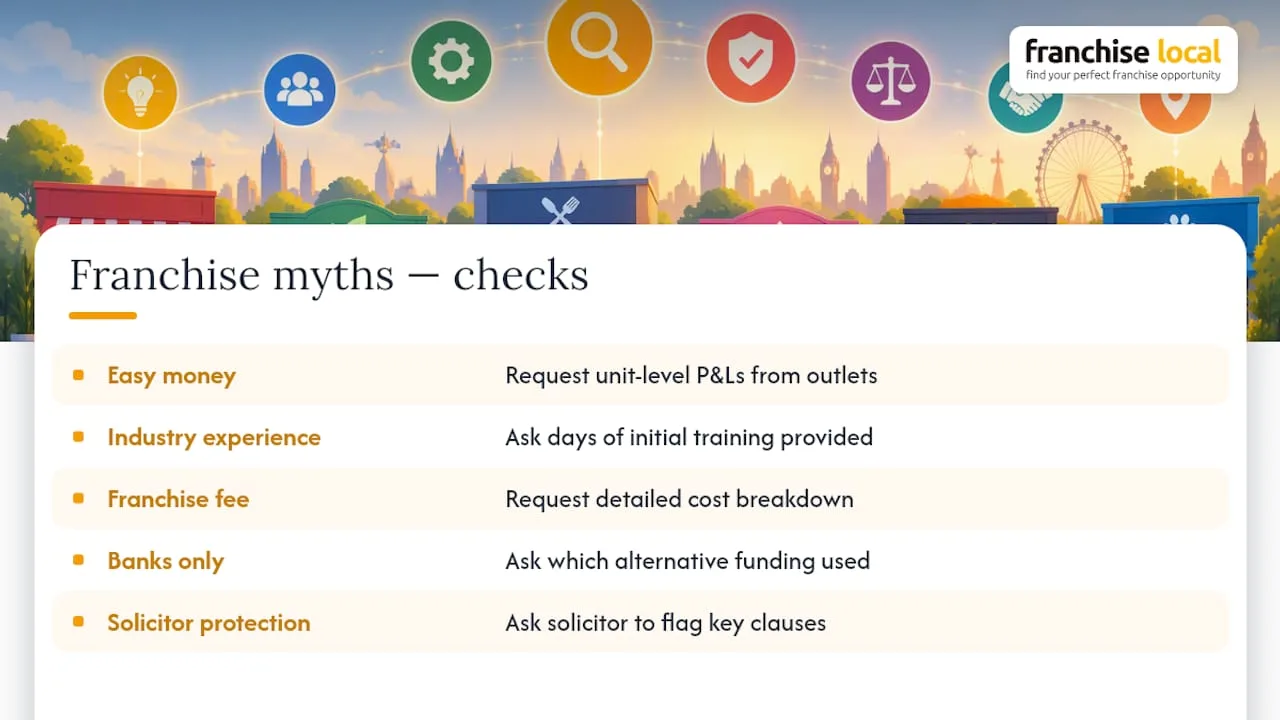
1. “Franchises are easy money.” No business format removes effort or risk. Reality check: ask the franchisor for unit-level profit and loss statements from several existing outlets, not headline averages.
2. “You need industry experience to succeed.” Most franchise systems are built around training packages precisely because they expect newcomers. Reality check: ask how many days of initial training are provided and what ongoing support looks like after the first year, a question covered in more depth in questions to ask a franchisor before you sign anything.
3. “Franchising kills creativity.” Operations manuals set standards, but most networks allow local flexibility in marketing and community outreach. Reality check: ask specifically what local marketing activity you’re permitted to run without head office sign-off.
4. “The franchise fee covers all your start-up costs.” It rarely does. The initial fee usually buys the licence, training and brand rights, while fit-out, stock, signage and working capital sit outside it. Reality check: request a detailed cost breakdown, and run the figures through a franchise financial assessment before you commit any deposit.
5. “Banks are the only source of funding.” High street lenders are one option among several; some franchisors run their own funding partnerships, and asset finance or personal investment often fill the gap. Reality check: ask the franchisor what alternative funding routes past franchisees have used and what deposit level is typical.
6. “A solicitor’s review will protect you from a bad deal.” A specialist franchise solicitor explains what you’re signing, including renewal rights and performance penalties; they don’t rewrite unfavourable terms for you, as the British Franchise Association points out. Agreements often run to 40 to 50 pages and are typically drafted in the franchisor’s favour. Reality check: ask your solicitor to flag the exact clauses covering renewal, termination and any personal guarantees.
7. “A certificate of insurance proves the franchise is properly run.” Insurance paperwork confirms cover exists, not that the wider business is sound. Reality check: ask to see the actual policy documents and evidence that other franchisees hold equivalent cover.
8. “A recognisable brand name guarantees local sales.” Footfall and demand vary by postcode regardless of how familiar the logo is. Reality check: ask for regional performance data from outlets in areas similar to yours, not just national averages.
9. “Renewal at the end of the term is automatic.” It usually isn’t. Renewal is typically conditional on performance and franchisor discretion, and recent commentary on renewal rights points to court scrutiny of how that discretion gets exercised. Reality check: ask to see the specific renewal conditions written into the agreement, not a verbal assurance.
10. “Franchising is just fast food and retail shops.” Franchise sectors span business services, cleaning, education, driving instruction, recruitment and financial services, among others. Reality check: browse listings by sector rather than assuming the format only fits one type of business.
Pro Tip: A franchisor who answers support questions with vague enthusiasm rather than specific figures, such as exact training days or named support staff, is usually one to question further.
2. A due-diligence checklist: documents, calls and red flags
Before any money changes hands, gather the paperwork and make the calls that actually reveal how a franchise operates.
Request these documents:
- The full franchise agreement, not a summary version.
- The operations manual, or at least a sample of its contents.
- Sample profit and loss statements from existing units.
- A list of current franchisees you can contact directly.
- A breakdown of ongoing fees and advertising levies.
Speak to three people before you speak to the franchisor’s sales team again: a BFA-accredited solicitor to explain the agreement, an accountant familiar with franchise accounts to sanity-check the numbers, and at least two independent franchisees who weren’t hand-picked by head office.
Trusted Traders endorsement**, which reflects how much weight independent verification carries when trust is hard to judge from marketing alone.
Watch for red flags: financials you can’t verify independently, a franchisor who refuses to share recent franchisee contacts, renewal terms that stay vague under questioning, or a pattern of dissolved companies linked to the same franchisor on the public register. Legal and financial checks typically take a few weeks and add a modest cost on top of the franchise fee itself, but skipping them is the single most common regret among franchisees who run into disputes later.
3. Where to run these checks and find verified listings
You don’t need to build this process from scratch. A franchise directory may let you filter opportunities by investment level, industry and lifestyle fit, and include affordability and ROI tools to give you a working figure before you contact any franchisor.
Pair that with independent trust signals:
- BFA accreditation, which requires franchisors to meet ethical and operational standards before they can display the badge.
- Which? Trusted Traders endorsement, which involves financial health checks and ongoing annual assessments rather than a one-off badge.
- The Gov, which sets out the legal distinctions and registration questions that matter for property and business rights.
A simple workflow: shortlist on FranchiseLocal, request the core documents, run the numbers through a calculator, then get a legal review before you sign anything.
4. How myths shape bad decisions before you even notice
Myths don’t usually cause outright fraud. More often, they shift how you weigh a decision without you realising it. Someone who believes fees cover everything underestimates the working capital they need and starts undercapitalised from day one. Someone who assumes renewal is automatic doesn’t push for clearer terms during negotiation, then discovers years later that the franchisor holds more discretion than expected.
The pattern is consistent: a myth lowers your guard on exactly the point where scrutiny matters most. Believing a brand name guarantees sales means skipping the regional performance check that would have flagged a weak local market. Believing a lawyer’s signature equals protection means treating legal review as a formality rather than reading the renewal and termination clauses yourself.
None of this means franchising is a poor route into business ownership. It means the myths tend to remove exactly the friction that would otherwise prompt a useful question. Treating each claim as something to verify, rather than something to accept, changes which franchises make your shortlist and which get a harder second look.
5. Spotting marketing spin before it shapes your view
Franchise marketing rewards confident language: “leading”, “recession-proof”, “proven system”. None of these phrases are illegal to use, but none of them are evidence either.
A few habits help separate substance from spin. Ask for the specific figure behind any superlative claim, such as the number of active units a “leading” network actually operates. Treat testimonials from hand-picked franchisees as marketing, not due diligence, and seek out franchisees the franchisor didn’t introduce you to. Be wary of pressure to sign quickly, since a genuine opportunity doesn’t usually depend on you deciding within days.
Cross-check public information where you can. Companies House filings are useful, but the register itself isn’t independently verified and has been flagged for abuse by fraudsters, so treat it as one data point rather than proof of anything. Online reviews carry similar caveats: a franchisor’s overall reputation is worth checking through independent channels, and practical guidance on assessing online reputation is useful groundwork before you take any glowing review at face value.
6. Why myths differ between food, retail and service franchises
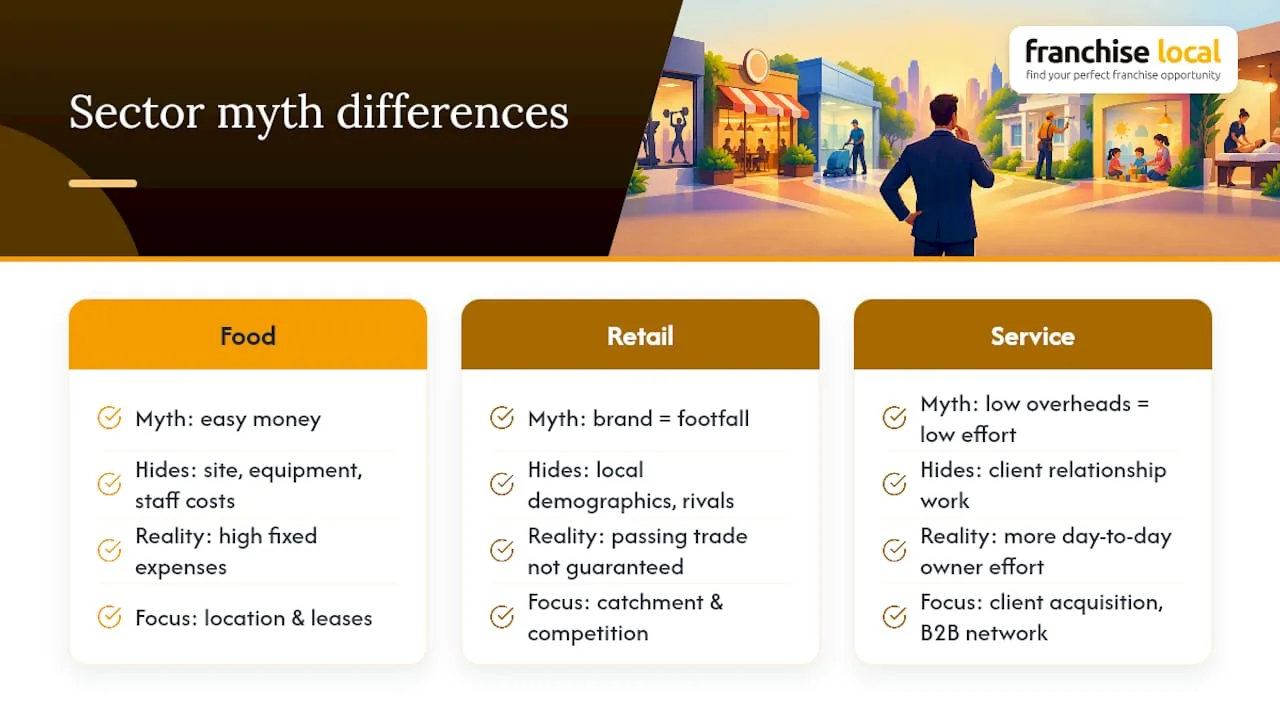
The same headline myth can mean something quite different depending on the sector. In food franchises, “easy money” myths tend to gloss over site costs, equipment leases and staffing, which are usually far higher than the initial franchise fee suggests. Retail franchises carry their own version, where the myth often centres on footfall: a strong brand name gets assumed to guarantee passing trade, when local demographics and competing stores matter just as much.
Service-based franchises, from cleaning to business consultancy, attract a different myth entirely: that low overheads mean low effort. Many service franchises actually demand more from the individual franchisee day to day, since the business often depends on personal client relationships rather than a fixed location. Business-to-business franchises face a myth of their own, where buyers assume a professional-sounding brand removes the need to build a client base from scratch.
The verification step stays the same across every sector: ask for real unit-level figures and speak to franchisees running a similar type of outlet to the one you’re considering, not just any franchisee within the network.
7. Use FranchiseLocal to shortlist and verify opportunities
Sorting fact from marketing gets easier once you can filter by the details that matter to you rather than reading through every franchisor’s website in turn. A franchise directory lets you search UK franchise opportunities by investment level, industry, and lifestyle fit, so your shortlist can reflect your budget and goals rather than a sales pitch.
- Filter listings by price, sector and home-based or full-time formats on the franchise search directory.
- Estimate what you can realistically afford with the franchise affordability calculator.
- Check likely returns with the ROI and profitability estimator before you request full documents.
Start with the trending UK franchise opportunities page, or head straight to the full directory to submit a short enquiry and request the paperwork covered earlier in this guide.
Sources
FAQ
What are seven common myths about entrepreneurship?
Common myths include the ideas that entrepreneurs are born rather than trained, that success requires a completely original idea, and that funding is the main barrier to starting out. Within franchising specifically, the myths covered above, around easy money, automatic renewal and brand names guaranteeing sales, follow the same pattern of oversimplifying real risk.
What is the hardest type of franchise to own?
There’s no single “hardest” franchise, since difficulty depends on your sector, location and personal fit rather than the format itself. Franchises with high fixed overheads, such as food outlets with equipment leases and staffing needs, tend to carry more financial pressure than home-based service franchises with lower running costs.
What are the four Ps of franchising?
Definitions vary by source, but a common version covers product, price, place and promotion, borrowed from the standard marketing mix and applied to how a franchise system operates. It’s a useful lens for comparing opportunities, though it’s not a formal legal or regulatory framework.
What are some genuinely useful facts about franchises?
Franchise agreements are typically lengthy, often 40 to 50 pages, and are usually drafted in the franchisor’s favour, which is why legal review matters. Renewal at the end of the term is also frequently conditional rather than automatic, governed by the specific terms written into your agreement.
How can I check if a franchise opportunity is trustworthy?
Speak directly to current franchisees rather than relying on hand-picked testimonials, and request full financial documents rather than headline figures. You can shortlist and compare verified UK opportunities through the franchise directory before starting that verification process.