

An exclusive territory means the franchisor agrees not to put another franchisee of the same brand in your defined area. A non-exclusive territory gives you the right to trade there but no promise that anyone else will be kept out. That one difference shapes how much local competition you may face from your own brand, what your business is worth when you sell, and how hard it is to grow.
This guide explains both models in plain terms, shows how UK agreements usually define a territory, and lists the clauses to read closely before you commit. It is general information, not legal advice. Have a solicitor with franchise experience review any agreement before you sign it.
The short answer
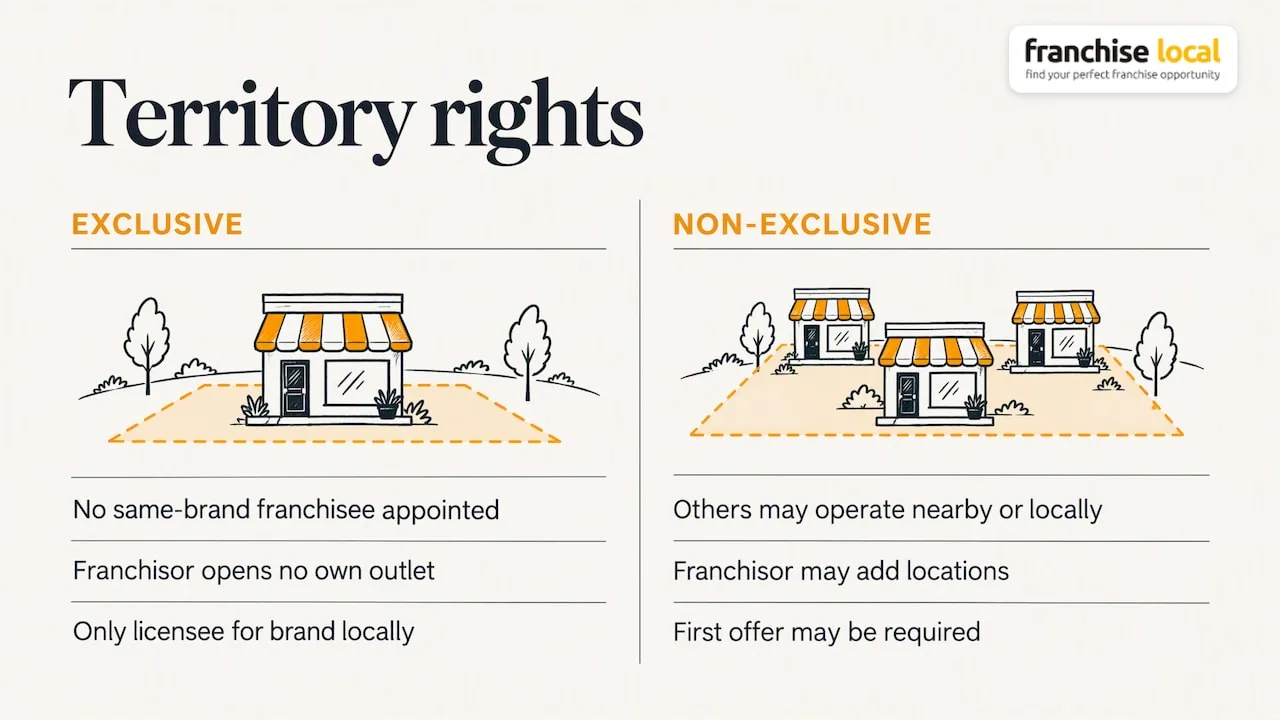
Exclusive territory: within the agreed boundary, the franchisor will not appoint another franchisee for the same brand and will not open its own outlet. You are the only one licensed to offer the brand’s products or services there.
Non-exclusive territory: you are licensed to operate in an area, but the franchisor keeps the right to appoint other franchisees nearby, or in the same area. Some agreements soften this by requiring the franchisor to offer a new location to you first.
Most franchise agreements sit somewhere between those two poles. The wording of the clause matters far more than the label on the brochure, so read the territory clause and its exceptions together.
What an exclusive territory gives you
In an exclusive arrangement, the area is yours to develop. In practical terms that usually means:
- No same-brand competition. Customers in your area who want the brand’s service come to you, not to a second franchisee a few streets away.
- Marketing that pays back. Local advertising, leaflets, sponsorships and networking build awareness in an area where you capture the result.
- A clearer resale story. A buyer of your franchise can see what the territory includes, which makes the business easier to value.
- Room to plan. You can set targets and staffing against a defined pool of customers.
Exclusivity is a contractual promise, not a legal entitlement. English law has no statute that requires franchisors to grant it, so you have it only if your agreement says so. Its size varies enormously: it can be a county, a group of postcodes, a single town, or one shopping centre or business park.
What exclusive does not always mean
Exclusive rarely means “nobody else can ever sell anything to anyone in this area”. Agreements commonly reserve certain rights for the franchisor. Typical reservations include:
- sales through the brand’s national website;
- national or corporate accounts, where a customer with sites across the UK is served centrally;
- concessions or outlets in special locations such as airports, stations, hospitals or university campuses;
- customers in defined categories, for example public sector contracts.
These reserved rights are often reasonable, because a national client cannot be split into postcode areas. The point is to know about them before you sign, and to ask how the franchisor shares income from them, if at all.
What a non-exclusive territory means
A non-exclusive territory is not necessarily a bad deal. It simply gives the franchisor flexibility to appoint further franchisees, or to add locations, as the market develops. Where the model suits it, that can be sensible. A brand built on mobile services with large catchment areas may want several operators in a busy city. A brand with a low entry price may offer non-exclusive rights as part of keeping the cost of joining down.
Things to look for in a non-exclusive clause:
- Right of first offer. Some agreements say that if the franchisor wants to appoint another franchisee in your area, it must offer the new location to you first. That gives you a chance to expand rather than be crowded.
- Minimum distances. Some franchisors commit not to open another outlet within a set radius, even without full exclusivity.
- Consultation. The franchisor may agree to consult you before making changes that affect your area.
- Lead allocation. Ask how enquiries from the brand’s website and national advertising are shared between neighbouring franchisees.
If none of these exist, you are relying on the franchisor’s commercial judgement. Ask the franchisor how many franchisees it plans to appoint in your region, and ask existing franchisees how that has worked in practice.
Protected territory: the middle ground
You will often see the word “protected” used instead of “exclusive”. The two are not always the same. A protected territory may mean the franchisor will not open another outlet or appoint another franchisee within a defined zone, while still allowing other routes to market, such as online sales or mobile operators who travel in from outside. Ask directly whether “protected” in the franchisor’s materials has the same meaning as “exclusive” in the contract. If the documents use different words, ask which one the contract actually follows.
Exclusive vs non-exclusive at a glance
| Point | Exclusive territory | Non-exclusive territory |
|---|---|---|
| Other franchisees in your area | Not appointed by the franchisor | May be appointed |
| Franchisor’s own outlets | Usually excluded in the area | May be permitted |
| Right of first offer on new locations | Rarely needed | Sometimes included |
| Competition from your own brand | Low within the boundary | Possible |
| Reserved rights (online, national accounts) | Often still apply | Often apply |
| Potential entry cost | Can be higher for larger protected areas | Can be lower |
| Effect on resale | Clear, defined area to sell | Depends on the clause wording |
| Conditions attached | Sometimes tied to performance targets | Sometimes tied to performance targets |
Treat the table as a guide to the questions to ask, not a rule. Individual agreements differ.
How territories are defined
A territory is only as good as its description. UK agreements typically define it in one of these ways:
- Postcode lists. The clearest option for most service businesses. Every postcode sector is either in or out.
- Radius. For example, a set distance from a shop. Easy to say, but disputes arise because a radius can be measured in a straight line or by road.
- Local authority or county boundaries. Official lines, so easy to verify.
- Population or household counts. Common where franchisors want territories of similar commercial size, such as a set number of homes or businesses.
- Customer categories. The territory may be tied to a type of customer, such as local small businesses, instead of, or as well as, a place.
Whichever method is used, the area should be shown on a map with clear boundary lines and attached to the agreement. If the territory you were told about in a meeting differs from the one in the contract, raise it before signing. If you want to understand how franchisors draw these lines, our guide to franchise territory mapping covers the approach, and how franchisors map out further territories shows the thinking from the franchisor’s side.
Online sales and customers outside the boundary
The internet makes strict territory lines harder to apply. Three questions come up repeatedly.
Who serves online orders? If the brand sells through a national website, the agreement should say whether orders from your area are passed to you, shared, or kept by the franchisor.
Can you sell outside your territory? Franchisors often restrict active selling outside your area, such as targeted advertising or door-knocking in a neighbour’s patch. UK competition rules, however, generally do not allow a franchisor to stop you responding to passive enquiries, where a customer from outside your area contacts you unprompted. In practice, many agreements handle this with a referral arrangement or a fee. Ask how yours works.
What about a national client? If a customer with branches in your area signs a national contract with the franchisor, does the work come to you? On what terms? A good agreement answers this specifically.
What UK law says, and what it leaves to the contract
The UK has no dedicated franchising statute. The relationship is governed mainly by contract law, intellectual property law and competition law. That makes the written agreement the main source of your territorial rights. Three consequences follow.
- Exclusivity is optional. Nothing in English law obliges a franchisor to give it. If the clause is silent, assume you have no exclusive rights.
- Competition law sets limits. Franchisors may grant exclusive territories, but there are limits on restricting passive sales and on certain online restrictions. These come from the UK’s vertical agreements rules, which apply to arrangements like franchising.
- Good faith is not a safety net. English courts are cautious about implying duties into commercial contracts. A general principle may help in extreme cases, where a franchisor’s conduct substantially strips away what it granted, but it is not something to rely on. Spell out the protections you need in the agreement.
For a wider look at the rules, see our overview of franchise regulation in the UK and the guide to franchise legal requirements. The British Franchise Association is the industry body whose members commit to a code of ethical practice. Membership is worth asking about, though it is not a substitute for reading the contract.
Conditions that can change your territory
Exclusivity is often conditional. Look for clauses that say your territory can change if:
- you miss minimum sales or performance targets;
- you fail to meet brand standards or breach the agreement;
- you do not develop the area within an agreed timescale, particularly where you hold a large multi-unit area;
- the franchisor needs to reorganise territories, usually after consultation.
The consequences can include a smaller area, another operator appointed alongside you, or your territory becoming non-exclusive. None of this is unusual or unfair in itself. Franchisors need to stop a large area sitting underused. What matters is that the targets are realistic, that you are given notice and a chance to put things right, and that the sanction is proportionate.
It also works in the other direction. Some franchisors prefer to start with a smaller area and expand it as the franchisee proves the model, since it is easier to enlarge a territory than to reduce one. If you are offered a modest area, ask whether there is a clear route to add adjoining areas and on what terms. Our article on what an exclusive territory means in franchising and the guide to securing your market through franchise territory rights go further on this.
Checklist: what to confirm before you sign
Work through these points with your solicitor and the franchisor.
- Is the territory exclusive, protected or non-exclusive? Find the exact words in the agreement, not the brochure.
- Is there a map or postcode list attached? It should match what was discussed in meetings.
- What rights does the franchisor reserve? Online sales, national accounts, concessions, special venues.
- How are online and national enquiries handled? Who receives them, and what happens to the revenue?
- Can the territory change? Look for performance targets, review dates and the notice you receive.
- What happens if you miss a target? Smaller area, non-exclusivity, or termination, and whether you can remedy it.
- Is there a right of first offer on neighbouring areas or new locations?
- What happens on resale or renewal? Check that the territory transfers to the buyer and carries into any renewal term.
- How do existing franchisees describe it? Speak to several, including some in neighbouring areas, and ask whether territory promises matched reality.
- Has a franchise solicitor reviewed it? An independent review is the best protection you can buy for a commitment of this size.
Our guides to UK franchise agreements and the role of franchise agreements explain how these documents are put together, and the list of legal considerations for UK buyers is a useful companion while you review the paperwork.
Which model suits you?
The right choice depends on the business model and what you want from it.
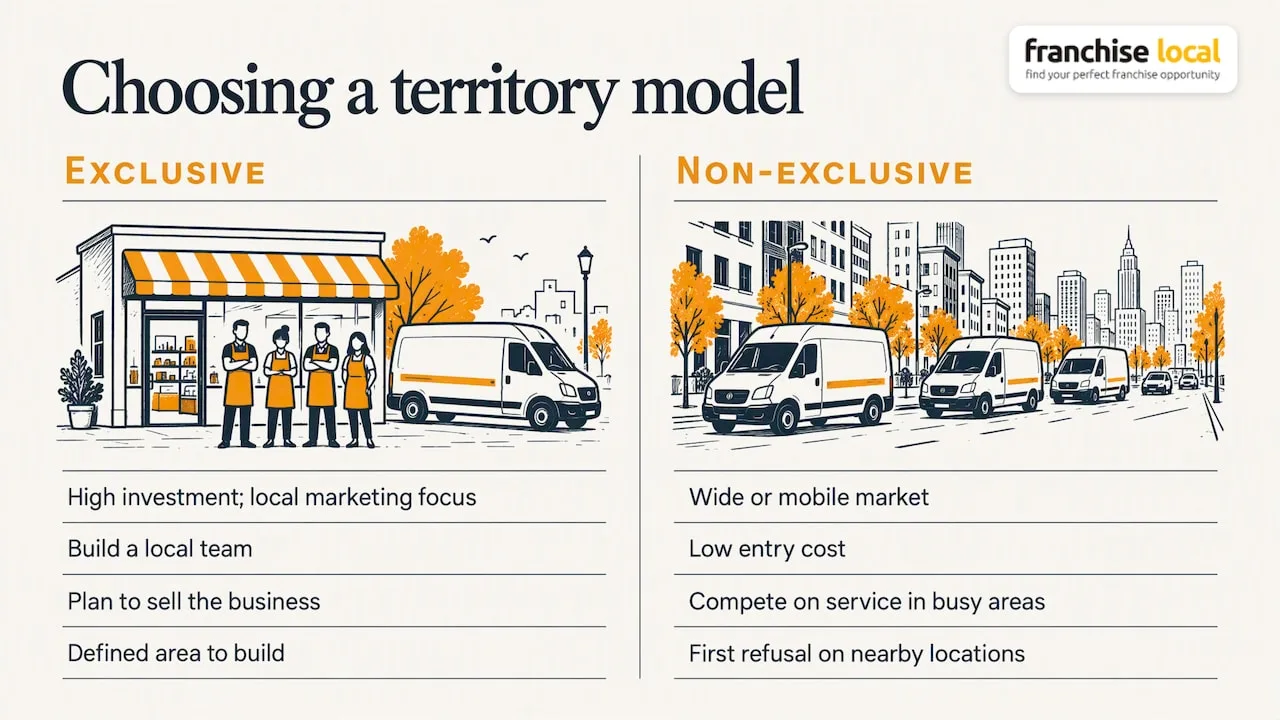
Exclusive suits you if you are investing a significant sum, relying on local marketing, building a team, or planning to sell the business later. A defined area gives you something to build and something to sell.
Non-exclusive can suit you if the brand sells to a very wide or mobile market, the entry cost is low, or you are happy to compete on service within a busy area. It is also worth considering if the agreement gives you first refusal on nearby locations.
Either way, look at how many franchisees already operate in the network and how close together they are. A well-drafted exclusive clause on a small territory may protect less than a non-exclusive clause with strong first-offer rights on a large one. Compare the real terms, not the labels.
Also ask what the territory is worth. Does it contain enough households or businesses to reach the income the franchisor describes? Ask for the basis of any projections, and test them against what existing franchisees in comparable areas actually achieve. Being a franchisee is a hands-on role, and our guide to the franchisee role in the UK covers what you will be responsible for within your area.
Compare franchises with their territory terms in mind
Territory terms differ from one brand to the next, so it helps to shortlist several and put the same questions to each. On Franchiselocal you can filter UK franchise opportunities by investment level, industry, lifestyle and location, then send an enquiry to the franchisors that fit. Start with the UK franchise directory or browse trending franchise opportunities, and ask each brand how its territories are defined before you go further.
FAQ
What is the difference between an exclusive and a non-exclusive franchise territory?
In an exclusive territory, the franchisor agrees not to appoint another franchisee or open its own outlet for the same brand in your defined area. In a non-exclusive territory, you can operate there, but the franchisor may appoint others, sometimes after offering the new location to you first. Always check the reserved rights, such as online sales and national accounts, which can apply in both.
Is an exclusive territory a legal right in the UK?
No. UK law has no franchising statute that requires exclusivity, so you have it only if your agreement grants it. Because the contract is the main source of your rights, the wording of the territory clause, the map and the exceptions matter a great deal. A franchise solicitor can check that the clause says what you were told.
Can a franchisor change my exclusive territory?
Only if the agreement allows it. Some agreements make exclusivity conditional on performance targets or compliance, so a shortfall could lead to a smaller area, another operator, or non-exclusive status. Check what triggers a change, what notice and consultation you get, and whether you can put things right before it takes effect.
Can I sell outside my franchise territory?
Often you can respond to customers who contact you unprompted, because UK competition rules generally do not allow a franchisor to block those passive sales. Actively targeting customers in another franchisee’s area is commonly restricted. Your agreement should explain how both situations are handled, including any referral arrangement.
Does an exclusive territory protect me from online sales by the franchisor?
Not necessarily. Many agreements reserve the franchisor’s right to sell through a national website or serve national accounts, even inside an exclusive area. Ask how orders from your area are treated and whether you receive them or any share of the income.