

A franchise directory is a searchable list of franchise opportunities, grouped so you can compare brands by industry, investment level, location and way of working. Use it to build a shortlist of three to five brands, then check each one properly before you speak to anyone. This guide shows how to filter well, how to read a listing, and which questions to take to the franchisor.
What a franchise directory is and what it tells you
A franchise directory collects franchise opportunities in one place. Each brand gets a listing, and the listing gives you enough to decide whether the opportunity is worth a closer look. Directories are usually free for the people searching. Franchisors, brokers and advisors pay to be listed or featured, which is how the sites run.
That last point matters when you read results. A listing is a shop window written by the franchisor. It is a good way to discover brands and compare headline figures. It is not independent verification, and no directory replaces your own checks.
A typical UK listing gives you:
- The brand name and a short description of the business.
- The industry or sector.
- An investment range, often shown as a band such as under £10,000 or a higher bracket.
- Whether the model is home based, mobile, office based, retail or part time.
- The areas where territories are available.
- A way to send an enquiry to the franchisor.
Some listings add more: training outline, the type of support, how many outlets are open, and what the ideal franchisee looks like. The more specific a listing is, the easier it is to compare. Treat vague wording as a prompt to ask a question, not as a reason to rule a brand in or out.
Start with you, not the directory
The fastest way to waste a week on any directory is to browse without criteria. Before you filter, write down four things.
- Budget. Decide the total you can commit, including working capital. The headline franchise fee is rarely the whole picture.
- Time. Full time, part time or alongside a job. Many franchises assume a particular weekly commitment.
- Way of working. Home based, mobile, on the road, in an office, in a unit, or managing a team.
- Strengths. Selling, hands-on work, managing people, or running systems. Pick a model that uses what you already do well.
If you are not yet sure franchising suits you, work through our six questions to test if franchising is right for you first. It takes a few minutes and makes the filters far easier to set.
How to narrow a directory search
Most directories offer the same four filters. Used in the right order, they cut hundreds of brands to a manageable list.
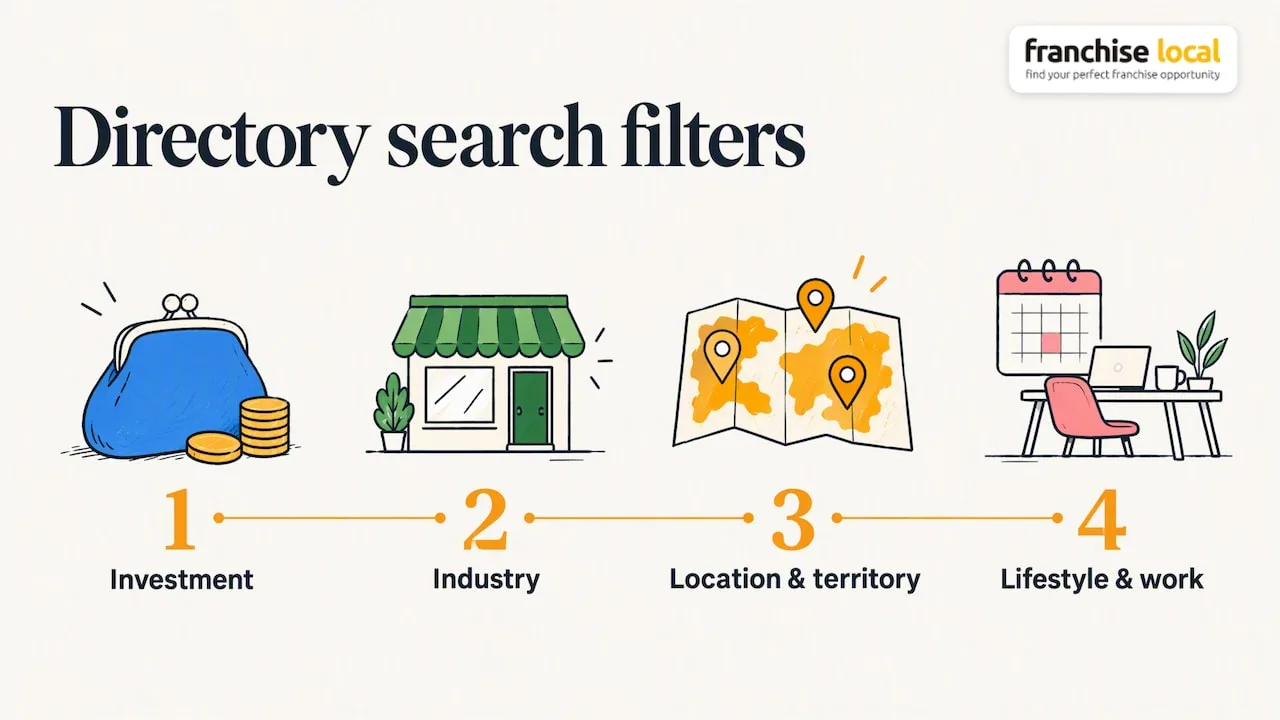
Filter by investment level first
Budget is the hardest limit, so apply it first. Set a band that matches what you can actually fund, then read the listing to see what the figure includes. Does it cover the franchise fee only, or equipment, vehicle, stock, training and launch marketing as well? Work out your own number for working capital, because you will need to live and trade before the business pays you.
If you are starting small, look for the lower bands, for example brands listed under £10,000. Lower entry cost often means a simpler, home based or service model. It does not mean lower effort.
Filter by industry second
Industry filters turn a long list into a sensible one. Pick the sectors you can picture yourself working in for years, not the ones that look trendy this month. You can browse franchises by industry to see how the categories break down, or go straight to a specific sector page such as networking franchises, loans franchises or fashion franchises.
Filter by location and territory
Location works differently in franchising than in a shop search. A home based franchise may be sold by territory, so what matters is whether your postcode area is still available, not where the head office is. A retail or unit based franchise needs a suitable site. Check both the brand’s coverage and whether your own area is open.
Filter by lifestyle and way of working
This is the filter many people skip and later regret. Home based, part time, mobile and low overheads each describe a different daily reality. Choose the one that fits your life, then look at what the brand expects in hours, travel and customer contact.
A quick reference for filter order
| Step | Filter | What to decide | Common mistake |
|---|---|---|---|
| 1 | Investment level | The total you can fund, including working capital | Reading only the franchise fee |
| 2 | Industry | Sectors you can commit to for years | Choosing on trend alone |
| 3 | Location | Whether your territory is available | Assuming head office location matters |
| 4 | Lifestyle | Hours, travel, home or premises | Ignoring the weekly time demand |
| 5 | Sort or trending | Which brands others are viewing | Treating popularity as proof of quality |
Trending lists are useful for discovery. They show what other searchers are looking at, and our trending franchise opportunities page updates as interest shifts. Popularity tells you what is attracting attention. It does not tell you whether a brand is right for you.
How to read a listing
Read each listing twice. The first time, look at what it says. The second time, look at what it leaves out.
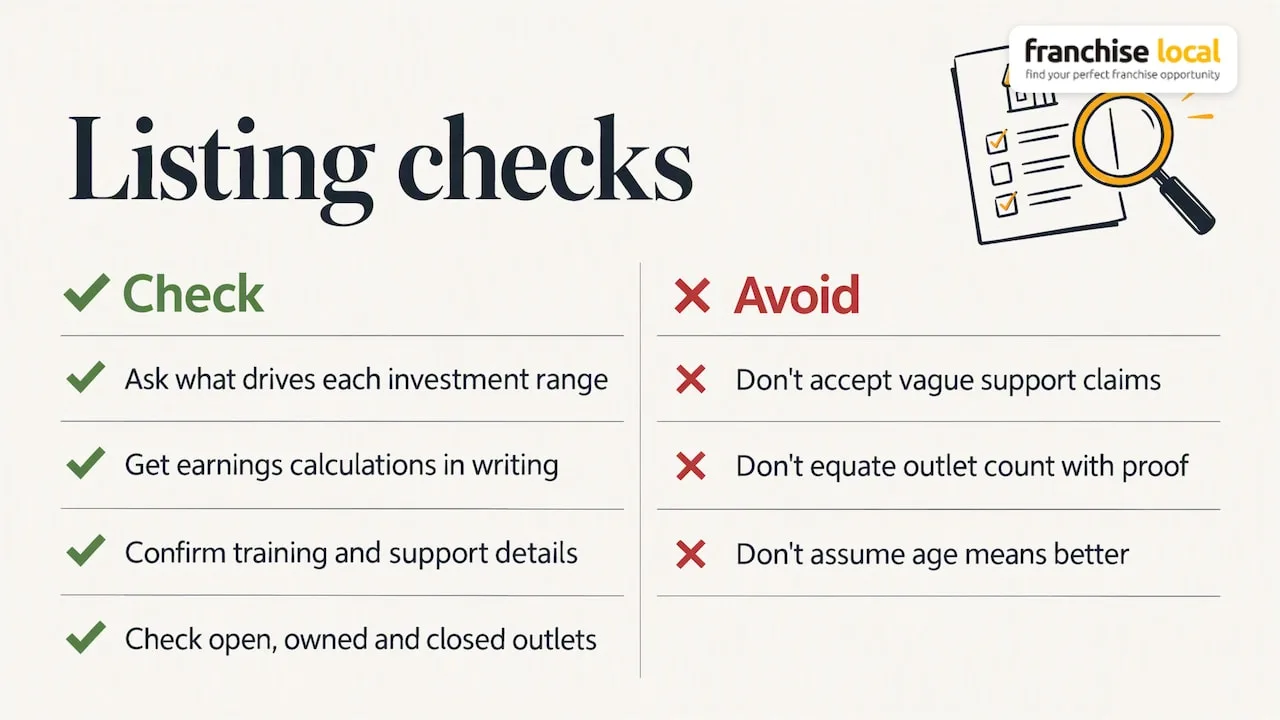
Investment figures. Look for a breakdown. A range is fine as a starting point, but ask what sits at the low end and what pushes you to the high end. Ask about working capital, ongoing fees and any costs that come after launch.
Earnings language. UK advertising must not mislead. The Business Protection from Misleading Marketing Regulations 2008 prohibit misleading advertising, and the British Franchise Association’s Code of Ethics for Franchising says recruitment advertising should be free of ambiguity and that references to future earnings must be objective and not misleading. If a listing promises big returns without saying how they were calculated, ask for the basis in writing.
Support claims. Words like “full training” and “ongoing support” mean little until you know the length of training, who delivers it, and what support costs after launch.
Number of outlets. More outlets can mean a proven model. It can also mean a crowded network. Ask how many are open, how many are company owned, and how many have closed or changed hands.
Brand history. A brand that has run for years has a track record you can examine. A newer brand may offer more territory and lower fees, but with less evidence behind it. Neither is automatically better. They carry different kinds of risk.
What to check before you contact a franchisor
An enquiry form is easy to send and the follow-up call can be persuasive. Go in prepared. The British Franchise Association suggests asking the franchisor about the franchise fee, working capital and ongoing fees, training and support, franchisee failures, the franchisor’s history, financial projections and the basis for them, whether the model was piloted or company owned, and the length of the agreement along with early termination and sale restrictions.
We set these out in full in questions to ask a franchisor before you sign anything. A few are worth putting at the top of your list:
- What exactly does the initial fee cover, and what is charged on top?
- What are the ongoing fees, and how are they calculated?
- Was the model proven by the franchisor running it before selling it?
- How many franchisees have left the network in the last few years, and why?
- What are the terms for renewal, exit and selling the business on?
Ask for the answers in writing. A franchisor confident in its model will not mind.
Check the claims with people who run the business
The most useful research comes from existing franchisees. Official guidance from Business Wales on buying a franchise recommends visiting franchisees, looking at performance figures and local competition, and examining the franchisor’s history, the success of the concept, the support provided and the terms of the agreement.
When you speak to franchisees, ask the same questions you asked the franchisor and compare the answers. Speak to more than the ones the franchisor suggests if you can. Our guide on questions to ask UK franchisees covers what to ask about hours, income, support quality and what they would do differently.
On money, look at the evidence behind any projection. Business Wales advises looking at performance figures, including three years of accounts if the business has traded that long, and management figures. If a franchisor cannot or will not show you figures, treat that as information.
Due diligence before you sign
A shortlist is where research starts, not where it ends. Before committing, you need to work through a structured checklist covering the franchisor, the finances, the market in your territory and the legal agreement.
Our six-step franchise due diligence checklist gives you the order to follow. If you prefer a schedule, the 30 day UK franchise background check plan lays the work out week by week. For the wider picture of why the process matters, read why franchise due diligence matters in the UK.
The franchise agreement
The UK has no dedicated franchise law. Franchise arrangements are governed by a mix of contract law, competition law and intellectual property law, so the contract carries a great deal of weight. The British Franchise Association’s Code of Ethics lists what the agreement should be checked for:
- Payment obligations.
- Duration and renewal.
- Intellectual property and brand use rights.
- Obligations of both franchisor and franchisee.
- Training and support.
- Termination.
- Transfer or resale.
- Non-compete and confidentiality provisions.
- What happens to franchisor property when the agreement ends.
Pay particular attention to restrictions that apply after the agreement ends. Post-term restrictions can be enforceable where they are limited and necessary, so do not assume they will fall away.
Have the agreement reviewed before you sign. Business Wales recommends using an experienced franchise solicitor accredited by the British Franchise Association, and the Code of Ethics says prospective franchisees should consider taking professional advice before signing. A general high street solicitor may not know franchise contracts well, so ask specifically about franchise experience. An accountant can review the figures at the same time.
For a wider view of the investment, our franchise business checklist for the UK covers the money, the contract and the practical steps together.
Directories, consultants and franchisor websites
There are three common ways to find a franchise, and they work best together.
| Route | Best for | What to remember |
|---|---|---|
| Directory | Comparing many brands quickly by price, industry, lifestyle and area | Listings are written by the franchisor |
| Franchise consultant or broker | Talking through your goals with a person | Ask how they are paid and which brands they represent |
| Franchisor’s own website | Detail on one brand | It is marketing, so verify the claims independently |
If you would rather talk it through, Mr Franchise is a franchise consultancy that helps people find a franchise to suit them, and there are consultancy videos if you want to see how the conversation works first. Whichever route you choose, ask how any adviser is paid. That is a fair question and a good adviser will answer it plainly.
Using Franchise Local to build your shortlist
Franchise Local is a UK franchise directory built around the filters in this guide. You can search by price, industry, lifestyle preference and area, look at trending franchises, and send an enquiry to the brands that interest you. It is free to use if you are searching for an opportunity.
A sensible way to begin:
- Browse the best UK franchise opportunities to get a feel for the range.
- Check new franchises in the UK if you are open to newer brands.
- Read our ultimate guide to franchising for the background on how franchising works.
- Save a shortlist and enquire.
Start your search at Franchise Local and set your budget and lifestyle filters first.
A five-step process from search to shortlist
Putting it together, here is a routine that keeps your search disciplined.
- Set your limits. Write down your budget, weekly time and preferred way of working.
- Filter in order. Investment level, industry, location, then lifestyle.
- Score each listing. Give every brand a mark for cost clarity, support detail, track record and fit with your skills. Drop any with unexplained gaps.
- Contact three to five brands. Ask the same list of questions of each so answers are comparable.
- Verify. Speak to franchisees, review figures, and take the agreement to a franchise solicitor.
Keep a simple spreadsheet with one row per brand. Note the fee, the total investment, the ongoing fees, the contract length and your impression of each conversation. Differences that felt small on the phone become obvious on paper.
For franchisors and advisers
If you are a franchisor, broker or adviser, the same standards apply to how you present an opportunity. UK advertising law prohibits misleading marketing, and the Code of Ethics asks for recruitment advertising free of ambiguity and earnings references that are objective. Clear listings with honest figures attract better enquiries, because prospects who understand the real cost and commitment arrive better qualified. Our franchise compliance checklist for UK franchisors is a useful starting point, and once you have signed a franchisee, the franchise launch checklist helps the first weeks go well.
Frequently asked questions
Is it free to use a franchise directory?
For the person searching, yes. Directories are generally funded by franchisors, brokers and advisors who pay for listings or featured placements. That is why you should treat listings as introductions and verify claims yourself.
How many franchises should I shortlist?
Three to five is a workable number. It gives you enough to compare without spreading your attention too thin. Ask each one the same questions and speak to existing franchisees before narrowing further.
Can I trust the figures in a listing?
Treat them as a starting point. Ask how the numbers were calculated, ask to see performance figures, and compare them with what current franchisees tell you. UK rules prohibit misleading advertising, but you still need to check the detail for yourself.
Do I need a solicitor to buy a franchise?
You are not legally required to have one, but professional advice before signing is strongly recommended by the British Franchise Association’s Code of Ethics. Choose a solicitor with real franchise experience, ideally one accredited by the BFA, and have an accountant look at the financials.
What is the best filter to start with?
Start with investment level, because it is your firmest limit. Then add industry, location and lifestyle. This order removes unaffordable options early and leaves you with brands you can actually pursue.