

Franchise lifestyle fit is how well a franchise’s real day-to-day work, hours, location, costs and required skills match the life you want. A good fit means you can do the job well, afford the start-up period and still have time for the things that matter to you. This guide shows you how to test that fit before you commit, step by step.
On Franchise Local you can filter UK franchises by lifestyle, budget, industry and location. The filters get you to a shortlist. This article helps you judge which of those businesses will work for you.
What lifestyle fit means when you choose a franchise
Lifestyle fit is not enthusiasm for a brand. Business Wales describes it as an operational match: the work the franchise requires, set against the work you prefer, your strengths and how you cope with stress. Liking a product is a good start. Liking the daily tasks of selling it is what keeps a business going.
In practice, lifestyle fit has four parts:
- Time: the hours the business demands, and when they fall (weekdays, evenings, weekends, seasonal peaks).
- Place: where you work, whether that is from home, in a van, on a client’s site or in premises, and how far you will travel.
- Money: the initial fee and working capital you can afford, and when profit is expected.
- People and tasks: whether you will be managing a team, selling to the public, serving businesses or working alone.
The British Franchise Association (BFA) adds a financial test. Lifestyle fit includes whether the initial fees and monthly working capital are affordable, and whether projected profit will be enough for the lifestyle you hope to achieve. Flexibility on paper counts for little if the income does not support your life.
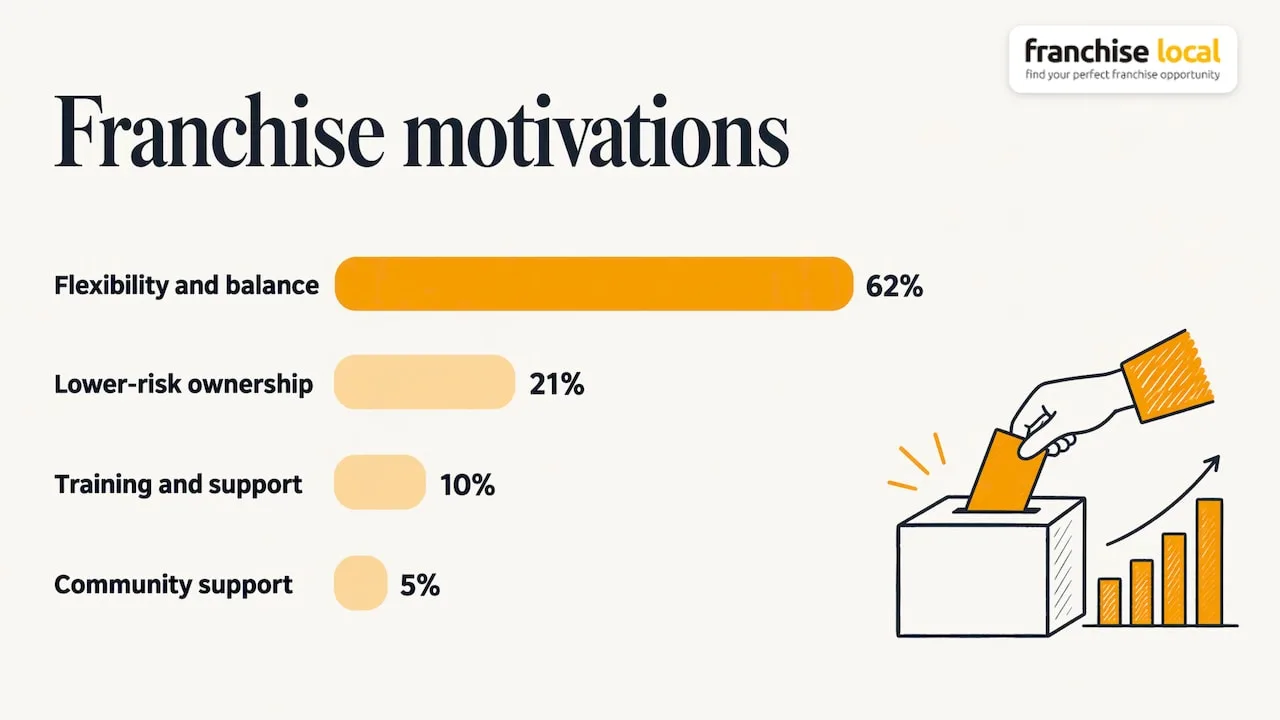
Why does this matter so much? Many people look at franchising because they want more control over their time. A 2026 Elite Franchise Magazine report on a BFA-member straw poll found that women cited flexibility and work-life balance as their main reason for franchising, at 62%. Lower-risk business ownership came next at 21%, then training and support at 10% and community support at 5%. Flexibility is a common motivation, so it deserves a proper test rather than an assumption.
Five questions to define your own lifestyle brief
Before you open a single franchise listing, write down what your ideal working week looks like. Answer these five questions in plain terms.
1. How many hours can you give, and when?
Be specific. “Part time” is not an answer. Do you need to finish by 3pm for the school run? Can you work Saturdays? Would you rather work two long days or five short ones? Write down your non-negotiable hours and your flexible ones.
2. Where do you want to work?
Some people want a home office. Others want to be out meeting customers, and some want a shop, unit or studio with regular opening hours. Home-based, mobile and premises-based models feel very different from week to week. Choose the setting first, then look at the sectors that use it.
3. What kind of work gives you energy?
Business Wales advises prospective franchisees to ask whether they enjoy managing people, selling to the public or working alone, because different franchise types commonly require different activities. Be honest. If you dislike cold calling, a sales-led model will drain you, however good the brand is. If you love building a team, a management model may suit you better than a hands-on one.
4. How much money do you need to take home, and by when?
Work out your monthly personal costs. Then work out how long you can live on reduced income while the business builds. This number shapes which investment levels are realistic for you.
5. What does success look like in three years?
Maybe you want a steady income from a small, owner-run business. Maybe you want a team and a bigger territory. These are both valid, and they point to different franchises. Writing down the answer now stops you drifting into a model built for someone else’s goals.
If you want a structured way to work through these points, our Franchise Planning Toolkit brings together planning tools for prospective franchisees. Our article on five top questions to ask yourself before choosing a franchise is a good companion to this step.
Match your priorities to a franchise model
Once your brief is clear, look at how franchises are structured. The model often tells you more about your week than the sector does. Common UK structures include business-format, product-distribution, manufacturing, management, conversion, mobile or van-based and home-based or online franchises.
The table below links lifestyle priorities to the models that tend to fit them. It is a starting point for your search, not a guarantee. Every franchise within a model runs differently.
| Your priority | Models to look at first | What to check in the detail |
|---|---|---|
| Work from home | Home-based or online | Which tasks you do alone, and how customers are found |
| Be out and about, no premises | Mobile or van-based | Territory size, travel time, equipment and vehicle costs |
| Fixed hours and a team | Management franchise | Staffing levels, recruitment support, your role day to day |
| Hands-on control of time and income | Owner-operator | Hours in the early stages, and how the business can scale |
| Business-to-business work | Service or consultancy models | Who finds the clients, and how long a sale takes |
| A community or retail presence | Premises-based business format | Opening hours, rent, staffing and location rules |
The BFA notes that owner-operator franchises are common in service sectors such as man-in-a-van businesses, mobile trades and home improvement, cleaning, financial services and education. In a management model, you generally run a team that delivers the service from the outset. In a home-based model, you work from home using the franchisor’s platforms and processes.
To browse by sector, use our franchise industries directory. If you already know you prefer people-facing work, you can look at sales franchises or networking franchises. If you like working with other businesses, our list of business to business franchises is a useful start. For people who want to work in finance, there is also a page on financial business franchises.
If fitness is your interest, read our guide on how to choose a fitness franchise. Fitness franchises range from gyms and studios to personal training, yoga and outdoor sessions, so the lifestyle can differ a great deal between them.
Plan for the early years
Owning a franchise gives you a proven blueprint. It does not give you customers automatically. Business Wales says franchisees need entrepreneurial flair, must be prepared to sell, and should expect hard work and potentially long hours.
The BFA describes the owner-operator model as one with real advantages: lower start-up and operating costs, direct control over time and income, a potentially faster path to profit and scope for scalable growth. It also says the model needs hands-on involvement, and that work-life balance can be tricky during early growth. The CEO of The Little Gym Europe made a similar point in Elite Franchise Magazine, saying work-life balance may not be realistic in the early years of building a business, even for people motivated by flexibility.
The practical lesson is to plan for it. Here is how:
- Build a ramp-up period into your plan. Assume the first year needs more hours than the long-term target.
- Tell the people around you. If your family knows the first months will be busy, you avoid friction later.
- Ask how owners scale. Owners can later grow by hiring staff, adding vehicles or taking on more territories. Find out what that path looks like and when franchisees typically take it.
- Look at systems, not just location. An ActionCOACH franchise owner featured in Elite Franchise Magazine built a team so the business could run with or without her. Flexibility came from staffing, systems and technology, not simply from working at home.
The founders of Pink Spaghetti, reported by Entrepreneur UK, put work-life balance first while raising young families. They deliberately limited growth to two new franchises a year for three years. That supported early franchisees and tested their model. It shows that good franchisors think about the pace of growth, and you can ask any franchisor how they approach it.
Our article on the role of ongoing support in franchise success explains why training and continuing help matter most in these first months.
Check the money behind the lifestyle
A franchise only fits your life if the numbers fit too. Business Wales suggests you budget for the initial fee, premises, equipment and stock. You should also allow for continuing management fees, rent, utilities, employees, training, advertising and any required stock purchases.
The BFA frames the financial test around three questions:
- Can you afford the initial fees and the working capital you need each month?
- When is profit expected?
- Will that profit meet your lifestyle goals?
A worked example makes this concrete. Home Instead UK’s resale funding page gives an example of a £20,500 franchise fee excluding VAT, with a 6.5% ongoing royalty excluding VAT. For a resale you would also account for the variable sale price, due-diligence costs and working capital. The point is not the figure itself. It is that a franchise cost has several layers, and you should list all of them.
Use this simple approach:
- List every upfront cost the franchisor quotes: fee, equipment, vehicle, stock, training, legal and accountancy.
- List every ongoing cost: royalties, marketing contributions, insurance, rent and wages.
- Add your personal living costs for the months before the business pays you.
- Compare the total with the franchisor’s projections, and ask how those were produced.
The BFA recommends asking for financial projections based on actual network performance, the working capital required, and whether finance will need security. Business Wales advises you to investigate initial and ongoing costs and the franchise’s financial prospects rather than relying on the franchisor’s forecasts alone. Your accountant can review the figures with you, and a lender can explain what security they would need.
Our ultimate guide to franchising covers fees, royalties and funding in more depth.
Test the franchisor’s claims about flexibility
Franchisors describe their businesses in positive terms, and that is normal. Your job is to turn those descriptions into specifics. Ask questions that produce numbers and examples, not adjectives.
The BFA advises speaking with existing franchisees before you decide, because their experience shows how the franchisor’s support works in practice. Business Wales adds that you should visit franchisees at different stages and locations. A franchisee in year one has a different week from one in year five.
Good questions to put to franchisees include:
- What does a typical week look like now, and what did it look like in your first six months?
- How many hours do you work, and how many did you expect to work?
- Which tasks take more time than you thought?
- When did you start taking a regular income?
- How quickly does the franchisor respond when you need help?
- Have you been able to take holidays, and how did you cover them?
The BFA suggests you ask whether you may choose which franchisees to speak with. That puts you in control of who you hear from. Our guide to questions to ask UK franchisees gives you a fuller list.
There are also protections in the system. The BFA Code of Ethics says recruitment advertising should be free of ambiguity and misleading statements. It also says prospective franchisees should receive full and accurate written disclosure of material information within a reasonable time before signing. Read that disclosure carefully, and take the agreement to a solicitor with franchise experience before you sign.
Three example profiles
These are illustrative scenarios, not real people. They show how the same process leads to different answers.
The parent who needs school-hour flexibility. Her brief is a home base, three to four set days and no evening work. She looks at home-based and service models, then asks franchisees how many hours the first year really takes. She accepts a longer ramp-up in exchange for control of her diary later.
The career changer who likes managing people. After years in a team leadership role, he wants to run a business with staff rather than do every job himself. A management franchise suits him. He checks recruitment support, staff costs and how many people the territory needs, then budgets working capital to match.
The professional who wants independence on a budget. She prefers working alone with clients and has limited capital. She compares lower-investment, owner-operator service models. Her key questions are about the initial fee, who finds customers and how soon income starts.
Each person reached a different shortlist because they began with their own priorities, not the franchise’s marketing.
A simple workflow for your search
Put the steps together in this order:
- Write your lifestyle brief covering hours, place, tasks, income and three-year goals.
- Set a budget that includes working capital and your living costs.
- Filter the directory by lifestyle, investment level, industry and location to build a shortlist of five or six.
- Request information packs and compare the fees, support and territory rules.
- Speak to franchisees at different stages, using the questions above.
- Review the agreement and projections with a solicitor and an accountant.
- Decide, and be willing to walk away from a franchise that does not fit.
Our franchise selection workflow goes through this process in more detail. If you are still deciding whether franchising suits you at all, try the six questions to test if franchising is right for you. The article 7 ways to find the perfect franchise offers a wider set of search methods.
Find franchises that match your lifestyle
Franchise Local is built for this kind of search. You can filter UK franchise opportunities by lifestyle, budget, industry and location, so your shortlist starts from your own priorities. Browse the 129 best UK franchise opportunities to see what is available, or send an enquiry to the franchisors that interest you. It costs you nothing to search.
Frequently asked questions
What is a lifestyle franchise?
A lifestyle franchise is a business designed to fit around your schedule, location and income goals. These are often owner-operator, home-based or mobile models with lower start-up costs. Lifestyle fit still depends on the individual franchise, so check the real hours and income with existing franchisees.
Can I run a franchise part time?
Some franchises are designed so that owners can work around other commitments, especially service models you run yourself. Ask each franchisor what hours the business needs in the first year and what is expected as it grows. Existing franchisees can tell you how their own hours changed over time.
How do I know if a franchise will give me enough income?
Ask the franchisor for financial projections based on actual network performance, the working capital required and when profit is expected. Then compare the figures with your personal monthly costs. An accountant can help you review them before you commit.
Which franchise type gives the most control over my time?
The BFA says owner-operator franchises offer direct control over time and income. They also need hands-on involvement, particularly early on. Management models can reduce your day-to-day tasks over time, but you will be leading a team from the start.
Should I speak to existing franchisees before signing?
Yes. The BFA advises it, because their experience tests what the franchisor says about support and daily running. Ask to choose which franchisees you speak to, and include some at different stages and locations.